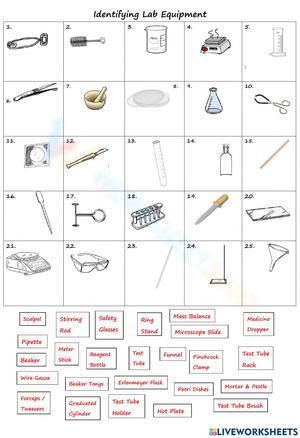
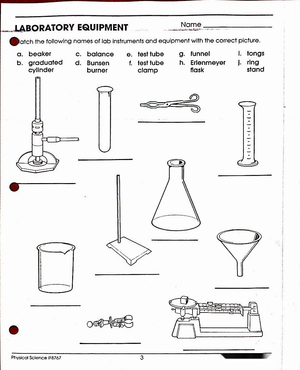
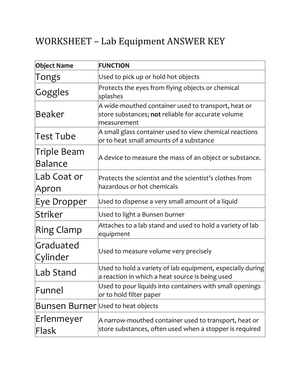
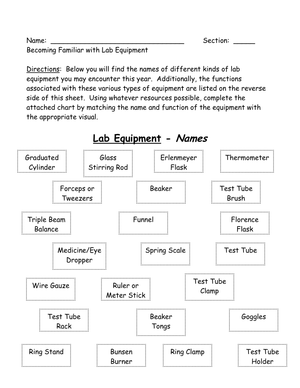
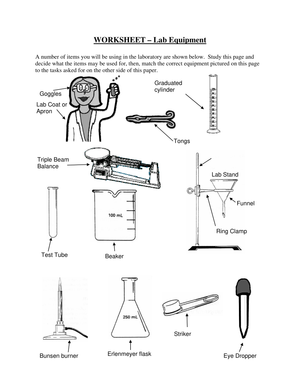
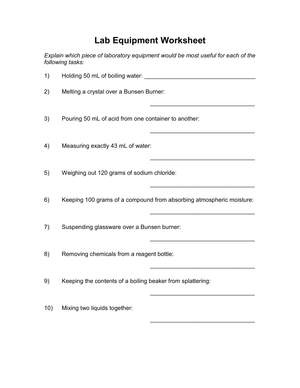
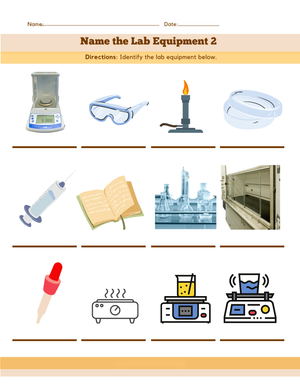
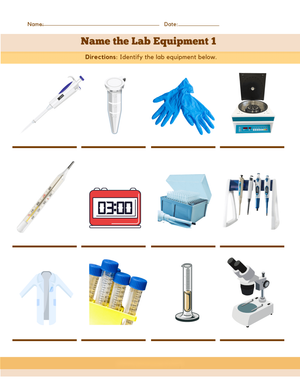
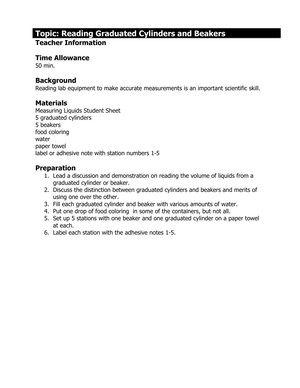
These lab equipment printable worksheets for 8th grade give teachers a ready-made entry point for chemistry unit preparation — well before students pick up glassware, measure liquids, or work near a heat source. Each worksheet moves students from passive recognition to active decision-making, asking them to name common tools, connect each item to a specific lab function, and choose the right instrument for a described task.
The Specific Skills These Worksheets Build
For a grade 8 chemistry class, the tools worth practicing most are the ones that appear again and again in real investigations: beakers, graduated cylinders, Erlenmeyer flasks, test tubes, funnels, thermometers, droppers or pipettes, and safety goggles. Naming them accurately is the entry point. The more demanding skill — and the one that matters most before any wet lab — is understanding what each tool does and when to reach for it over a similar-looking alternative.
- Labeling diagrams of common instruments by name
- Matching each piece of equipment to its primary function
- Selecting the appropriate tool for a described task
- Explaining in writing why one tool is better suited for a specific measurement or transfer job
- Connecting equipment choices to safety expectations — including when goggles are required
A Core Distinction That Makes Every Lab Go More Smoothly
The most instructive comparison in this set is between the beaker and the graduated cylinder. Students who see both on a lab bench often reach for whichever is closest. In grade 8, when measurement precision starts to carry real consequences for data quality, that habit needs to be corrected before an investigation begins. Beaker markings are approximate — suitable for mixing or rough pouring — while a graduated cylinder delivers a more reliable volume reading. When students learn that tool selection affects the accuracy of their measurements, not just how organized the lab bench looks, they begin treating equipment decisions as scientific ones.
Each worksheet that features this comparison asks students first to identify which tool fits a described task, then to explain their reasoning. A prompt like Which item would you use to measure exactly 25 milliliters of water? forces the distinction into words. That justification step is where teachers get the clearest evidence of whether a student has understood the concept or simply memorized which picture matches which label.
How to Work These Worksheets Into Your Chemistry Unit
The most natural placement for this set is the week before the first wet lab of the term. A bell ringer on Monday that asks students to label three tools from a diagram, followed by a matching worksheet mid-week, and a scenario-based worksheet at the end of the week gives the class three separate exposures without taking more than eight or ten minutes of any lesson. That spaced repetition — rather than a single large block of instruction — helps eighth graders hold onto lab vocabulary when they actually need it during hands-on work.
These worksheets also hold up well as sub plans. A worksheet that combines labeling, matching, and two or three scenario questions keeps students on meaningful science content without requiring any materials setup. Teachers have used them at stations, as exit tickets, and as pre-lab checks the morning of an investigation. Because each worksheet stands alone, teachers can assign one as homework after a classroom introduction and use a second the following day for quick formative review.
Lab equipment printable worksheets for 8th grade also slot naturally into the second half of a chemistry unit, once labs are underway. A scenario-based worksheet assigned after students have handled the equipment reinforces vocabulary through a different channel — written reasoning about tool choice — rather than repeating the same identification activity students completed at the unit's start.
Error Patterns to Watch for on Pre-Lab Practice
The most consistent mistake is treating "beaker" and "graduated cylinder" as synonyms. On a task that asks which item to use when measuring 30 milliliters of water, students frequently select the beaker — partly because it tends to appear more prominently on lab bench diagrams, and partly because they have watched teachers pour from beakers far more often than they have seen a careful graduated-cylinder reading taken. That selection error is a reliable indicator that a student has learned a word without internalizing the function behind it.
A second pattern involves safety goggles. Students can usually name them and label them on a diagram. Where they stumble is on scenario questions — they omit goggles from "equipment needed" lists unless the task explicitly mentions an open flame or a visible chemical reaction. The underlying assumption is that eye protection belongs only in dramatic, high-risk moments rather than in any task involving liquid transfer or careful measurement work.
Confusing a dropper with a thermometer is a smaller but persistent problem. Both are narrow and elongated, and at standard diagram scale they look nearly identical to a student who has not yet handled both in person. In a live lab setting, that mix-up stalls the whole group and creates a safety concern — exactly the situation a focused pre-lab practice worksheet helps prevent.
Adapting Each Worksheet for a Range of Learner Readiness Levels
Students who are still building basic science vocabulary do better when the tool list is narrowed. A matching or labeling worksheet covering only beakers, graduated cylinders, test tubes, and safety goggles gives those students a completable, confidence-building task. Once they work through that smaller set accurately, the remaining tools can be added across subsequent class periods rather than introduced all at once.
Students who are ready for more challenge benefit from written justification prompts. Asking a student to write two sentences explaining why they chose a graduated cylinder rather than a beaker for a specific measurement pushes past the recall level and into the kind of reasoned explanation that shows up on state science assessments. Lab equipment printable worksheets for 8th grade that include both basic labeling tasks and open-ended scenario questions give teachers a single resource that can serve different readiness levels in the same class period without requiring separate preparation.
Standard Alignment
NGSS Middle School Science Practice 3 — Planning and Carrying Out Investigations — identifies the ability to select and use appropriate tools as a core expectation for grades 6 through 8. Lab equipment identification is not a standalone vocabulary activity; it is a prerequisite for that practice standard. Students cannot plan or carry out an investigation reliably if they cannot name tools accurately or explain why one instrument is better suited for a task than another.
The focus on graduated cylinders versus beakers connects directly to quantitative measurement language found in physical science standards for density, solutions, and chemical reactions — all standard eighth grade topics. Most state frameworks that align with NGSS at the middle school level carry similar expectations around accurate tool selection and measurement precision.
Frequently Asked Questions
What lab equipment should 8th graders know before chemistry labs begin?
At minimum, students should be able to name and describe the function of beakers, graduated cylinders, Erlenmeyer flasks, test tubes, funnels, thermometers, droppers or pipettes, and safety goggles. These are the tools that appear in introductory investigations, density labs, and mixture activities. The goal is accurate naming paired with functional knowledge — understanding why each item exists, not just recognizing its outline on a diagram.
How is a beaker different from a graduated cylinder?
A beaker is useful for mixing, heating, and pouring liquids, but its volume markings are approximate. A graduated cylinder gives a more precise volume reading and is the better choice when measurement accuracy matters. Which tool a student reaches for on a task requiring careful measurement is one of the most useful formative checkpoints a teacher can use before the class moves into a live lab.
When during a chemistry unit should these worksheets be assigned?
Most teachers introduce them at the unit's start, before any hands-on lab work. Bell ringers and matching tasks in the first week build familiarity with tool names and functions. Scenario-based worksheets work better mid-unit, after students have seen the equipment in use. A brief review worksheet in the final week serves as both reinforcement and assessment preparation. Lab equipment printable worksheets for 8th grade are flexible enough to serve all three of those moments without significant adaptation.
Can these worksheets work as sub plans or homework?
Yes. Each worksheet covers a self-contained skill — labeling, matching, or applying equipment knowledge to a scenario — and students do not need a teacher present to complete the work. That makes them a reliable choice when a science teacher is out. As homework, they reinforce classroom vocabulary without requiring any materials or equipment at home.