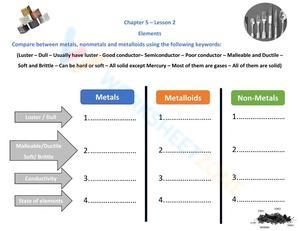
These 8th grade metals nonmetals and metalloids worksheets give teachers a set of standalone classification exercises built around one of the more intellectually demanding tasks in middle school physical science: asking students to use the periodic table as a reasoning tool rather than a reference to be copied. Each worksheet stands alone, targets a specific layer of the topic, and asks students to explain their classifications in writing — not just circle an answer.
What Students Practice on Each Worksheet
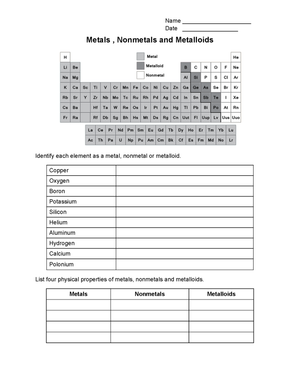
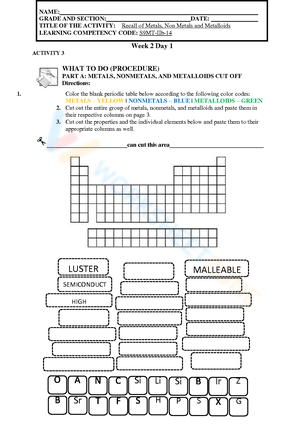
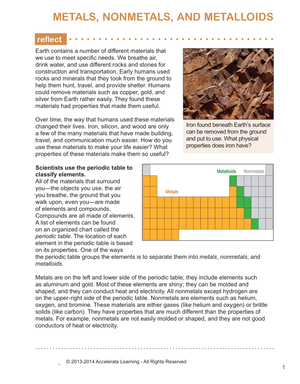
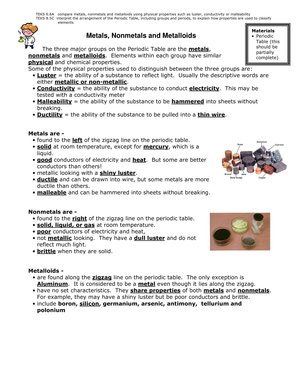
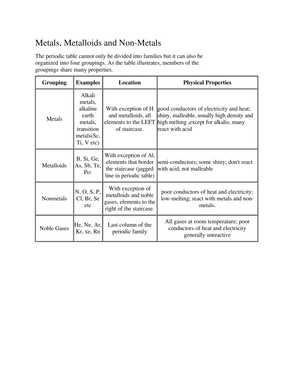
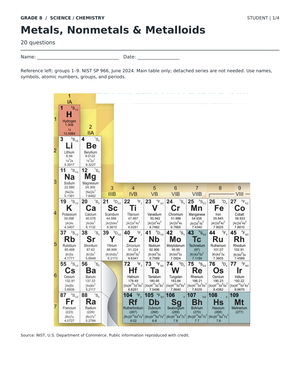
The entry-level task on most worksheets is locating and labeling: students identify an element's position on the periodic table and assign it to a group. Metals occupy the left and center of the table, nonmetals cluster on the upper right, and metalloids run along the diagonal staircase boundary separating the two larger regions. That visual pattern is the first thing students internalize, and it gives them a system — not a list to memorize.
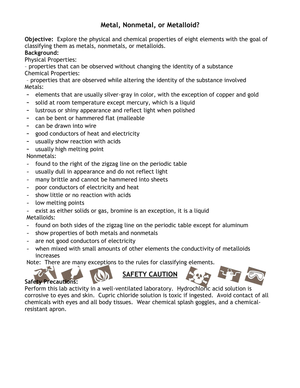
From there, each worksheet pushes students into property-based reasoning. They connect group membership to observable traits: conductivity, metallic luster, and malleability in metals; poor conductivity, brittleness, and variable physical states in nonmetals; and blended, inconsistent behavior in metalloids. Students write those connections into their answers rather than selecting from a word bank, which is where the real practice happens. Recall-level tasks reveal very little about whether students can apply this knowledge when they encounter an unfamiliar element later in the unit.
- Classify elements by periodic table location using the metal-metalloid-nonmetal boundary
- Connect group membership to specific physical properties in written responses
- Explain why a metalloid cannot be cleanly assigned to either of the two larger groups
- Distinguish between physical state (gas, liquid, solid) and element category — a common source of confusion at this grade level
- Apply vocabulary — conductor, luster, malleable, brittle — in complete sentences rather than isolated labels
Why the Staircase Elements Carry the Most Instructional Weight
Silicon, germanium, arsenic, antimony, boron, and tellurium are where Grade 8 classification thinking gets genuinely demanding. Students who label aluminum as a metal without hesitation will slow down at silicon — and that hesitation is not a problem to fix; it's the point. Each worksheet that targets metalloids asks students to name at least one metal-like property and at least one nonmetal-like property before settling on a classification. That two-step requirement blocks the guessing that makes assessment data useless.
Silicon also opens a productive two-minute moment that most eighth graders find worth the detour. Its semiconductor behavior — conducting electricity under certain conditions but not others — is why it dominates electronics manufacturing. Most students have heard "silicon chip" or "Silicon Valley" without knowing what makes silicon chemically distinctive. Connecting that real-world application to the in-between conductivity that positions silicon on the staircase makes the classification task feel like actual chemistry rather than a sorting exercise. The worksheets create the opening; teachers bring the context.
Building These Worksheets Into Your Lesson Plan
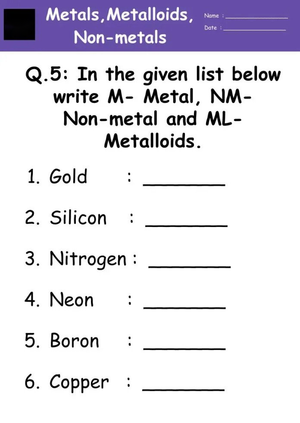
As a warm-up, five or six quick classification items work well in the eight to ten minutes before direct instruction begins. Students locate an element, label it, and name one property that supports their choice. Teachers circulate and collect a fast read on who already understands the visual boundary and who is guessing. That information shapes how much of the subsequent lesson focuses on periodic table orientation versus property connections.
The 8th grade metals nonmetals and metalloids worksheets are also well-suited to the pre-quiz review block — the class period right before students take a unit assessment, when rereading notes rarely helps but a focused classification task does. Working through eight to ten items that span all three groups, including at least two metalloid examples, surfaces the gaps that appear most often on tests: shininess confusion, state-of-matter confusion, and unfamiliarity with elements that sit near the staircase boundary.
One practical note worth flagging: the written-response items go slowly for students who haven't had at least one guided example with a metalloid before working independently. Teachers who assign the full worksheet without that preparation tend to get more incomplete responses than wrong ones — students leave metalloid items blank rather than guess. Incomplete responses tell you something different than errors do, and it's worth distinguishing between them when you review the work.
- Warm-up tasks during the first two or three days of a periodic table unit
- Independent practice with written justifications as the unit's core activities wind down
- Exit tickets targeting metalloid elements specifically — the category where errors concentrate
- Partner work where students must verbally defend one classification before writing it down
Common Classification Errors to Catch Before the Unit Test
The shininess error is the most consistent pattern across Grade 8 classrooms. Students see "shiny" in a property description and write "metal" before checking anything else. The problem is that iodine — a nonmetal — has a visible metallic sheen, and some graphite samples look dark and dull even though graphite is a form of carbon, also a nonmetal. A worksheet item that treats luster as just one property alongside periodic table location forces students to weigh multiple pieces of evidence before committing to an answer. Single-property tasks don't produce that check; multi-evidence tasks do.
State-of-matter confusion is nearly as common. When students learn that many nonmetals appear as gases at room temperature, some flip that logic and classify any gas as a nonmetal and any solid as a metal. A worksheet item placing mercury (a metal liquid) alongside bromine (a nonmetal liquid) makes that rule collapse on paper, which is where it needs to collapse — not during the assessment. Physical state is a property that varies with conditions; group membership is determined by atomic structure and periodic table position, and that distinction holds even when state seems to contradict the expected pattern.
A third pattern worth watching for is rote metalloid identification. Some students memorize the staircase list — boron, silicon, germanium, arsenic, antimony, tellurium — and treat classification as pure recall. Those students handle familiar elements confidently but struggle when a worksheet presents an unfamiliar near-boundary element like astatine or polonium. Short written explanations, even a single sentence, reveal immediately whether a student understands the underlying pattern or is working entirely from a memorized set of names.
Adjusting the Set for Mixed-Ability Classrooms
Students who struggle with periodic table orientation often can't demonstrate what they know about physical properties because they can't locate the elements in the first place. Providing a color-coded periodic table — one where the metal, metalloid, and nonmetal regions are already shaded — removes that navigation difficulty without removing the classification reasoning. The task stays the same; the geographic barrier is reduced. That's a meaningful distinction when the goal is to assess property knowledge rather than how quickly students can scan an unfamiliar chart.
For students who move quickly through identification tasks, comparison prompts extend the thinking without requiring a different worksheet. Ask them to write one sentence explaining why silicon and aluminum are in different categories despite sitting adjacent on the periodic table, or to identify a real-world context where a metalloid's in-between behavior matters more than a pure metal's would. Those extensions build directly from the core classification task. The 8th grade metals nonmetals and metalloids worksheets support that kind of open-ended push because the classification foundation gives faster students something specific to press against — not an open-ended void.
For students still developing English proficiency, pairing each worksheet with a short bilingual property chart — listing conductor, malleable, brittle, and luster alongside brief plain-language definitions — keeps the science accessible without translating the task itself. The classification reasoning stays intact; the vocabulary barrier is addressed separately, which keeps the two skills from masking each other during grading.
Frequently Asked Questions
What properties should students focus on when classifying elements?
Conductivity, luster, malleability, and brittleness are the four most useful properties at this grade level. They map cleanly onto all three groups and give students a consistent set of criteria to apply across any element. The most productive worksheets ask students to cite at least two of these properties in written answers, because relying on one alone leads directly to the shininess error or the state-of-matter confusion described above.
How do these worksheets connect to later units in the year?
Classification by element group is a foundation that pays forward into atomic structure, bonding, and chemical versus physical change. Students who understand that periodic table position predicts behavior — not just assigns a group name — have an easier time later understanding why metals and nonmetals form ionic compounds, why certain reactions follow predictable patterns, and why materials scientists choose specific materials for specific applications. That transfer is one reason this topic sits in Grade 8 rather than earlier in the K-8 science sequence: students are developmentally ready to move from descriptive classification into explanatory reasoning.
Do students need a separate periodic table to complete these worksheets?
Each worksheet specifies whether a periodic table is provided or required. Some include a simplified reference version printed directly on the worksheet; others expect students to use a classroom copy. Checking that before photocopying avoids a mid-lesson scramble — especially for the classification tasks that ask students to identify elements they would not recognize from memory alone.
Can these be used digitally as well as in print?
The 8th grade metals nonmetals and metalloids worksheets are formatted for print but function well in digital annotation tools where students can type or handwrite responses directly. The written-response questions transfer cleanly to a PDF annotation workflow. The one practical consideration for digital use is that students need access to a digital periodic table in a separate window or tab, since the location-based classification tasks require an actual reference rather than recall of element positions.