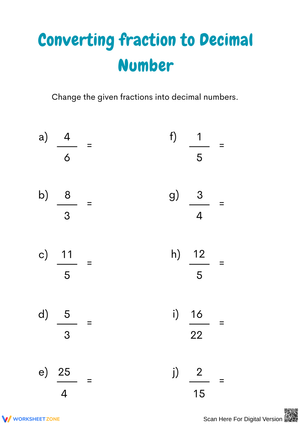
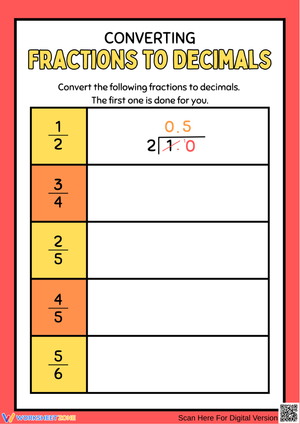
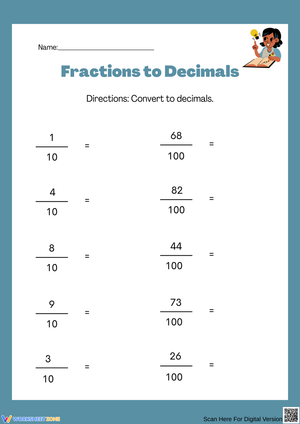
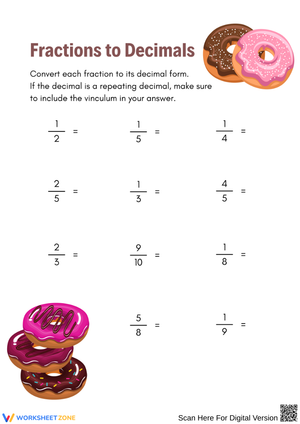
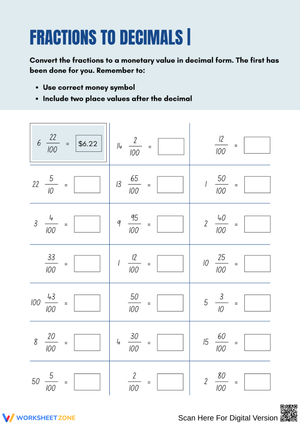
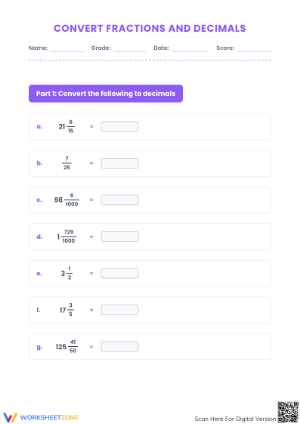
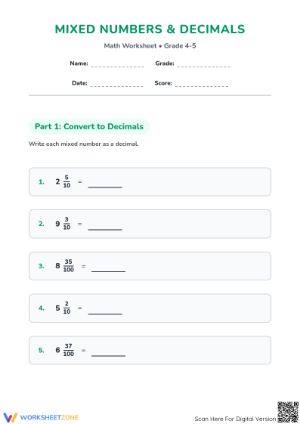
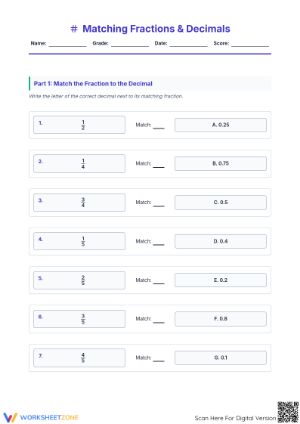
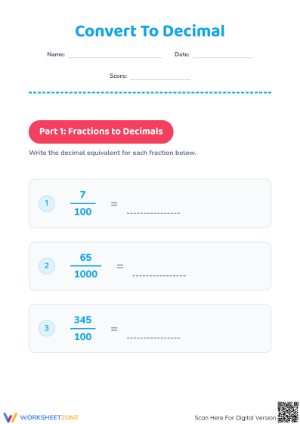
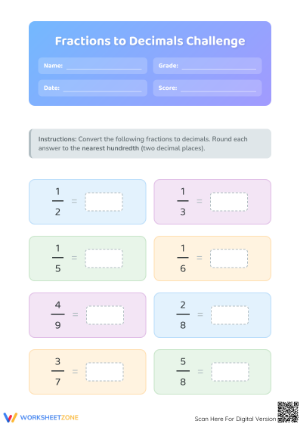
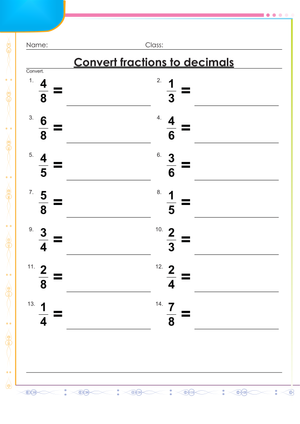
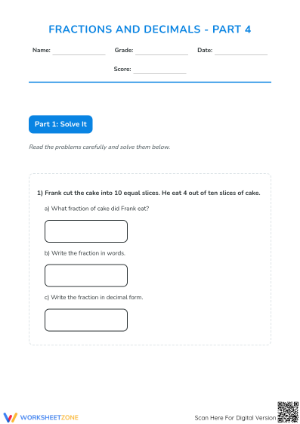
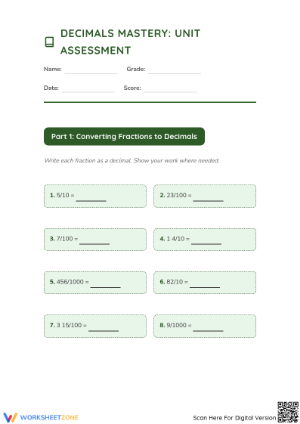
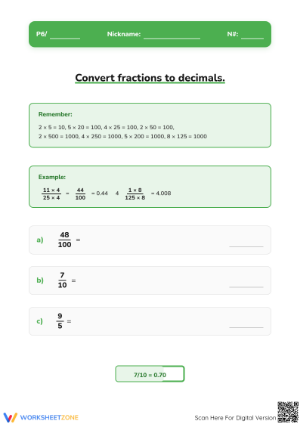
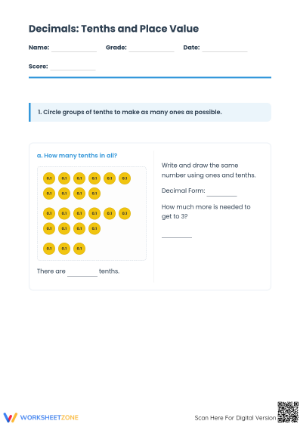
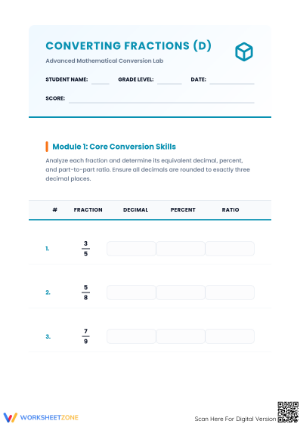
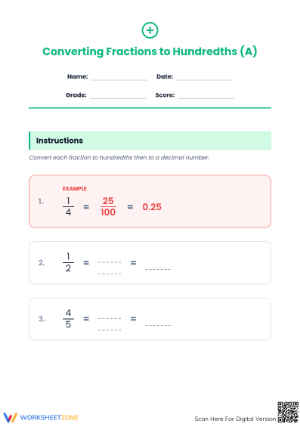
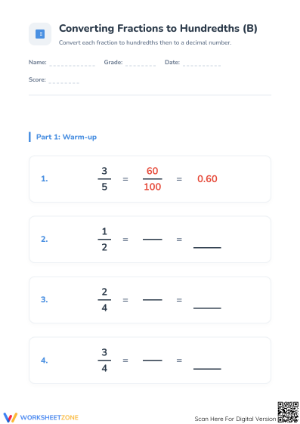
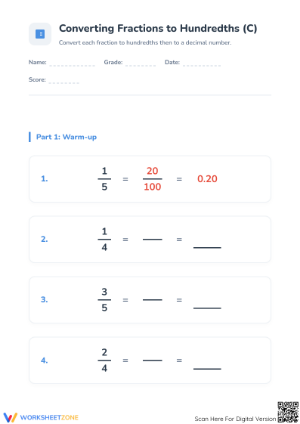
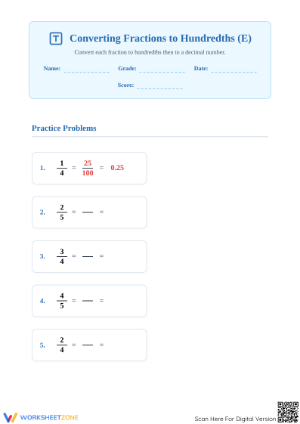
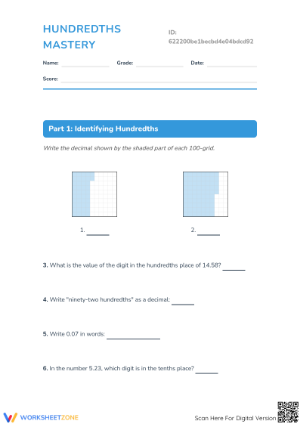
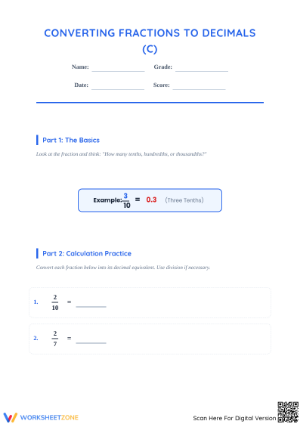
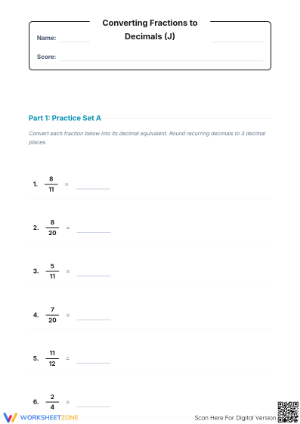
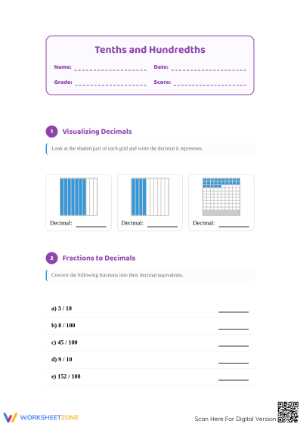
These 5th grade converting fractions to decimals pdf worksheets give teachers structured practice spanning both conversion methods fifth graders need: the equivalent-fraction approach for friendly denominators and long division for everything else. The set moves from fractions with denominators of 10 and 100 — where the decimal almost reads itself — into problems that require students to divide numerator by denominator, add zeros to the dividend, and carry the work out to the thousandths place.
The Two Methods, and Why Treating Them as Separate Skills Matters
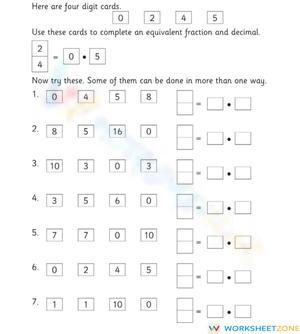
Fifth graders need two distinct skills here, and materials that blur them together leave students stuck the moment the simpler method fails. The equivalent-fraction method works when a denominator is a factor of 10, 100, or 1,000: a student converts 4/5 by multiplying both numerator and denominator by 2 to get 8/10, then reads that directly as 0.8. Fast, and it reinforces multiplication fluency at the same time. But fractions like 3/8 or 7/16 don't cooperate — their denominators won't divide evenly into any power of ten, which means students have to use the division algorithm instead: numerator becomes the dividend, denominator becomes the divisor, and zeros get added after a decimal point to continue dividing until the quotient terminates or reaches the thousandths place.
Each worksheet in this set targets one method or the other, with some worksheets mixing both so students practice deciding which approach applies. That decision-making step — identifying whether a denominator is a factor of a power of ten before choosing a method — is exactly where fifth graders stall, and repeated exposure builds the habit automatically.
Skills Students Build Across the Set
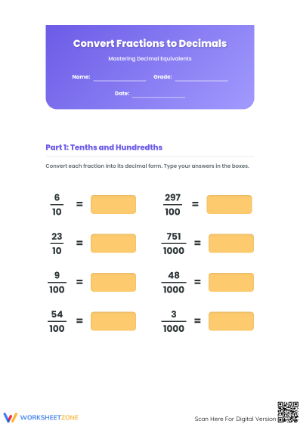
- Converting fractions with denominators of 10, 100, and 1,000 by reading place-value position directly
- Building equivalent fractions to reach a power-of-ten denominator, then writing the decimal form
- Setting up and completing long division problems where the dividend carries trailing zeros
- Placing digits accurately in the tenths, hundredths, and thousandths columns
- Converting mixed numbers by treating the fractional part separately from the whole number
- Checking a result by confirming the decimal falls between the two nearest benchmark values
Student Errors Worth Knowing Before You Hand These Out
The most persistent mistake is decimal placement. When a student sees 6/100, they frequently write 0.6 rather than 0.06 — they recognize the digit 6 and know a decimal is involved, but haven't locked in that the denominator 100 demands two decimal places, not one. This error rarely surfaces on a straight fraction worksheet, so teachers are often caught off guard when it appears here in force.
With long division, the problem is abandonment. Students divide until they hit a remainder and stop, writing something like "1 R2" as their final answer. The fix is a setup habit: before beginning the division, students rewrite the numerator as, say, 4.000 — those three zeros give visible runway to continue past the remainder and reach a true decimal result. Teaching this as a setup step rather than a mid-problem rescue makes it stick much faster. A third error appears when students scale only the numerator when building an equivalent fraction, forgetting to apply the same factor to the denominator — they change the value of the fraction entirely without realizing it.
Standard Alignment
These worksheets address CCSS.MATH.CONTENT.5.NBT.A.3, which requires students to read, write, and compare decimals to the thousandths place. The long-division worksheets also align with CCSS.MATH.CONTENT.5.NF.B.3, the standard that explicitly interprets a fraction as division of the numerator by the denominator. In classroom terms, 5.NF.B.3 typically lands in the second half of the school year — after students have worked through fraction multiplication and before state assessment windows open — so these worksheets fit naturally into that instructional stretch without competing with other priority standards.
Working These Worksheets Into Your Weekly Lesson Plans
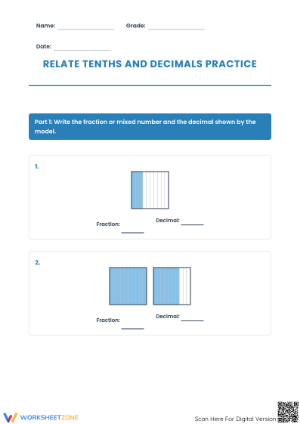
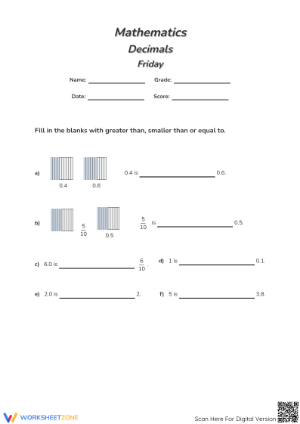
The equivalent-fraction worksheets work well as the unit entry point. Use them during the first few days while students are still connecting visual models — hundredths grids, base-ten blocks — to written decimals. Once students can handle denominators of 10 and 100 with confidence, shift to the long-division worksheets. A ten-minute warm-up slot suits those better than an opening independent-work period, because the division algorithm takes concentration that early-morning routines don't always support.
The 5th grade converting fractions to decimals pdf worksheets that blend both methods work best as review — the day before a quiz or during a Friday problem set when students are choosing strategies on their own rather than following a direct instruction prompt. Pulling one mixed-method worksheet as an exit ticket quickly separates two different error types: students who chose the wrong method for the fraction type, and students who chose the right method but made a computation error along the way. Those are two separate teaching problems, and the exit-ticket data makes the distinction visible before the next lesson begins.
Adjusting the Set for a Range of Learners
Students with shaky multiplication facts will struggle with the equivalent-fraction method even when they understand the underlying concept — they can't quickly identify what factor turns a given denominator into 10 or 100. For those students, long division is actually more accessible because it's procedural rather than flexible. Starting them on the division worksheets, with a completed example at the top of each worksheet and a small reference chart of common equivalents (1/4 = 0.25, 1/5 = 0.2, 1/8 = 0.125), gives them a working path while their multiplication fluency catches up.
Students who have already mastered both methods are ready for fractions that produce repeating decimals — 1/3, 2/9, 5/6. The full treatment of repeating decimals belongs in a later grade, but these students can carry the division to the thousandths place, notice that the remainder keeps cycling, and record their answer with appropriate rounding. That exploration doesn't require new materials. The 5th grade converting fractions to decimals pdf worksheets written for on-level students don't include those fractions by default, but the same problem format accommodates them when a teacher writes a few in by hand.
Frequently Asked Questions
What fraction types does the set include?
The worksheets cover denominators of 2, 4, 5, 8, 10, 20, 25, 50, and 100 — the full range a fifth grader is expected to handle. Denominators of 2, 4, 5, 20, 25, and 50 all have clean power-of-ten equivalents and respond to the scaling method. Denominators of 8 steer students toward long division, since 8 does not divide evenly into 10 or 100, though advanced students can discover that 8 × 125 = 1,000 and use that route instead.
How many problems does each worksheet contain?
Most worksheets in the set carry between 12 and 20 problems. That range keeps practice focused without making the task feel punishing — enough repetition to build fluency, short enough to assign as targeted review without reteaching the full lesson first.
Can I use these for small-group intervention?
These 5th grade converting fractions to decimals pdf worksheets that isolate one method at a time work well in pull-out settings. A teacher can model the first two or three problems aloud, then have students work through the rest while discussion continues around the table. The format — fraction on the left, blank on the right — is direct enough that students spend their attention on the math rather than decoding instructions.
Do the worksheets include answer keys?
Yes. For long-division problems, the answer key shows the full division setup alongside the final decimal, not just the answer. That matters when the goal is pinpointing exactly where a student's process went wrong rather than simply marking the result correct or incorrect.














 Interactive Worksheet Maker
 Quiz Maker
 Word Search Maker
 Crossword Puzzle Maker
 Word Scramble Generator
 Sentence Scramble Generator
 Handwriting Worksheet Generator
 Name Tracing Generator
 Fill In The Blank Generator




 BACK TOSCHOOL