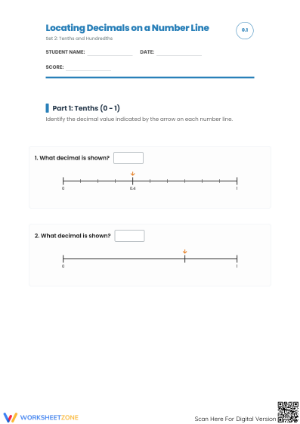
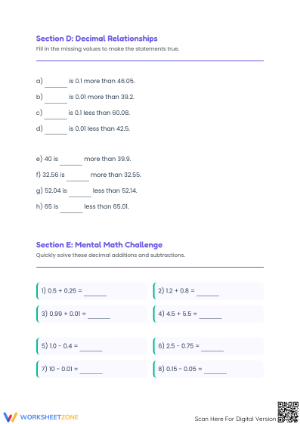
These 5th grade decimals on the number line printable worksheets give students a spatial model for decimal magnitude at the exact moment in the curriculum when place value abstraction tends to fall apart. By fifth grade, most students can write 0.5 in expanded form and name the decimal place correctly, but many still struggle to say whether 0.05 or 0.5 is closer to one — because they've learned the digit name without ever building a sense of quantity. Plotting, identifying, and comparing decimal values on a number line closes that gap directly.
What Students Practice
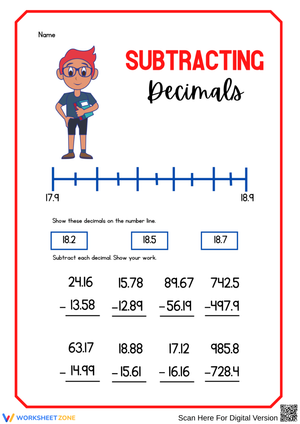
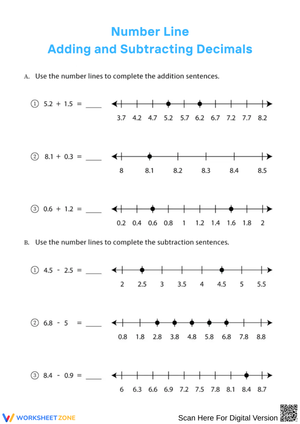
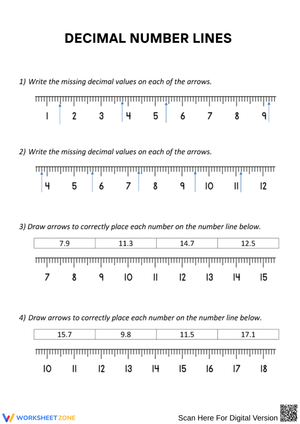
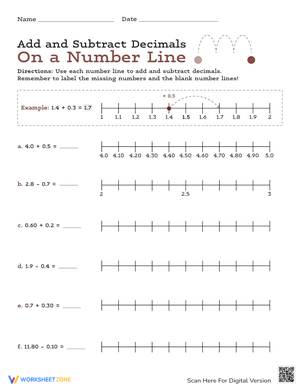
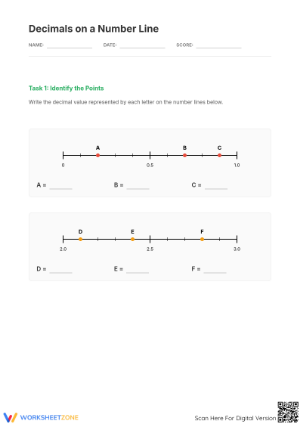
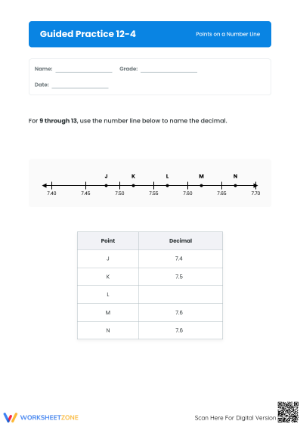
Each worksheet focuses on one of three precision levels — tenths, hundredths, or thousandths — and asks students to do more than mark a single point. They read intervals to determine scale, plot given values, identify the decimal represented by a marked position, and compare two decimals by their location (farther right means greater than, farther left means less than). Several worksheets include a fraction-decimal pairing task: students label the same tick mark with both a fraction and its decimal equivalent, writing one-half above the line and 0.5 below it. That dual-labeling reinforces equivalence more reliably than a conversion table does.
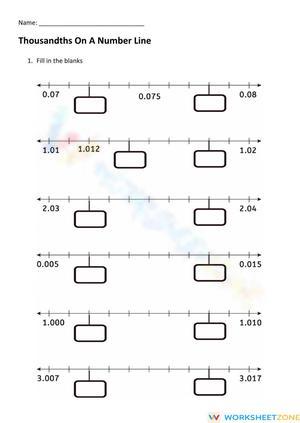
The tenths-level worksheets build directly on fraction number line work from third and fourth grade — students are partitioning a whole into ten equal segments, which is the same task they did with unit fractions. Hundredths worksheets zoom into the space between two tenths, say between 0.3 and 0.4, and ask students to subdivide that interval into ten smaller segments, showing how hundredths nest inside tenths. Thousandths worksheets deal with densely marked lines where each tick represents 0.001, and the primary skill becomes reading the scale accurately before attempting to place or identify any point at all.
Errors Worth Anticipating Before You Hand These Out
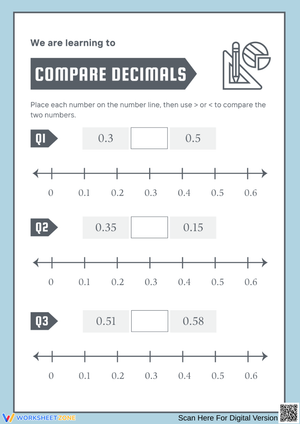
The "longer is larger" misconception shows up constantly in fifth grade decimal work. A student will circle 0.15 as greater than 0.2 because fifteen is greater than two as whole numbers. When that same student plots both values on a number line — 0.2 landing exactly two-tenths of the way across, 0.15 sitting only halfway through the second tenth — the contradiction becomes hard to argue with. No amount of explaining the rule that "you compare tenth by tenth" corrects this as efficiently as the visual placement does.
A second error surfaces when students ignore the whole-number portion of a decimal entirely. Asked to compare 1.2 and 0.9, many students select 0.9 because nine is greater than two. On a number line, 0.9 sits just short of the whole number 1, while 1.2 is clearly past it — the spatial distance makes the correct answer obvious without any digit-by-digit reasoning. A third, subtler error involves interval counting: students count tick marks rather than spaces when determining scale. If a line runs from 0 to 0.5 with four internal tick marks, some students count six marks total (including endpoints) and divide incorrectly. Teaching students to count the spaces between marks rather than the marks themselves usually resolves this in one focused lesson.
Standard Alignment
These worksheets address CCSS 5.NBT.A.3, which requires students to read, write, and compare decimals to the thousandths place using base-ten numerals, number names, and expanded form. The comparison strand — 5.NBT.A.3b specifically — asks students to compare two decimals based on the meaning of each digit's position and record the result with greater than, equal to, or less than symbols. Number lines supply a geometric proof for those comparisons: the value positioned farther right is always greater, regardless of how many non-zero digits appear in either number. That single visual principle addresses the underlying logic of 5.NBT.A.3b more directly than any procedural alignment rule. The 5th grade decimals on the number line printable worksheets in this set give students repeated practice applying that principle across all three decimal place values the standard requires.
Where These Worksheets Fit in Your Lesson Plans
The most effective use pattern is to open a new decimal precision level with a whole-group number line activity, then assign an independent worksheet from this set the following day as consolidation practice. The gap matters — students who practice on paper the same day as whole-group instruction tend to imitate procedure without building real understanding. Waiting even overnight creates a small retrieval challenge that firms up the concept faster than immediate repetition does.
Exit tickets are another strong fit. A short worksheet used in the last eight minutes of class — two "identify this point" items and two "place this decimal" items — gives immediate data on who needs a re-teach before the next lesson. For small-group pullout, the hundredths worksheets work particularly well because you can narrate interval-counting out loud as students work, catching the tick-marks-versus-spaces error before it becomes a habit. Math centers can absorb the tenths and hundredths worksheets independently; thousandths generally need at least one teacher touchpoint before students can self-correct their interval misreads with any consistency.
Reaching Both Ends of the Room With the Same Set
Students who struggle with thousandths benefit from a two-pass approach before reading or placing any point: use one color to mark every tenth on the line first, then a second color to mark every hundredth. This breaks the perceptual complexity of a densely ticked line into two manageable layers. It's not a separate worksheet — it's a pencil technique that takes about thirty seconds and dramatically reduces placement errors for students who otherwise freeze when they see fifty tick marks in a row.
For students who are ready for more challenge, remove the labeled endpoints from a number line and provide only two interior points with their values marked. Students determine the scale, identify all remaining points, and then write a comparison statement using greater than or less than. This format demands that students construct the structure themselves rather than read a given one — a meaningful difference in cognitive load. For classes with a wide ability range, these 5th grade decimals on the number line printable worksheets cover enough ground at each precision level that a two-group rotation is workable in one class period without printing separate materials for each group.
Frequently Asked Questions
How do I teach students to determine scale on a number line that isn't fully labeled?
Have students identify the start and end values first, then count the number of spaces between those points — not the tick marks, the spaces. Divide the total difference by the number of spaces, and the result is the value of each interval. Running this routine verbally in a small group before students attempt it independently makes the transfer to independent work noticeably cleaner than just writing the steps on the board.
At what point should students move from hundredths to thousandths?
When a student can reliably place any hundredths value on an unlabeled line and identify any marked point with no more than one error per worksheet, they're ready to move forward. Rushing to thousandths before hundredths are automatic creates interval-reading errors that are difficult to untangle later, because it becomes hard to tell whether a mistake is conceptual or just a miscounting artifact from an unfamiliar scale.
Can these worksheets function as formative assessment data rather than just practice?
Number lines require production rather than selection, which is what makes them useful for assessment. A multiple-choice decimal comparison item tells you the student got the right answer; a number line shows you exactly where they placed 0.37 — whether they treated the line as having ten spaces or eleven, whether they started counting from the nearest tenth or from zero. That placement data surfaces reasoning errors that a circled answer never reveals. Used as a pre-and-post assessment pairing within the same unit, these 5th grade decimals on the number line printable worksheets give you consistent format data across the full arc from tenths through thousandths, so growth is measurable and the comparison is clean.














 Interactive Worksheet Maker
 Quiz Maker
 Word Search Maker
 Crossword Puzzle Maker
 Word Scramble Generator
 Sentence Scramble Generator
 Handwriting Worksheet Generator
 Name Tracing Generator
 Fill In The Blank Generator




 BACK TOSCHOOL