




























Views
Downloads



Printable Fraction to Decimal Worksheet | Grade 5 Math

Paste this activity's link or code into your existing LMS (Google Classroom, Canvas, Teams, Schoology, Moodle, etc.).
Students can open and work on the activity right away, with no student login required.
You'll still be able to track student progress and results from your teacher account.
Mastering the relationship between fractions and decimals is a critical milestone in upper elementary mathematics. This comprehensive worksheet provides students with targeted practice in converting common fractions into their decimal equivalents, moving from foundational tenths and hundredths to more complex denominators. By completing these exercises, learners develop a concrete understanding of place value and numerical representation.
At a Glance
- Grade: 5 · Subject: Math
- Standard:
CCSS.MATH.CONTENT.4.NF.C.6— Use decimal notation for fractions with denominators 10 or 100- Skill Focus: Fraction to decimal conversion
- Format: 3 pages · 40 problems · Answer key included · PDF
- Best For: Independent practice and decimal fluency
- Time: 20–30 minutes
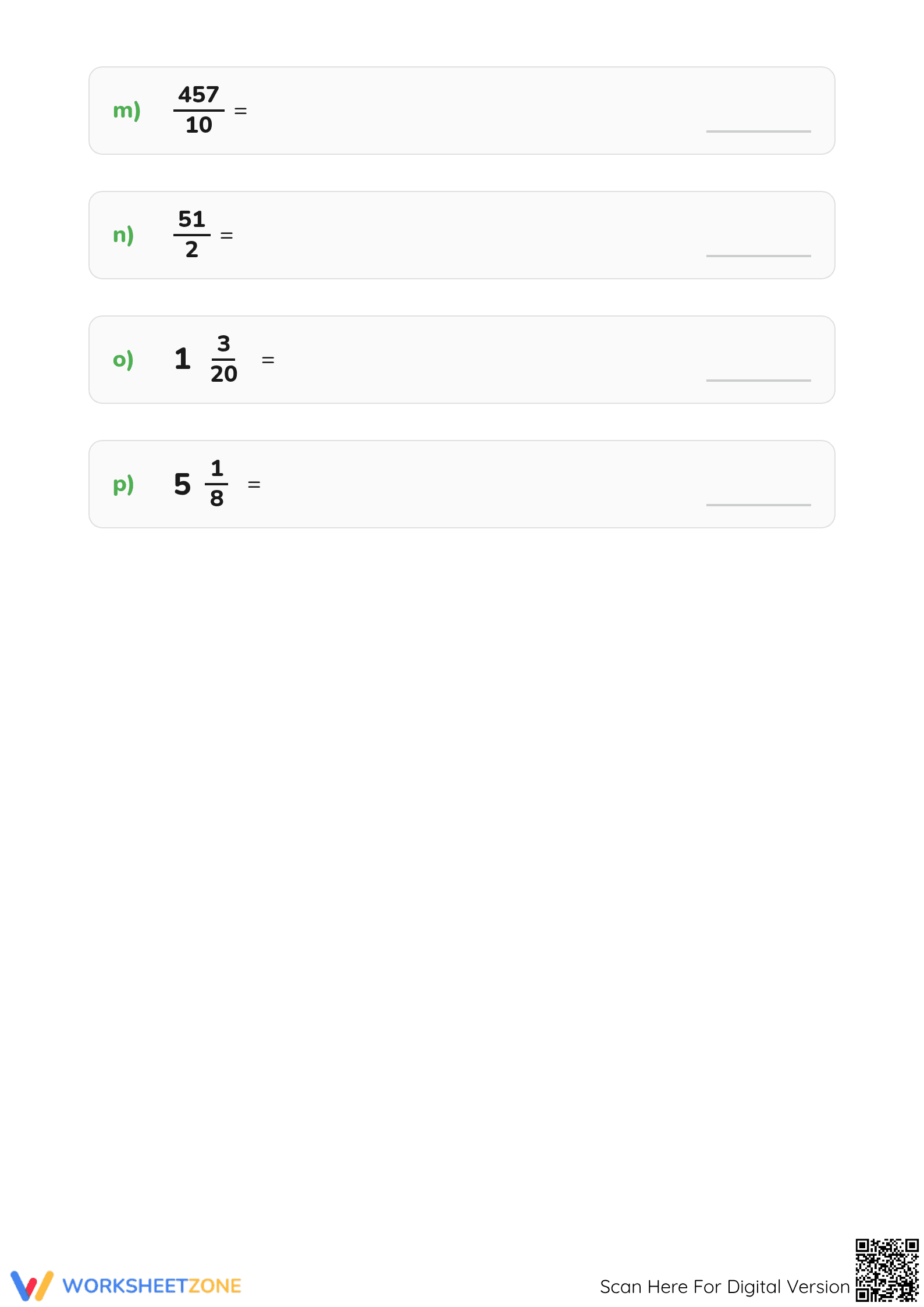
This three-page PDF resource includes two distinct worksheets designed to build fluency in decimal notation. The first page focuses on fractions with denominators of 10 and 100, while the second page introduces denominators like 2, 4, 5, 20, 25, and 50, requiring students to find equivalent fractions before converting. A full answer key is included for immediate feedback and grading efficiency.
Skill Progression
- Guided practice: The worksheet begins with fractions where denominators are already 10 or 100, allowing students to focus solely on decimal placement (20 problems).
- Supported practice: Students encounter common fractions like 1/2 or 1/4, where the conversion to a denominator of 10 or 100 is intuitive (10 problems).
- Independent practice: The final set of problems challenges students with denominators like 25 or 50, requiring multiple steps to achieve decimal form (10 problems).
This gradual-release approach ensures that learners build confidence through repeated success before tackling higher-level abstractions.
Standards Alignment
The primary alignment is CCSS.MATH.CONTENT.4.NF.C.6, which requires students to use decimal notation for fractions with denominators 10 or 100. It also supports CCSS.MATH.CONTENT.5.NBT.A.3 by reinforcing the reading and writing of decimals through thousandths. Both standard codes can be copied directly into lesson plans, IEP goals, or district curriculum mapping tools.
How to Use It
Assign this worksheet as a follow-up to direct instruction on decimal place value to reinforce the connection between parts of a whole and their decimal counterparts. During the session, observe if students are correctly identifying the power-of-ten equivalent for denominators like 20 or 25, as this indicates strong proportional reasoning. Completion usually takes 20–30 minutes.
Who It's For
This resource is ideal for Grade 4 students moving toward mastery and Grade 5 students requiring fluency reinforcement. It serves as an excellent companion to an anchor chart illustrating common fraction-to-decimal benchmarks like 1/4 and 0.25 or 1/2 and 0.5.
The conversion of fractions to decimals is a core competency that bridges early rational number concepts with advanced algebraic thinking. According to the NAEP framework, students proficient in decimal representation are better prepared for proportional reasoning. This worksheet provides the structured repetition necessary for cognitive load reduction during problem-solving. Research from Fisher & Frey (2014) emphasizes that "gradual release of responsibility" through scaffolds—like the progression from tenths to non-standard denominators found here—is essential for retention of mathematical procedures. By utilizing this CCSS.MATH.CONTENT.4.NF.C.6 aligned tool, educators provide a rigorous yet accessible path toward decimal mastery. The inclusion of a full answer key further supports self-directed learning and immediate error correction, both of which are high-leverage instructional practices according to recent ScienceDirect TpT Analysis.


