Estimating Decimals Worksheets Teachers Can Use for Grade 5 Practice
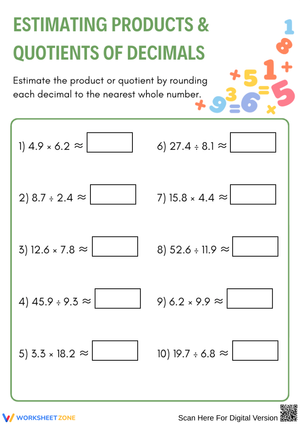
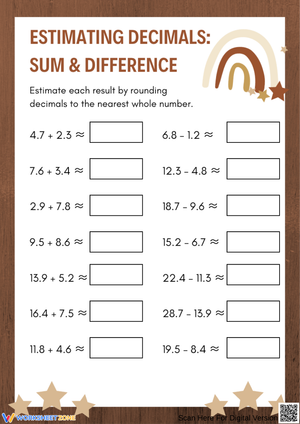
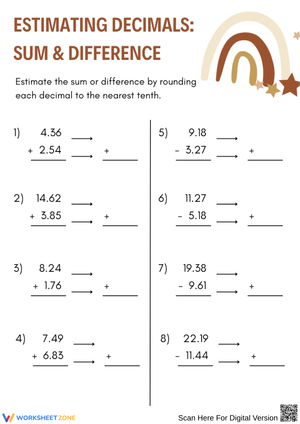
These estimating decimals worksheets for 5th grade give teachers a ready set of practice resources for one of the most consequential decimal skills in upper elementary: rounding to a named place value and using that rounded figure to decide whether a computed answer is in the right range. The set covers rounding to the nearest whole number, tenth, and hundredth, then extends into estimation applied to decimal addition and subtraction — matching the instructional sequence most Grade 5 teachers follow after introducing decimal place value.
The Specific Skills Targeted
Each worksheet focuses on a clear, nameable task rather than mixing too many operations at once. Rounding to the nearest whole number comes first because students can anchor to familiar integers while they work out the logic of looking one place to the right. Rounding to the nearest tenth and hundredth follows, and those worksheets require students to identify the target place, find the deciding digit, and apply the rounding rule — not just guess from the shape of the number.
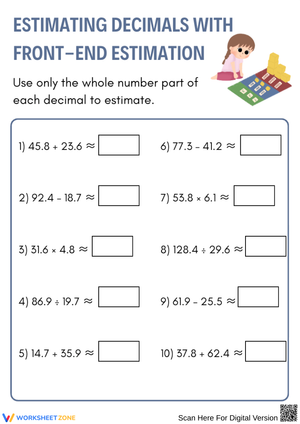
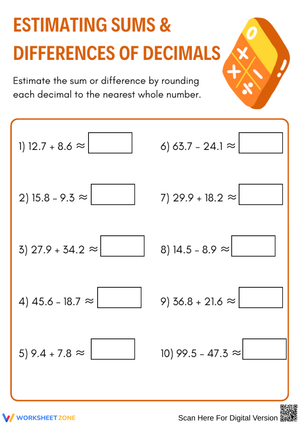
Later worksheets in the set move into estimation within operations. Students round two decimal addends or subtrahends before solving, then compare their estimate to the computed result and mark whether the answer is reasonable. That final step — judging reasonableness — is the skill that transfers most directly to multi-step problem solving, and it shows up consistently on standardized assessment items at this level.
Mistakes Students Make That These Worksheets Help You Catch
The most persistent error at this level is not ignoring the deciding digit — it is reading the wrong digit altogether. A student rounding 12.045 to the nearest tenth will often write 12.1 because they lock onto the 4 in the hundredths place rather than the 0 in the tenths place. They are looking to the right in a general sense but haven't anchored to the target place before moving. These worksheets expose that pattern because they vary the target place across items on the same worksheet — students working from habit rather than place value structure start making inconsistent errors the moment the target changes row to row.
A second error worth anticipating: students who round 3.45 to the nearest tenth and write 3.4 because "the 5 rounds down." This reflects a shaky grasp of the rounding rule itself, not just place value confusion. When a student shows this in written work, a number line conversation resolves it faster than re-explaining the rule verbally — placing 3.45 between 3.4 and 3.5 and asking which endpoint it is closer to makes the answer visible rather than procedural.
There is also a structural error pattern that appears when target places are mixed across rows. A student who rounds every number correctly when all items target the nearest tenth will sometimes round to the nearest hundredth on an item asking for the nearest tenth — they're attending to the digit structure of the number rather than the instructions. Several worksheets in the set are built specifically to surface this, with rows that shift the requested place so teachers can see whether students are reading the problem or working on autopilot.
Standard Alignment
The primary standard addressed is 5.NBT.A.4, which calls for students to use place value understanding to round decimals to any place. The key word in that standard is understanding — it sits within the "Understand the place value system" cluster, not the operations cluster, which tells teachers something important about intent. Students are expected to connect the estimate to the actual value of the digits, not to execute a memorized shortcut. In classroom terms, that means estimation practice done right is also place value practice. A student who explains that 6.382 rounds to 6.4 because the deciding digit is 8 — and 8 is greater than or equal to 5 — is demonstrating the conceptual work the standard requires. Mixed-target practice, where the place being rounded changes across items, gives teachers a reliable way to check that understanding rather than just fluency with one routine.
How to Build These Worksheets Into Your Lesson Plans
The worksheets fit most naturally into the first five minutes of math or the last eight before the period ends. For a bell ringer, three mixed-target rounding problems with a one-sentence explanation prompt — "which digit helped you decide?" — take about six minutes and give a fast read on who has the concept before the lesson moves forward. For an exit ticket, two problems where one decimal rounds up and one stays the same force students to show they're applying the rule rather than guessing. Papers where both answers go in the same direction flag students who need a follow-up conversation before the next lesson.
Math centers work well with this set because each worksheet requires no setup beyond printing. One station can hold a worksheet with number line support, another can run independent practice at mixed target places, and a third can tackle the estimation-in-operations worksheets. In small-group reteach, keep the item count at three to five per worksheet and build in oral explanation between each problem — students who talk through the benchmark value before writing consistently retain the skill better than those who jump straight to the answer line.
These estimating decimals worksheets for 5th grade also travel well to homework folders. The format is familiar enough that students can work through them without needing to look up directions, and parents can follow the place value logic without a separate explanation sheet — which matters when you're sending decimal review home mid-unit and don't want the work to stall at the kitchen table.
Adjusting the Set for a Range of Learners
For students still building confidence with place value, the most useful adjustment is to add one pre-step: before solving any item, students circle the target place and underline the deciding digit. That physical act slows the process down enough that students stop guessing from number shape and start reading the decimal structure. It doesn't change the worksheet — it changes how the student enters each problem.
Students who are ready for more challenge can work with the same estimating decimals worksheets for 5th grade by adding a comparison task: after rounding, they write two possible estimates — one rounding up, one rounding down — and explain which gives a more useful approximation for a specific context. That extension turns a fluency exercise into a reasoning task without requiring a separate resource. On the operations-level worksheets, stronger students can estimate before solving, calculate the exact answer, and then describe how far off the estimate was and why — which builds the kind of number sense that shows up in open-response problems.
Pacing is another lever that costs nothing. Some students benefit from working only the nearest-tenth row on a mixed worksheet while others tackle the full set in the same block. Because each worksheet uses a consistent format, the teacher can manage both groups at once without printing different materials for each.
Frequently Asked Questions
What order should I introduce these worksheets in?
Start with rounding to the nearest whole number, then move to tenths, then hundredths. Once students can explain which digit decides the estimate across all three target places, introduce the worksheets that embed estimation in addition and subtraction. Moving through that sequence too quickly is the most common pacing mistake — students who reach operations before they're solid on place value-based rounding make errors that look like computation mistakes but are actually conceptual gaps.
Can I use these for intervention with students who are below grade level?
Yes, and these estimating decimals worksheets for 5th grade work particularly well in intervention because each worksheet has a clear, narrow focus. If a student is struggling specifically with rounding to the nearest hundredth, you can pull that worksheet without sorting through a mixed packet. In a 15-minute pull-out block, three to four problems with oral explanation between each item gives more instructional traction than a longer silent assignment.
Do students need number lines or place value charts to use these worksheets?
Not every student does, but both tools help during initial instruction. Number lines are strong for showing which benchmark value a decimal is closer to — a student who marks 4.67 between 4.6 and 4.7 and sees it sitting nearer 4.7 stops treating the rounding rule as arbitrary. Place value charts help students isolate the target digit before they do anything else. Teachers can project either tool during guided practice and then ask students to work independently on the worksheet once the visual model is familiar — the goal is to move toward working without the support, not to keep it in place indefinitely.
Clear All