




























Views
Downloads

Printable Decimal Notation Worksheet for Grade 4 Math

Paste this activity's link or code into your existing LMS (Google Classroom, Canvas, Teams, Schoology, Moodle, etc.).
Students can open and work on the activity right away, with no student login required.
You'll still be able to track student progress and results from your teacher account.
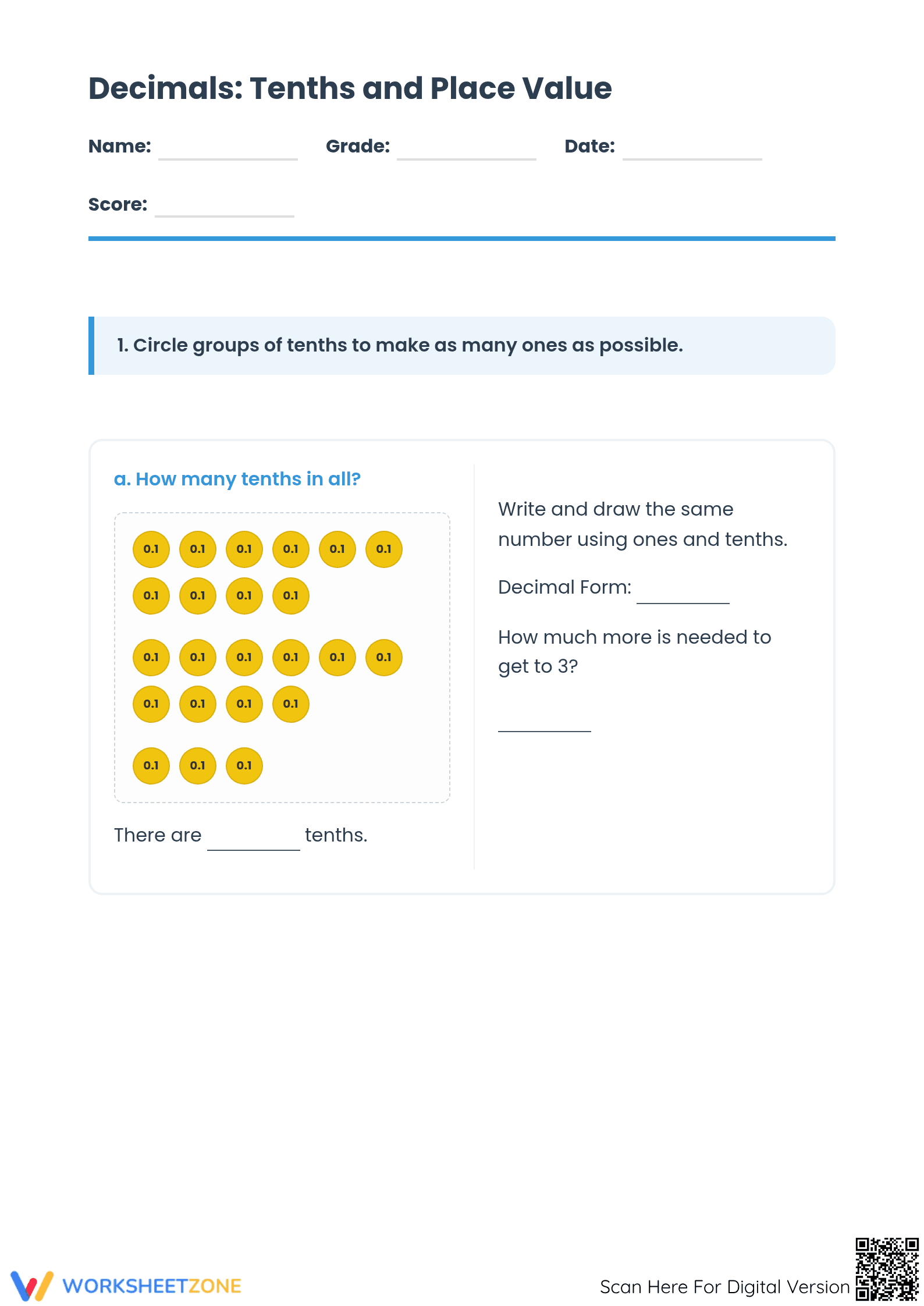
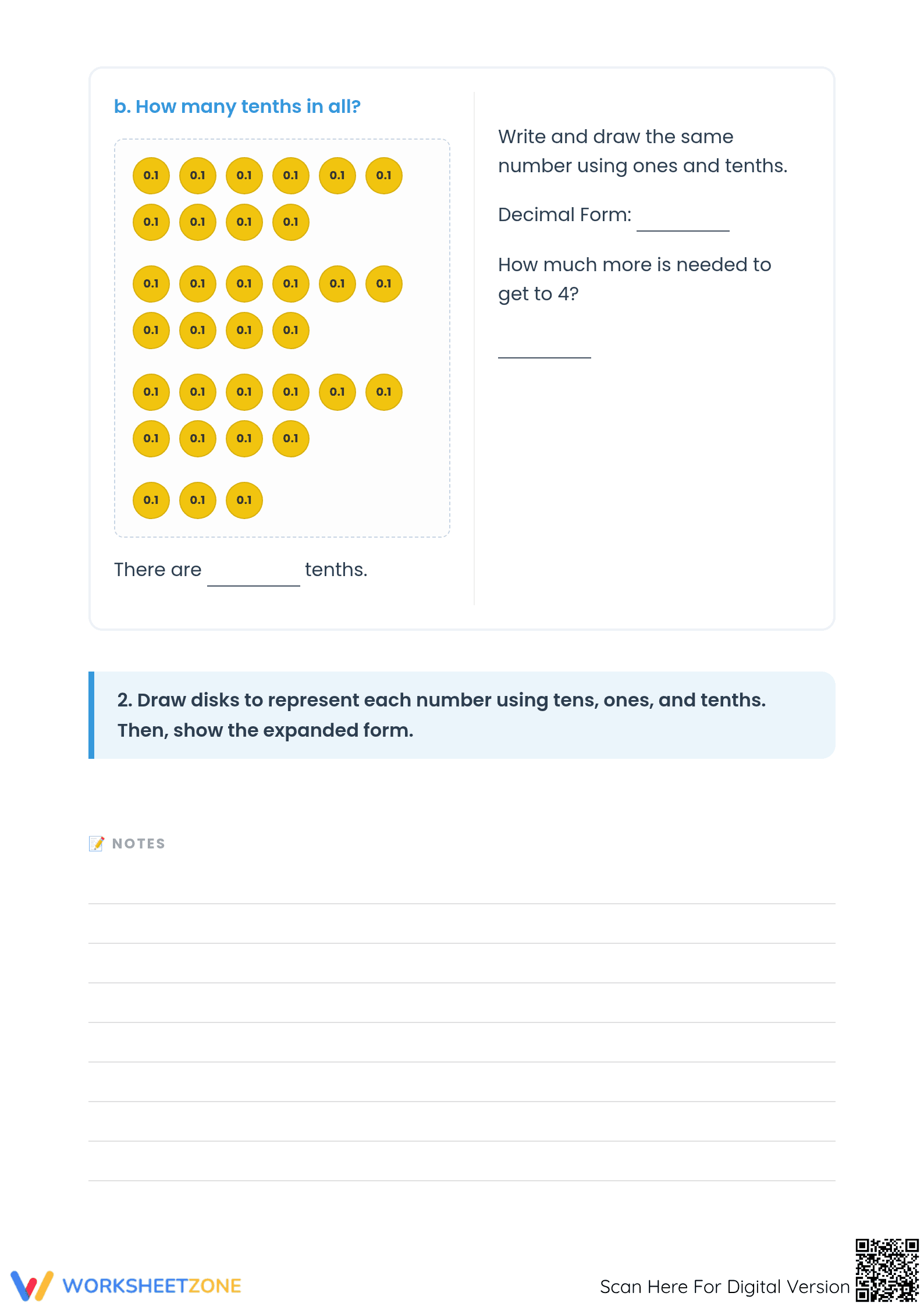
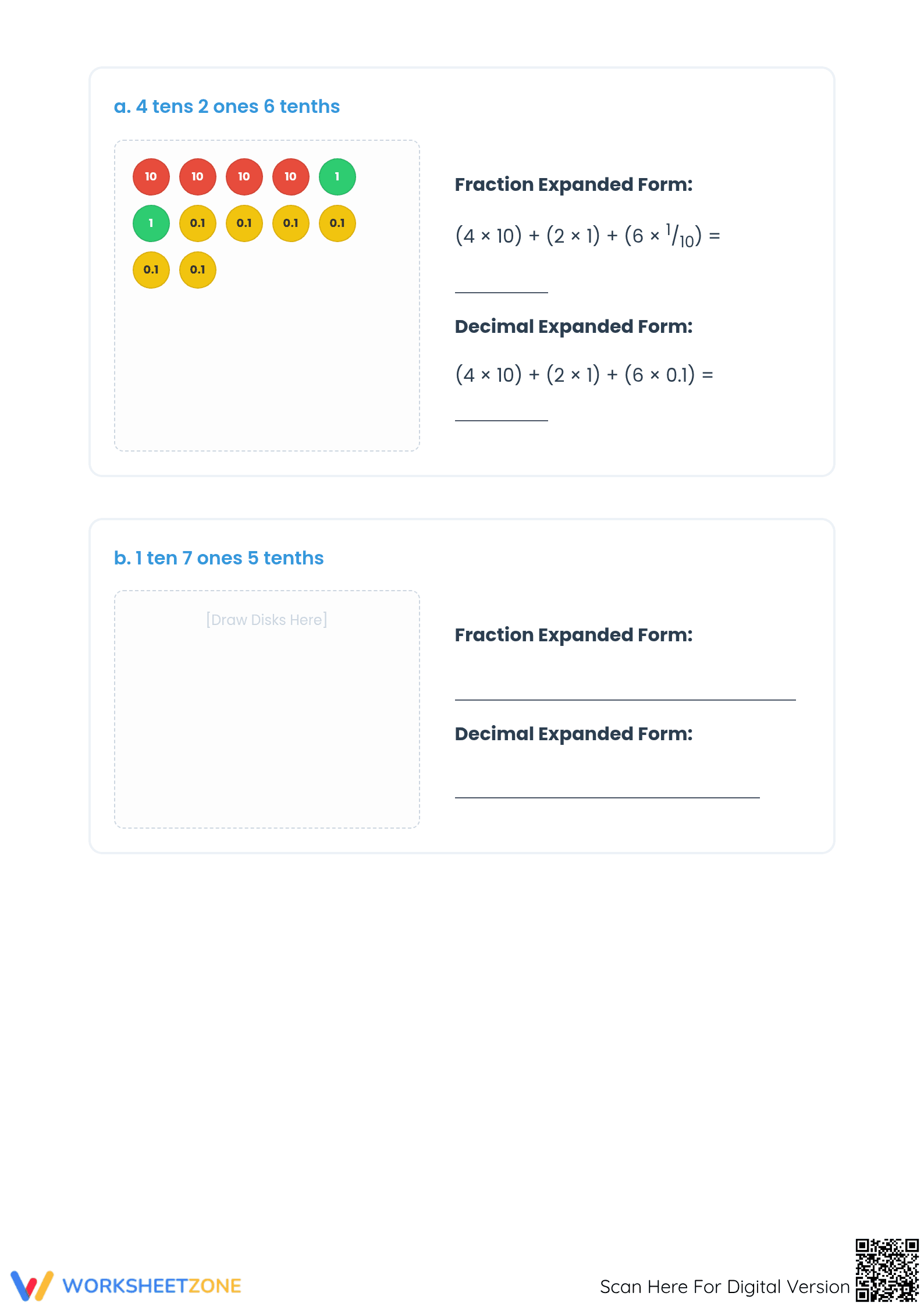
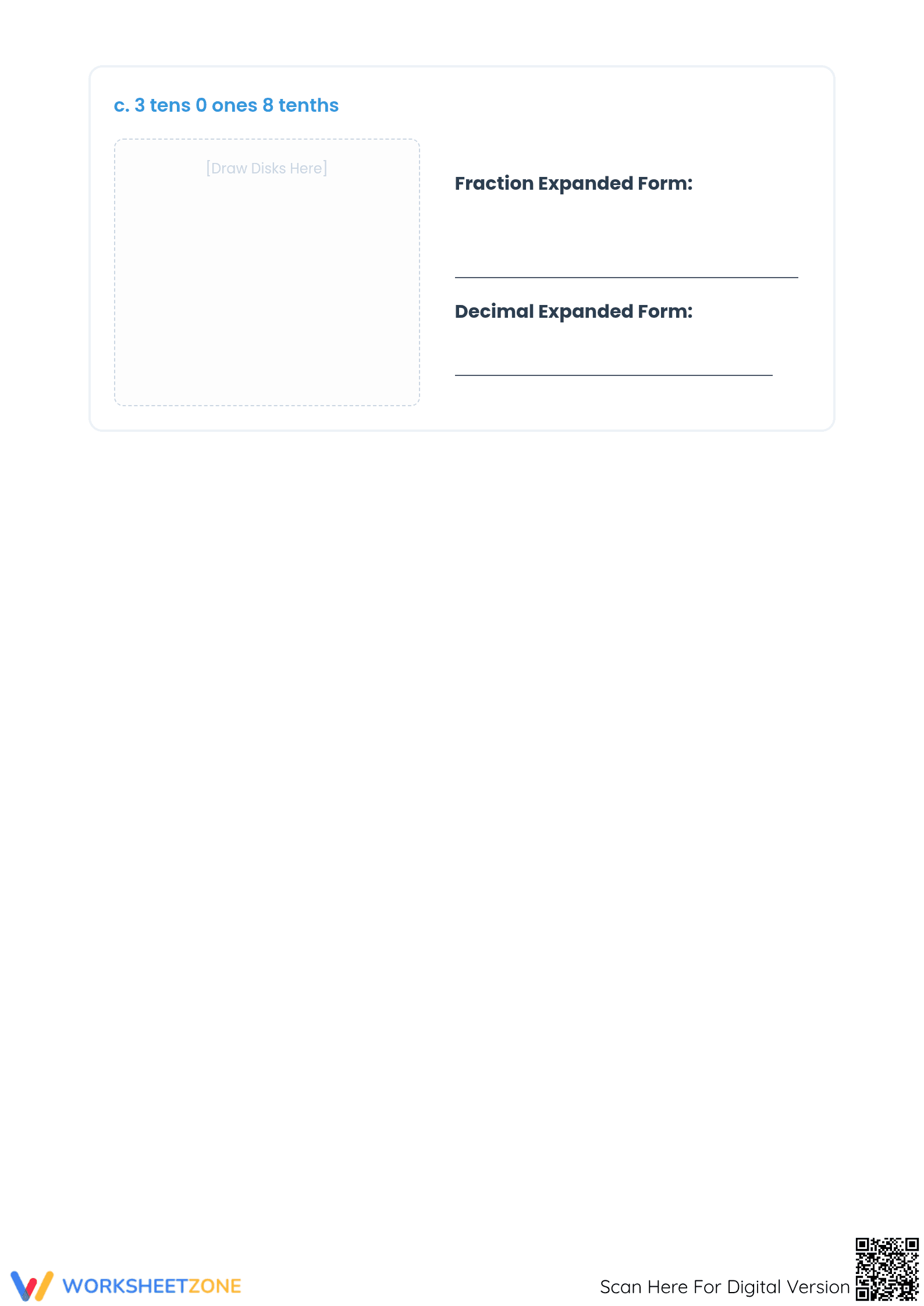
This comprehensive Grade 4 math worksheet focuses on the critical transition from fractions to decimal notation. By using concrete models like number disks and visual representations on number lines, students learn to express mixed numbers with units of tens, ones, and tenths. This resource ensures students develop a deep conceptual understanding of place value before moving into abstract calculations.
At a Glance
- Grade: 4 · Subject: Math
- Standard:
CCSS.MATH.CONTENT.4.NF.C.6— Use decimal notation for fractions with denominators 10 or 100- Skill Focus: Representing decimals on number lines and number disks
- Format: 4 pages · 14 problems · Answer key included · PDF
- Best For: Initial instruction and guided place value practice
- Time: 30–45 minutes
What's Inside: This 4-page instructional packet includes structured exercises that guide students through multiple representations of decimals. The first two pages focus on visual modeling using number disk diagrams, while the subsequent pages challenge students to plot mixed numbers on precisely scaled number lines. The set includes a full answer key, ensuring quick feedback and easy grading for teachers or parents.
Skill Progression
- Guided Practice: Students begin with 6 problems using number disks to visualize the relationship between tens, ones, and tenths, providing a concrete bridge to abstract notation.
- Supported Practice: The worksheet transitions to 4 number line problems where students must identify and plot decimals between whole numbers, reinforcing the concept of fractional parts.
- Independent Practice: The final 4 tasks require students to write values in expanded form and decimal form without visual aids, demonstrating mastery of the place value system.
Standards Alignment
This resource is strictly aligned to `CCSS.MATH.CONTENT.4.NF.C.6`: Use decimal notation for fractions with denominators 10 or 100; for example, rewrite 0.62 as 62/100; describe a length as 0.62 meters; locate 0.62 on a number line diagram. Both standard codes can be copied directly into lesson plans, IEP goals, or district curriculum mapping tools.
How to Use It
Use this worksheet during the direct instruction phase of a unit on decimals or as a targeted intervention for students struggling with the concept of tenths. A helpful formative assessment tip is to observe students as they plot points on the number line; look for those who confuse the intervals between whole numbers, as this indicates a need for further instruction on decimal scale. Expected completion time is approximately 35 minutes.
Who It's For
This resource is designed for Grade 4 students but is also highly effective for Grade 5 learners who require a refresher on decimal foundations. It is particularly useful for students who benefit from visual scaffolds like number disks. Pair this worksheet with a decimal place value anchor chart or a short video lesson on tenth-unit equivalence for maximum instructional impact.
According to research from Fisher & Frey (2014) on the gradual release of responsibility, students acquire mathematical fluency most effectively when instruction moves systematically from concrete modeling to abstract representation. This Grade 4 worksheet applies these findings by utilizing number disks to ground the concept of decimal place value before asking for independent notation. By satisfying the requirements of CCSS.MATH.CONTENT.4.NF.C.6, the resource provides the necessary 14 tasks to build student confidence in identifying tenths on a number line. The inclusion of an answer key supports immediate error correction, which NAEP data suggests is a significant factor in long-term retention of fractional concepts. Educators can rely on this structured approach to ensure students are prepared for more complex decimal operations in subsequent grade levels.


