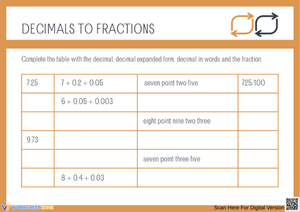
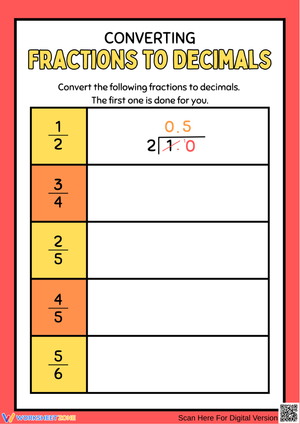
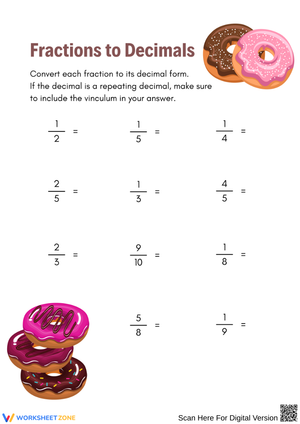
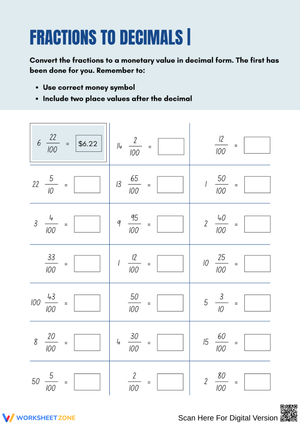
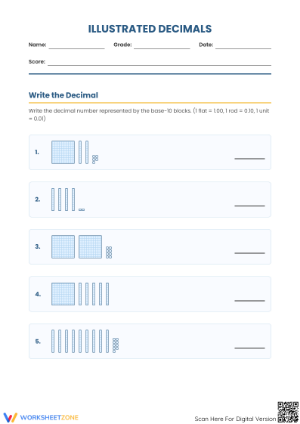
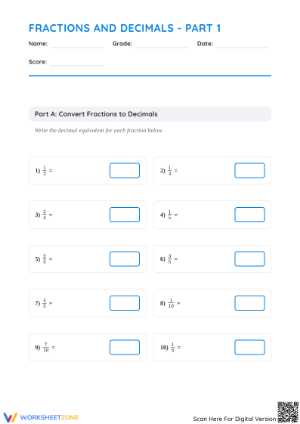
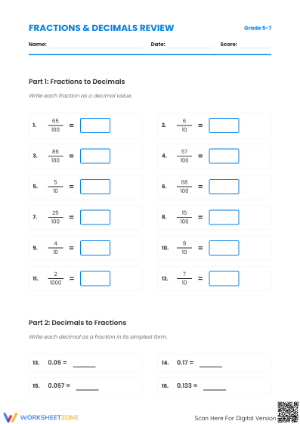
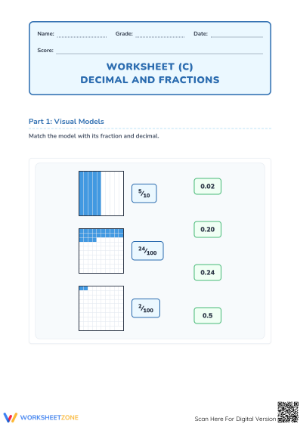
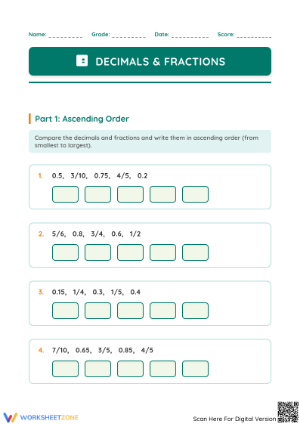
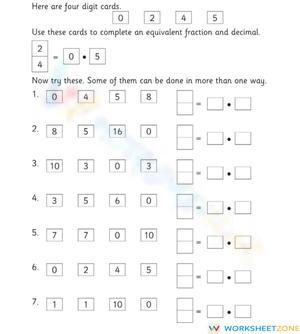
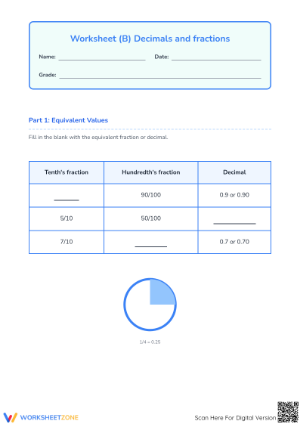
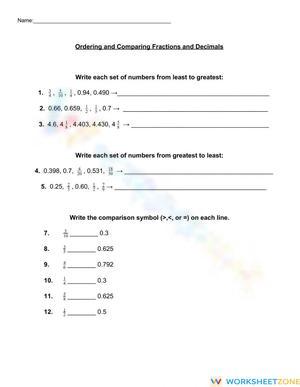
These 5th grade converting decimals and fractions printable worksheets give teachers a set of standalone practice resources organized around grade 5 place value expectations — each worksheet targets a specific conversion direction or model type, so you can assign them individually based on where your class or small group actually is in the unit. The set covers the full progression from visual model work with tenths and hundredths grids through abstract numeric conversions and simplified fraction forms.
The Specific Skills Each Worksheet Targets
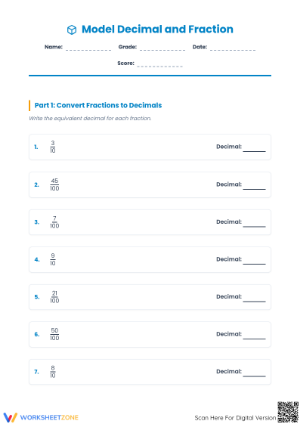
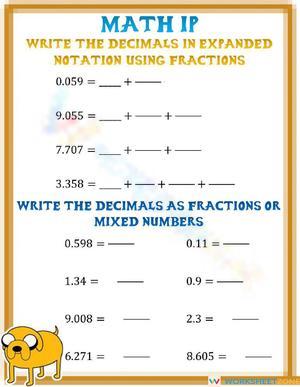
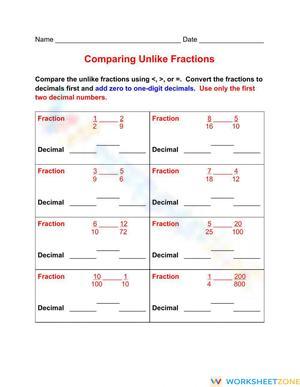
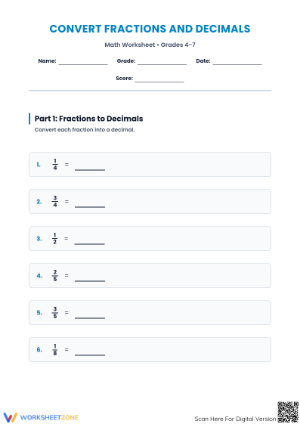
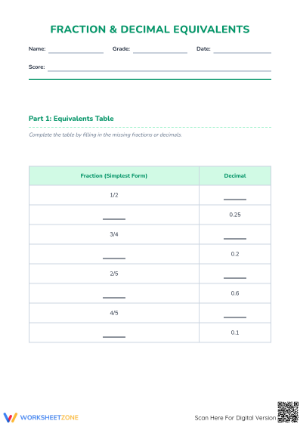
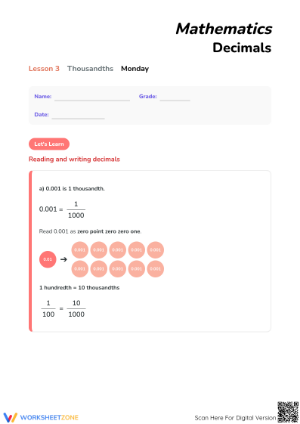
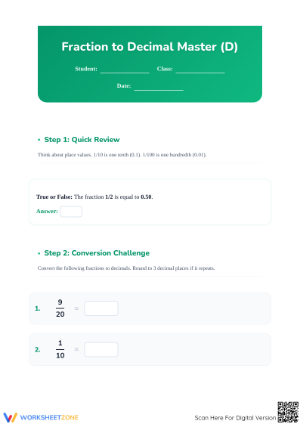
The set moves through four distinct skill areas. Visual model worksheets ask students to shade hundredths grids and connect the shaded portion to both a decimal and a fraction — that double representation is where many students first see that 0.35 and 35/100 are not two separate ideas but one quantity described two ways. Decimal-to-fraction worksheets ask students to name the place value of the final digit, write the fraction, and simplify where possible. Fraction-to-decimal worksheets work from benchmark denominators — fifths, fourths, twentieths — and require students to build an equivalent fraction with a denominator of 10 or 100 before writing the decimal. Mixed review worksheets combine all three conversion directions along with short comparison tasks where students write a greater than or less than symbol to order a decimal and a fraction. The set also includes quick-check worksheets with four to six items sized for use as warm-ups or exit tickets.
Among the 5th grade converting decimals and fractions printable worksheets in this set, the fraction-to-decimal direction tends to produce the most useful diagnostic evidence. When students can convert 3/4 to 0.75 by building the equivalent fraction 75/100, they are demonstrating place value reasoning — not pattern recall. That distinction matters at the moment you are deciding whether to keep moving or slow down for reteach.
Errors That Surface Consistently in Student Work
Three error types appear with enough regularity that it is worth anticipating them before assigning any worksheet in this set. First, students confuse tenths and hundredths when writing a decimal as a fraction — a student who writes 0.6 as 6/100 is reading the numeral correctly but misidentifying its place. The 6 is in the tenths column, which means the fraction is 6/10. The error shows up most often when students have been working primarily in hundredths and the denominator feels automatic. Second, students stop the conversion correctly at 34/100 for 0.34 but never simplify to 17/50 — they understand the decimal as a fraction but do not treat simplification as part of the conversion task. Third, students turn 3/5 into 0.3 by writing the numerator after the decimal point, which reveals pattern-matching from the digit rather than reasoning through equivalence or division.
The most useful instructional move is to sort these into two separate categories: representation errors and simplification errors. Representation errors — where the denominator is wrong — need place value modeling. Simplification errors happen after a correct initial conversion and call for equivalent fraction review, not more decimal work. Treating them as one undifferentiated "conversion problem" leads to reteach sessions aimed at the wrong root cause. Adding a sentence stem to any worksheet in the set — "I wrote this fraction because the digit is in the ___ place" — makes both error types visible before the answer key does.
What Students Need in Place Before Converting
Conversion work at grade 5 exposes gaps in base-ten structure quickly. Before students begin a worksheet that asks them to move between representations, three readiness conditions matter:
- Students can name the place value of each digit in decimals like 0.08, 0.3, and 0.45 without counting columns from the decimal point on every item.
- Students can generate equivalent fractions and explain why 3/5 equals 6/10 rather than just writing it from memory.
- Students understand that a fraction represents division — 3/4 means 3 divided by 4, which is why it equals 0.75.
If any of these three conditions is shaky, the conversion worksheet becomes a procedure-following exercise rather than a reasoning task. Starting with a shaded grid or a base-ten model before assigning abstract numeric items is not supplementary — it is what makes those abstract items productive later.
Smart Ways to Work These Worksheets Into Your Week
The visual model worksheets work well during whole-group instruction when you want students to articulate their thinking before anyone writes a conversion. Projecting a grid and asking students to mark both the decimal and the fraction before they see the answer keeps the reasoning in the room. In small-group reteach — the kind that runs eight to ten minutes while the rest of the class works independently — the model-based worksheets are better with fewer items and a verbal check after each one: "Tell me why you wrote tenths and not hundredths."
For independent practice, the mixed review worksheets are more useful than a worksheet that targets only one conversion direction, because students need to shift strategies across items without teacher prompting. That shift — seeing a fraction, deciding whether to build an equivalent form or divide, writing the decimal — is exactly what the unit is building toward. For exit tickets, pull four to six items from any worksheet in the set and add one written explanation requirement. The explanation is where you see whether a student understands the conversion or is completing it by pattern. A class set of those written responses takes about three minutes to scan and tells you more than a scored answer key does about who needs place value work versus who needs equivalent fraction practice.
Standard Alignment
The primary standard these worksheets address is CCSS.MATH.CONTENT.5.NBT.A.3, which requires fifth graders to read, write, and compare decimals to thousandths using base-ten numerals, number names, and expanded form. Conversion between decimals and fractions sits at the center of that standard's intent: students should be able to explain that 0.7 represents seven tenths, not simply read it aloud as "point seven." The simplification work in fraction-to-decimal tasks also connects to CCSS.MATH.CONTENT.5.NF.B.3, which positions fractions as expressions of division — a conceptual link that carries directly into long division later in grade 5 and into ratio reasoning in grade 6.
Instructionally, both standards appear in the first major unit of most grade 5 pacing guides, which means these worksheets are most in use from late September through November. The quick-check worksheets serve a second purpose in March and April when teachers are returning to this content during review cycles before state assessments.
Adjusting Each Worksheet for a Range of Learners
5th grade converting decimals and fractions printable worksheets can be adapted across readiness levels without requiring separate materials. For students who are still solidifying place value, limit the task to tenths only — set the hundredths items aside for a second session once tenths conversions are automatic. That single adjustment reduces the number of competing denominator patterns students are managing at once and keeps the lesson focused.
Students who finish the standard worksheet quickly benefit from a follow-up challenge: convert fractions with denominators that are not 10 or 100 — sevenths, thirds, sixths — using long division rather than equivalent fraction strategies. Those items reveal whether students understand why a decimal terminates or repeats, which is a genuine grade 5 extension rather than added volume. For students who need more guided support, working through the first two items on each worksheet together and asking them to narrate each step before writing anything tends to produce more durable understanding than simply slowing the pace or reducing the item count.
Frequently Asked Questions
What prior knowledge do students need before using these worksheets?
Students should be able to name place values in decimals to hundredths and generate equivalent fractions with confidence. If either skill is unstable, begin with the visual model worksheets and check understanding verbally before moving to numeric conversion items.
Can individual worksheets from this set double as exit tickets?
Yes. The quick-check worksheets in the set are sized for that purpose. For a more targeted exit ticket drawn from any other worksheet in the set, pull four to six items and add a one-sentence written explanation requirement — that combination gives you cleaner formative evidence than scoring a full set of answers alone.
Do the worksheets cover both conversion directions?
Each worksheet focuses on one primary direction — decimal to fraction or fraction to decimal — though the mixed review worksheets bring both together. Keeping the directions separate in early practice lets students build confidence with each before they encounter them side by side.
How does the grade 5 conversion work in this set differ from what students saw in grade 4?
Grade 4 conversion work typically stays within denominators of 10 and 100. What separates these 5th grade converting decimals and fractions printable worksheets from grade 4 materials is the expectation that students simplify fractions after converting, use division to convert fractions whose denominators are not powers of ten, and reason about equivalence across a wider range of fraction forms — not just those with tidy base-ten denominators.














 Interactive Worksheet Maker
 Quiz Maker
 Word Search Maker
 Crossword Puzzle Maker
 Word Scramble Generator
 Sentence Scramble Generator
 Handwriting Worksheet Generator
 Name Tracing Generator
 Fill In The Blank Generator




 BACK TOSCHOOL