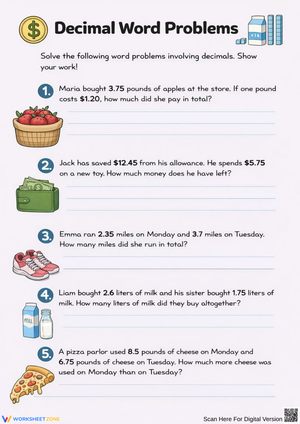
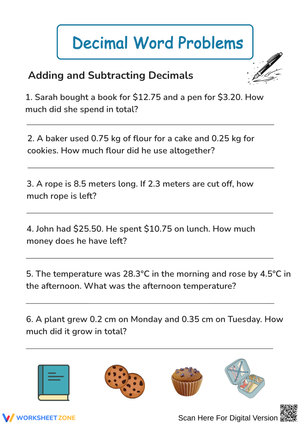
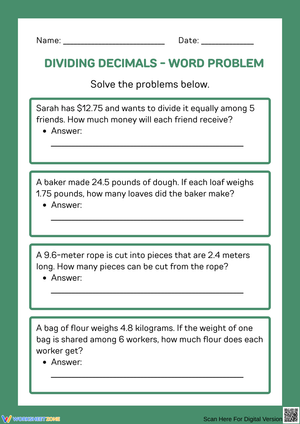
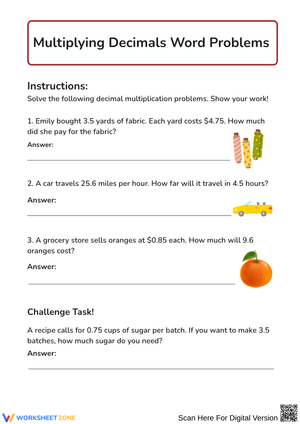
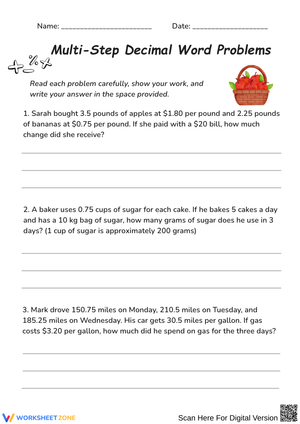
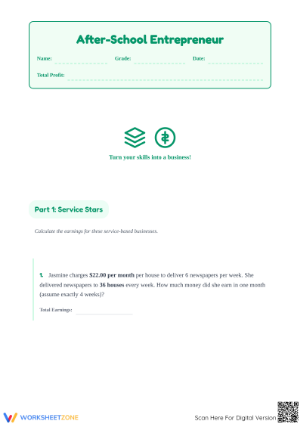
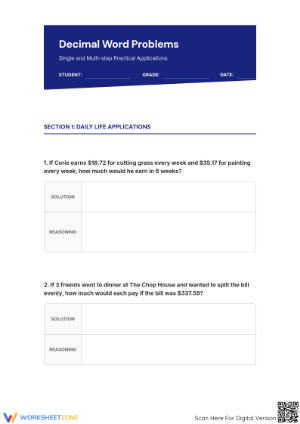
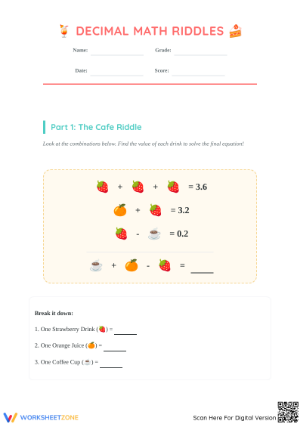
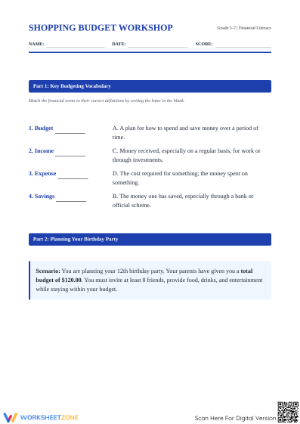
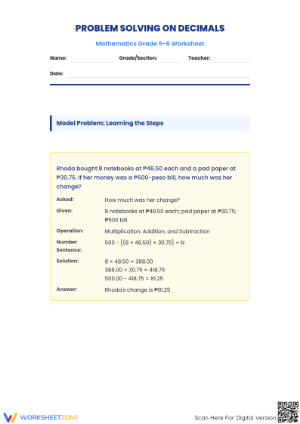
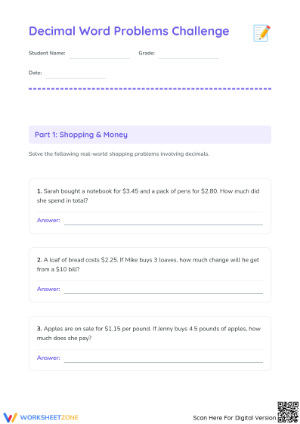
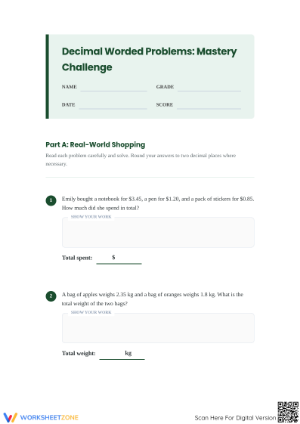
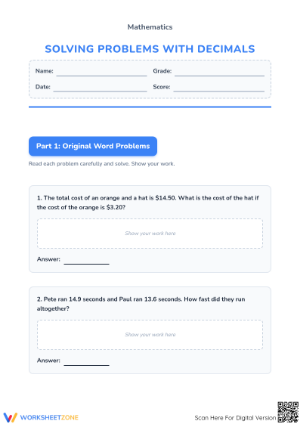
These decimal word problems worksheets for 5th grade give teachers a ready supply of real-context exercises across all four decimal operations — addition, subtraction, multiplication, and division to the hundredths place. The problems draw from money, measurement, and science data scenarios so students meet decimals in the same places they appear outside of math class. Each worksheet targets a specific skill or problem structure, making it easy to slot one into an existing lesson without rebuilding the day around it.
What the Set Covers
The worksheets address a range of skills and problem types, moving from single-operation work to more demanding multi-step problems:
- Decimal addition and subtraction with tenths and hundredths, including problems where the two values don't share the same number of decimal places
- Decimal multiplication — whole number times decimal, and decimal times decimal
- Decimal division, covering both dividing a decimal by a whole number and dividing a decimal by a decimal
- Multi-step problems that require students to identify which operations to apply and in what sequence
- Measurement contexts: track and field distances, liquid volume, recipe amounts
- Money problems ranging from single-item purchases to multi-item totals and change calculations
Single-operation worksheets let students work on one procedure at a time before they face problems that require them to decide what to do first. That sequencing matters — students who jump to mixed practice before they're consistent on decimal placement in division tend to carry those errors forward for several weeks.
Student Error Patterns Worth Getting Ahead Of
Decimal addition and subtraction produce one persistent error: students line up the rightmost digits instead of the decimal points. A student who writes 3.4 + 12.75 by stacking the 4 above the 5 and the 3 above the 7 will produce a confident-looking answer — 16.15 — but the columns represent different place values and the answer is wrong. Requiring students to draw a vertical decimal-point guide before starting the calculation, or having them work on graph paper where each column is one place value, catches this before it becomes automatic.
Multiplication brings a different problem. Students learn to count decimal places to determine where the decimal point goes in the product, but under any time pressure they miscount. A student who multiplies 3.2 by 4.1 and writes 131.2 has misplaced the decimal by one spot. Building a quick estimation habit — "three times four is twelve, so my answer needs to be close to twelve, not one hundred thirty" — takes less than thirty seconds and functions as a reliable self-check for the rest of the year.
The most common word problem error at this level isn't arithmetic. It's choosing the wrong operation. Students see the phrase "how much more" and subtract automatically, even when the problem requires a multiplication step before any comparison can happen. Slowing down to underline what the question is actually asking — separate from identifying the numbers — addresses this more than additional computation drills.
Standard Alignment
These worksheets address 5.NBT.B.7, which requires fifth graders to add, subtract, multiply, and divide decimals to hundredths using concrete models, drawings, and strategies grounded in place value and properties of operations. The decimal word problems worksheets for 5th grade in this set meet that standard not just through calculation, but through the reasoning demand in each problem — students must interpret a situation, select operations, execute the math, and then check whether their answer is plausible. That full sequence is what 5.NBT.B.7 calls for in practice, not just the numerical result.
How to Build These Worksheets Into Your Lesson Plans
The single-operation worksheets work well as a focused warm-up or a closing exit ticket. Six money-context addition problems at the start of a lesson take about eight minutes and immediately show which students lined up their decimal points and which didn't. That quick read shapes the next twenty minutes of instruction more usefully than a verbal check-in before the lesson begins.
Multi-step worksheets belong after direct instruction and at least one round of guided practice — not as the first independent work students see. When students encounter a three-step problem before they've watched the annotation process modeled, they tend to guess at operations rather than reason through the setup. Reserve those worksheets for the second or third day on a new operation, or use them during Friday review when the week's skills can be brought together.
For stations and small-group rotations, sorting worksheets by context — all money problems together, all measurement problems together — lets teachers steer students toward the scenario type that matches the vocabulary they know, lowering the reading barrier without reducing the math demand.
Adjusting the Set Across a Range of Learners
The decimal word problems worksheets for 5th grade that work at the tenths level are the right starting point for students who are still consolidating place value. Hundredths problems add an extra layer of abstraction, and students who haven't internalized that 0.3 and 0.30 are equivalent produce consistent errors that look like arithmetic mistakes but are actually conceptual gaps. Tenths-level worksheets also tend to use cleaner numbers, which keeps reading and calculation load lower while the core concept firms up.
Students who move through grade-level material quickly benefit from problems that layer a second condition into the setup — for example, a measurement scenario where one value is given in meters and another in centimeters, requiring a unit conversion before the decimal operation begins. You can also ask those students to write their own word problem for a given decimal equation, which reveals quickly whether they understand what decimal multiplication means versus just the steps for computing it.
For students who struggle with organizing multi-step work, providing a pre-drawn place value chart alongside each problem reduces the planning overhead without reducing the math. That's different from doing less math — it removes the organizational step that stalls some students before the calculation even starts, so more of their attention goes to the arithmetic itself.
Frequently Asked Questions
Which decimal operations are included across the set?
The set covers addition, subtraction, multiplication, and division of decimals to the hundredths place — the full scope of 5.NBT.B.7. Some worksheets isolate one operation so students can build accuracy before mixing types. Others present mixed problems where selecting the correct operation is part of the work.
How many problems does each worksheet include?
Most worksheets in the set include five to eight problems. Multi-step worksheets tend toward five or six to leave adequate workspace for students to show their reasoning. Single-operation worksheets typically run six to eight problems, which fits comfortably into a ten-minute warm-up or exit ticket block.
Can these be used with students who are still building foundational decimal understanding?
The decimal word problems worksheets for 5th grade that focus on tenths and single-step addition or subtraction work well for students who need more time with the basics. Starting at that level and moving to hundredths once students are consistently accurate is a practical approach for a student who is working below grade-level expectations in math.
Are these appropriate as formative assessment tools?
Several worksheets in the set function naturally as formative checks. They're short enough to complete in the final ten minutes of class and specific enough to pinpoint exactly where understanding breaks down. The error pattern a student leaves behind on a focused six-problem worksheet gives more actionable information than a longer end-of-unit test — you can see immediately whether the issue is decimal alignment, operation selection, or place value in the product.














 Interactive Worksheet Maker
 Quiz Maker
 Word Search Maker
 Crossword Puzzle Maker
 Word Scramble Generator
 Sentence Scramble Generator
 Handwriting Worksheet Generator
 Name Tracing Generator
 Fill In The Blank Generator




 BACK TOSCHOOL