


























Views
Downloads



Mixed Numbers to Decimals | Grade 4 Printable Worksheet
Paste this activity's link or code into your existing LMS (Google Classroom, Canvas, Teams, Schoology, Moodle, etc.).
Students can open and work on the activity right away, with no student login required.
You'll still be able to track student progress and results from your teacher account.
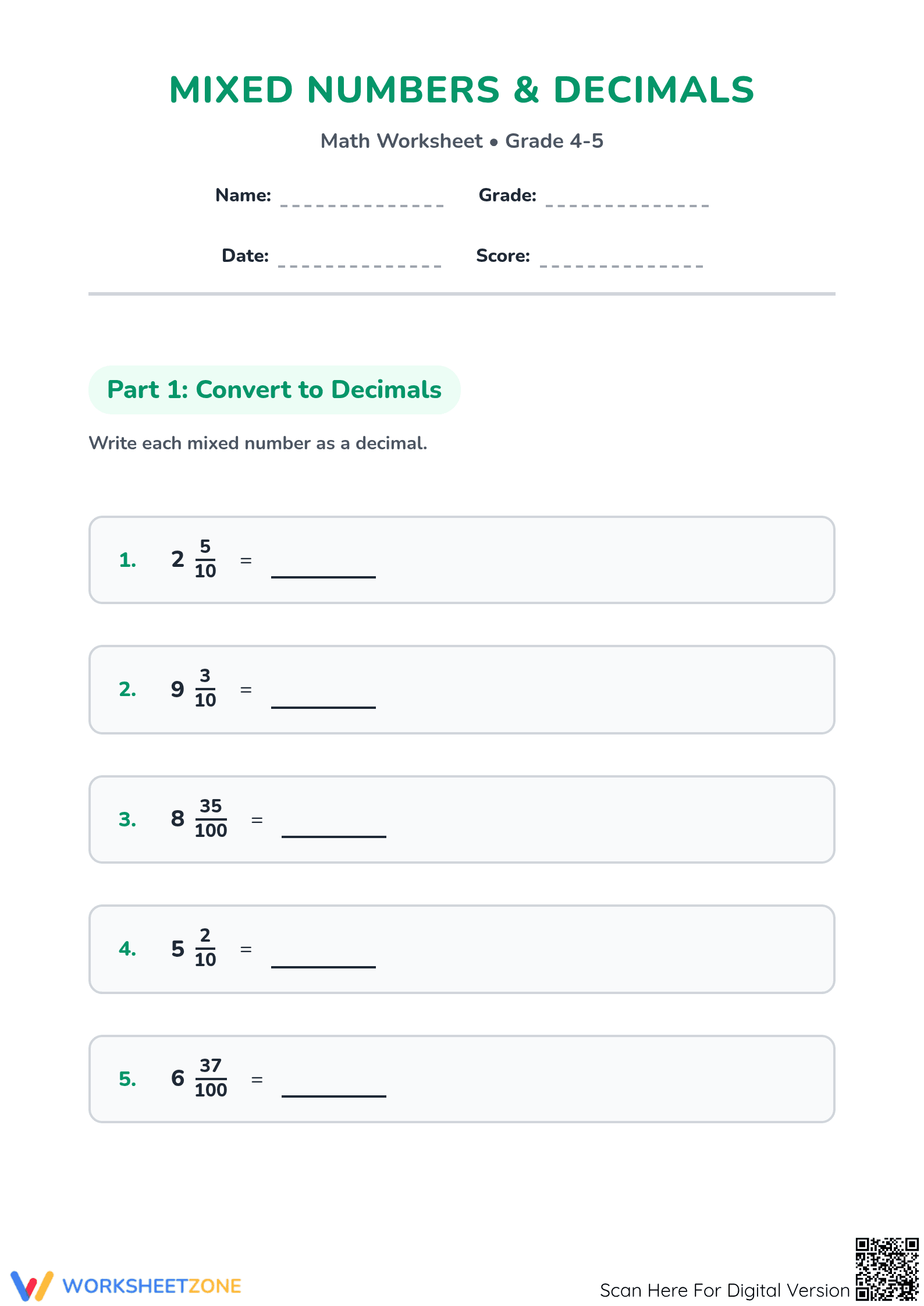
This Grade 4 math worksheet provides comprehensive practice for students mastering the conversion of mixed numbers to decimals. By bridging fractional concepts with decimal notation, learners develop a concrete understanding of place value and numerical relationships. This essential resource ensures students can fluently translate complex fractional forms into precise decimal values for academic success.
At a Glance
- Grade: 4 · Subject: Math
- Standard:
CCSS.MATH.CONTENT.4.NF.C.6— Use decimal notation for fractions with denominators 10 or 100- Skill Focus: Converting mixed numbers to decimals
- Format: 5 pages · 50 problems · Answer key included · PDF
- Best For: Independent practice and decimal mastery
- Time: 25–40 minutes
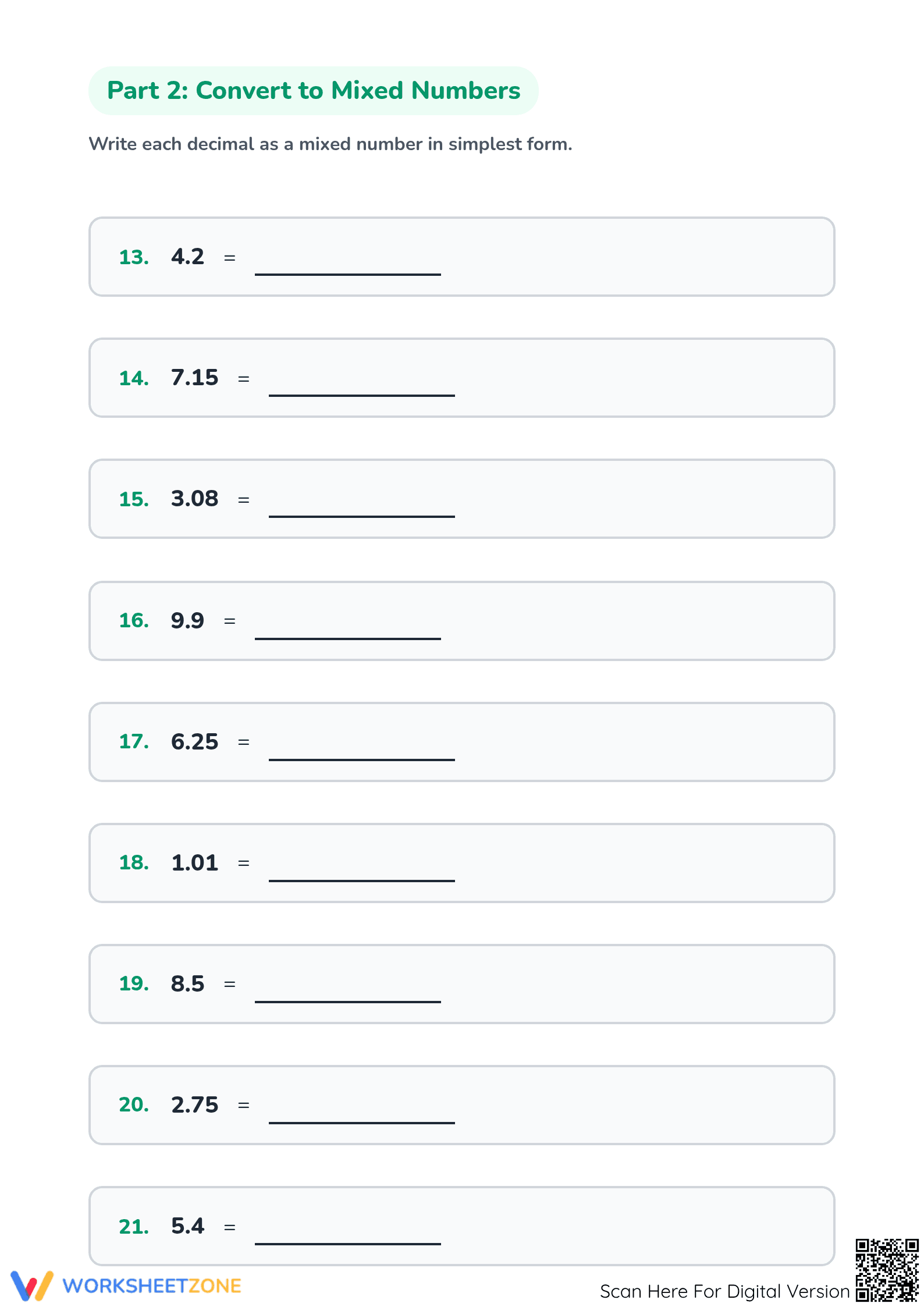
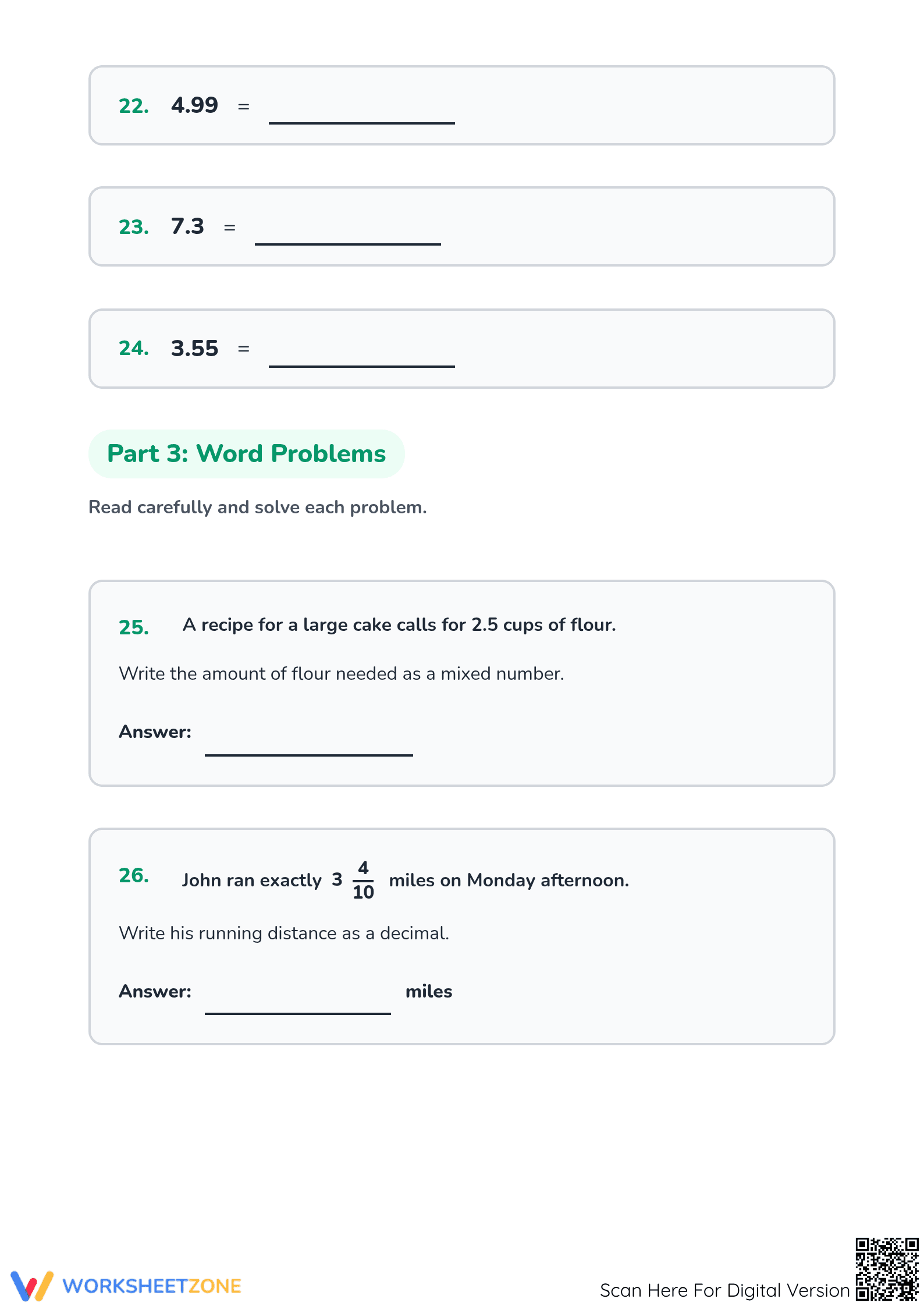
This packet contains five distinct pages of practice, each featuring 10 problems that challenge students to convert mixed numbers into decimal format. The layout is clean and focused, providing ample workspace for student calculations. A full answer key is included at the end of the document, allowing for rapid grading or student self-correction.
Zero-Prep Workflow
Implementing this resource into your math block is efficient and straightforward.
- Print: Select the desired number of copies and hit print (less than 1 minute).
- Distribute: Hand out the five-page packet to students for independent or guided work (30 seconds).
- Review: Use the included answer key to check for accuracy or lead a whole-class review (under 5 minutes). Total preparation time is minimal, making this an ideal choice for emergency sub plans.
Standards Alignment
The primary focus of this worksheet is `CCSS.MATH.CONTENT.4.NF.C.6`. The standard requires students to "use decimal notation for fractions with denominators 10 or 100." This resource extends that skill by requiring students to handle whole numbers alongside fractional parts. This alignment ensures that the material supports district curriculum goals. Both standard codes can be copied directly into lesson plans, IEP goals, or district curriculum mapping tools.
How to Use It
Use this worksheet during the independent practice portion of a lesson on decimal place value. It is effective after students have explored visual models of tenths and hundredths. For a formative-assessment observation tip, watch how students handle the transition from the whole number to the decimal point to ensure they understand the place value of the non-fractional part.
Who It's For
This resource is designed for Grade 4 students and Grade 5 learners needing additional reinforcement in decimal notation. It serves as an excellent support for students who are comfortable with fractions but struggle with decimal placement. Pair this worksheet with a place value anchor chart to provide a visual reference for students as they complete the 50 conversion tasks.
Converting mixed numbers to decimals is a critical milestone in the Grade 4 "Numbers and Operations—Fractions" domain. This worksheet targets the specific cognitive shift required to recognize that mixed numbers and decimals are simply different representations of the same quantity. According to Fisher & Frey (2014), purposeful practice that isolates specific skill transitions—such as moving from fractions to decimals—is vital for building mathematical fluency. The 50 problems provided here offer the repetition necessary to move this skill from guided practice to automaticity. By focusing on denominators of 10 and 100, the worksheet aligns with the foundational requirements of CCSS.MATH.CONTENT.4.NF.C.6. Educators can use the resulting data to identify specific misconceptions regarding place value or fractional equivalence. This evidence-based approach to mathematical drill supports long-term retention and prepares students for the more complex decimal operations introduced in subsequent grades.


