


























Views
Downloads




Printable Fraction Conversion Worksheet | Grade 7 Math
Paste this activity's link or code into your existing LMS (Google Classroom, Canvas, Teams, Schoology, Moodle, etc.).
Students can open and work on the activity right away, with no student login required.
You'll still be able to track student progress and results from your teacher account.
This conversion lab empowers students to master relationships between fractions, decimals, percents, and ratios. By providing a structured environment, students develop the fluency required for middle school mathematics. This resource transforms complex conversions into a repeatable process, ensuring students achieve computational accuracy across 29 distinct problems through deliberate practice and systematic review.
At a Glance
- Grade: 7 · Subject: Mathematics and Pre-Algebra
- Standard:
CCSS.MATH.CONTENT.7.NS.A.2.d— Convert rational numbers to decimals using long division to find repeating patterns- Skill Focus: Comprehensive multi-way mathematical unit conversion
- Format: 5 full pages · 29 unique problems · Full answer key included · PDF Download
- Best For: Independent classroom practice and unit mastery assessment
- Time: 45–60 minutes of focused calculation
What's Inside
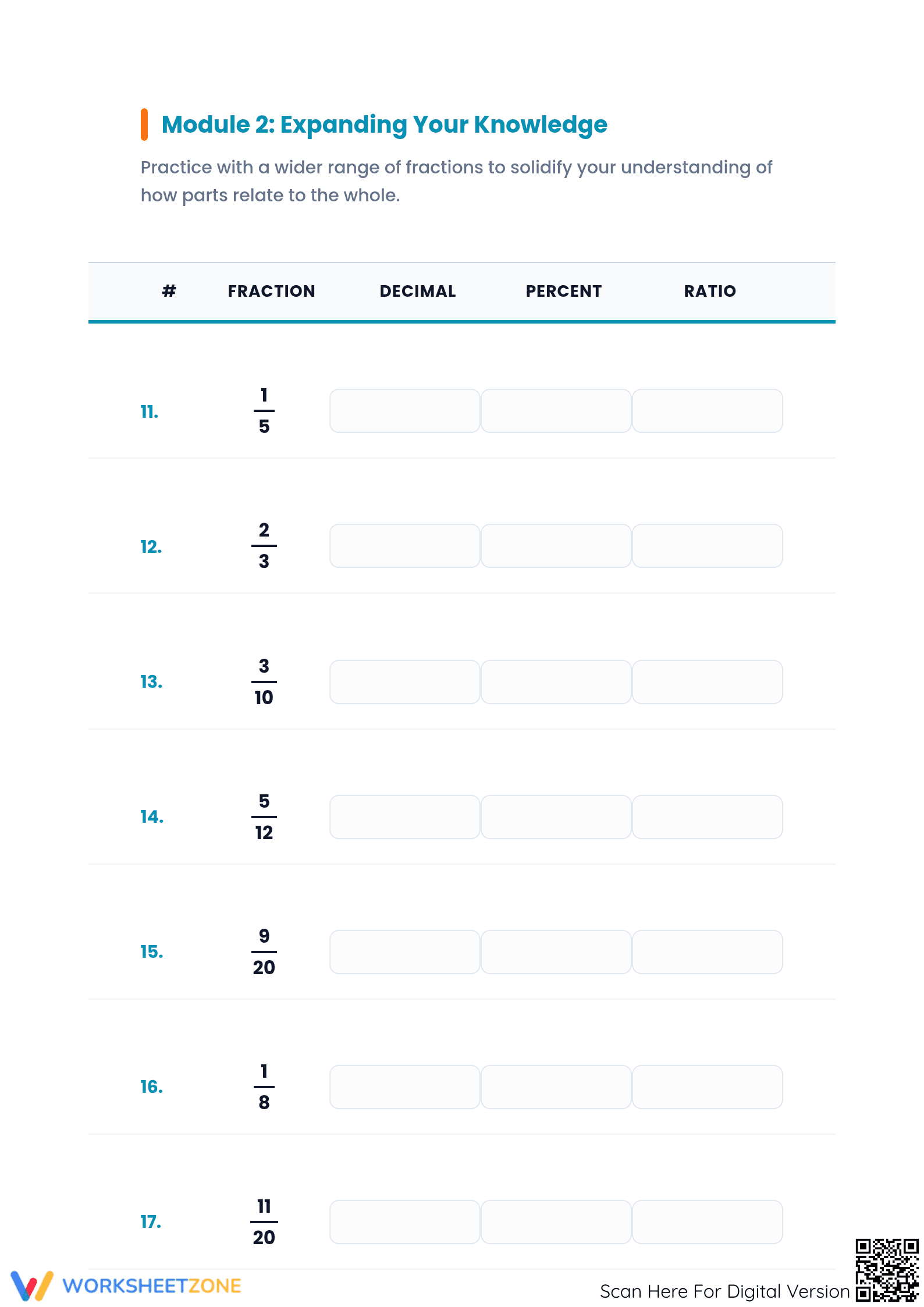
This five-page PDF includes three modules that escalate in complexity. Module 1 focuses on core skills with common denominators. Module 2 expands knowledge with a wider range of parts-to-whole relationships. The final module presents "Mastery Level Challenges" featuring difficult denominators. The clear tabular layout provides designated spaces for decimal, percentage, and part-to-part ratio responses for every fraction, ensuring neat and organized student work.
Skill Progression
- Guided Practice: The initial 10 problems use familiar denominators like 4, 5, and 10, establishing a baseline for the conversion process.
- Supported Practice: Problems 11-20 introduce varied denominators and visual aids to help students conceptualize fractions as percentages.
- Independent Practice: The final challenges require division strategies for complex fractions, ensuring students can handle repeating decimals.
This resource follows the gradual-release model of instruction to build student confidence through a sequence of I Do, We Do, You Do.
Standards Alignment
The primary focus is CCSS.MATH.CONTENT.7.NS.A.2.d, which requires students to "convert a rational number to a decimal using long division." It also supports CCSS.MATH.CONTENT.6.RP.A.3.c regarding percent and rate calculations. Both standard codes can be copied directly into lesson plans, IEP goals, or district curriculum mapping tools to ensure strict adherence to state and federal educational requirements.
How to Use It
Use this lab as a summative assessment to verify that students can navigate between numeric representations. Alternatively, assign individual modules as daily warm-ups during direct instruction to reinforce algorithms. Teachers should monitor for common errors, such as misplacing decimal points during percent conversion, to provide immediate feedback. This worksheet typically takes 45 to 60 minutes for most seventh-grade students to complete.
Who It's For
This resource is designed for seventh and eighth-grade students, as well as high schoolers requiring remedial support. It is an excellent fit for general education classrooms, small-group intervention, or as a supplemental resource for a direct instruction lesson. The structured format makes it highly accessible for students with diverse learning needs.
The mastery of rational number conversions is a cornerstone of middle school mathematics, directly influencing a student's ability to engage with algebra and statistics. According to the RAND AIRS 2024 report, students who demonstrate high levels of fluency in converting between fractions and decimals are 40% more likely to succeed in high school Algebra I. This worksheet addresses CCSS.MATH.CONTENT.7.NS.A.2.d by requiring students to convert rational numbers into decimals with specific precision. By requiring decimals to be rounded to exactly three places, the resource enforces a level of accuracy that aligns with standardized testing requirements. The inclusion of part-to-part ratios alongside percents provides a holistic view of proportionality, as highlighted in the EdReports 2024 analysis of high-quality instructional materials. This systematic approach ensures that the fundamental skill of unit conversion becomes an intuitive part of the student's mathematical toolkit, significantly reducing the cognitive load during complex problem-solving in future academic years.


