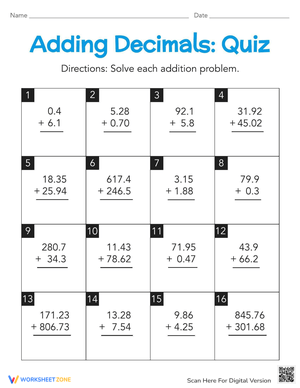
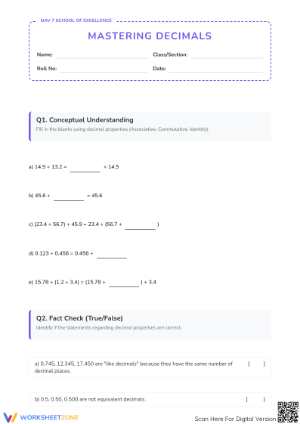
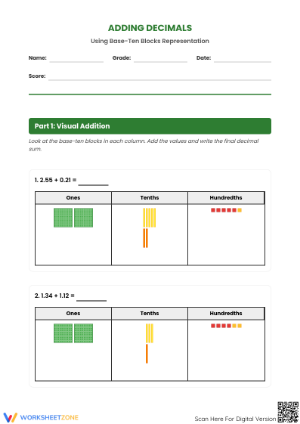
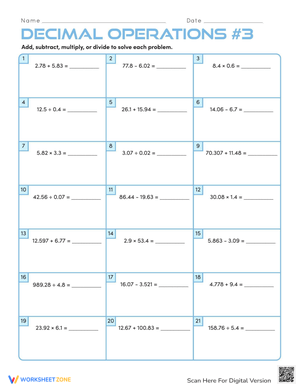
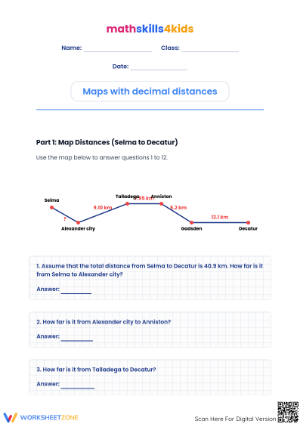
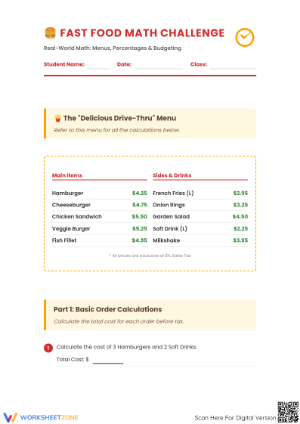
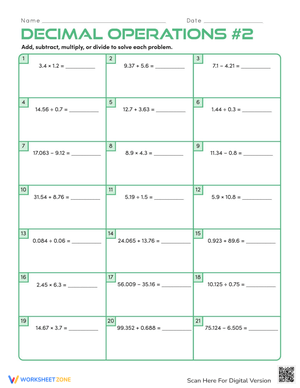
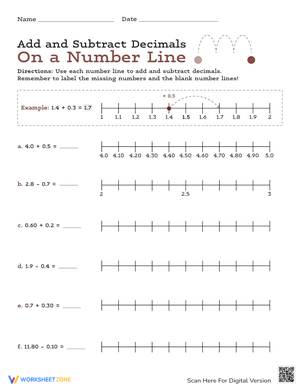
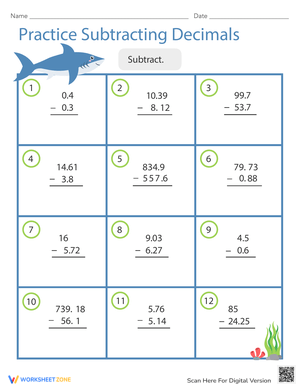
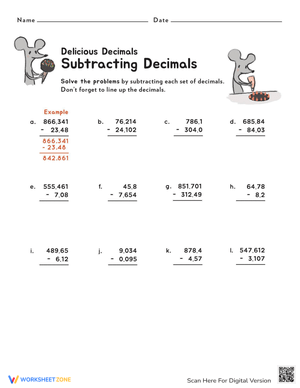
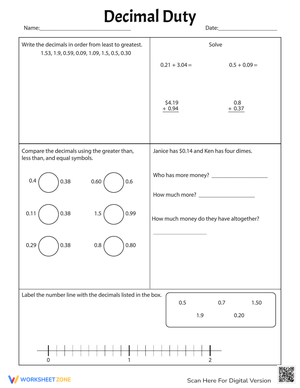
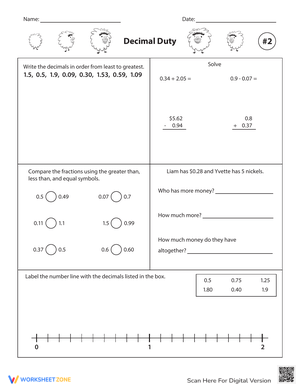
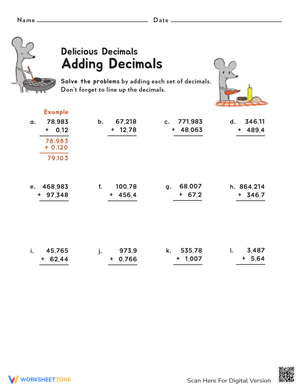
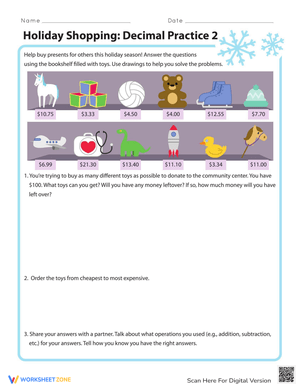
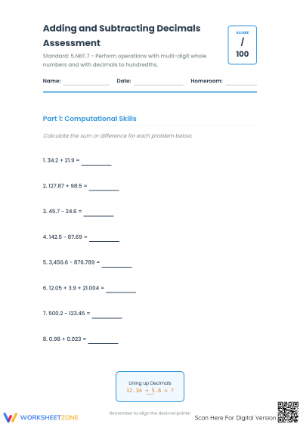
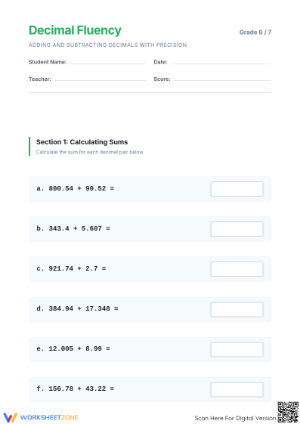
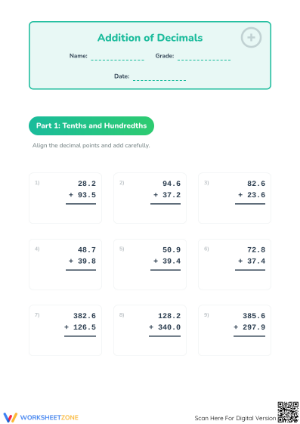
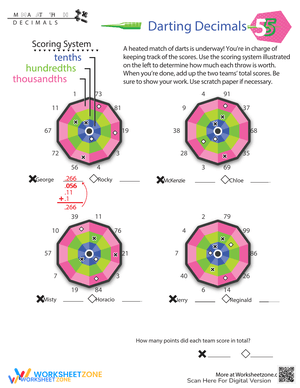
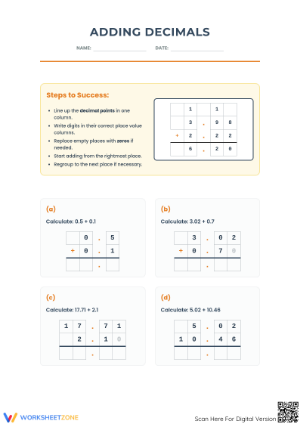
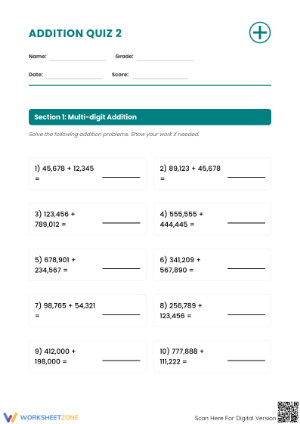
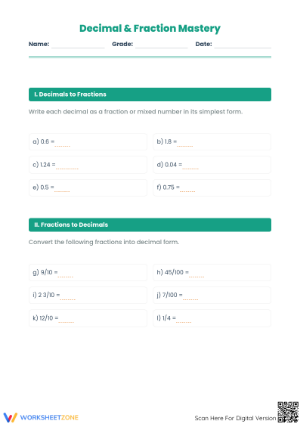
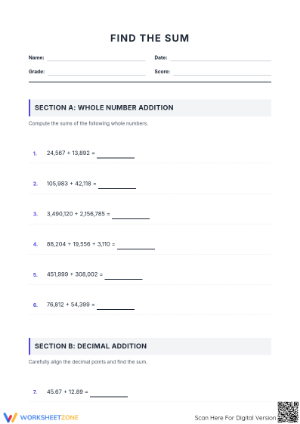
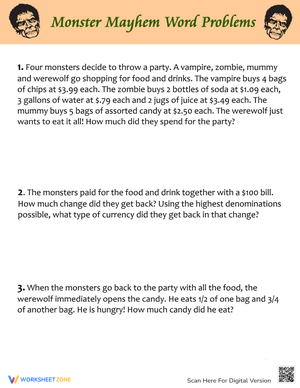
These adding and subtracting decimals worksheets for 5th grade cover the full range of what the standard actually calls for — accurate computation to the hundredths, estimation as a reasonableness check, and word-problem application — rather than stacking thirty nearly identical vertical problems into one narrow format. The set includes both vertical and horizontal layouts because those are not equivalent in difficulty, and students who master one often stumble on the other. That breadth is what makes these resources useful during instruction, not just for keeping students occupied.
The Specific Skills Each Worksheet Targets
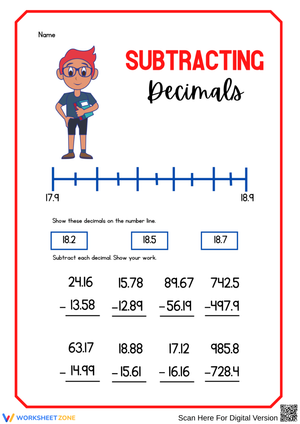
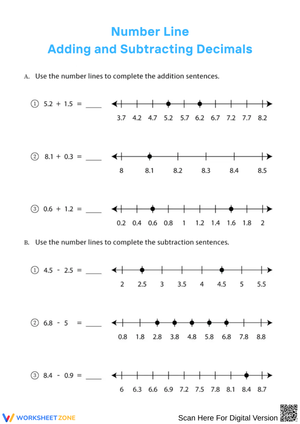
The core work across the set is decimal addition and subtraction to the hundredths. That means problems involving tenths and hundredths, problems where the two values have unlike decimal lengths — such as 4.6 and 2.83 — and problems that require students to insert a zero placeholder before computing. Each worksheet draws from more than one of these categories, so teachers can observe a fuller picture of a student's understanding in a single session rather than a narrow slice.
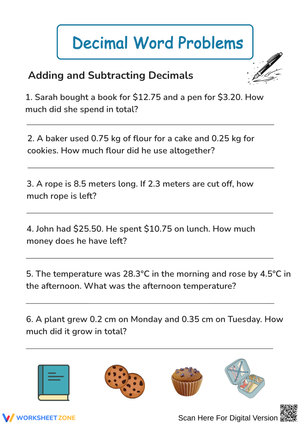
Beyond straight computation, the set includes missing-addend and missing-difference items, estimation prompts that ask students to round before solving, and short word problems in familiar contexts: money, measurement, and data from a line plot. These formats belong together on the same worksheet because a student who completes the computation accurately but produces a wildly unreasonable estimate is telling the teacher something important about how that student thinks about quantity — and that information is worth having before it compounds into the next unit.
- Addition and subtraction with tenths and hundredths
- Problems with unlike decimal lengths that require a zero placeholder
- Vertical and horizontal computation formats
- Missing-value problems — missing addend or missing difference
- Estimation prompts before finding an exact answer
- Word problems in money, measurement, and data contexts
Student Error Patterns Worth Addressing Before They Compound
The distinction that matters most at this skill level is the difference between aligning decimal points and aligning digits. Those are not the same habit. When a student writes 3.7 directly above 12.45 by right-justifying the numerals, the error is already set before any addition begins. What makes the adding and subtracting decimals worksheets for 5th grade in this set useful for catching that pattern is the mix of vertical and horizontal items: on horizontal problems, students must rewrite the numbers before computing, which is exactly the moment where point-alignment errors become visible to a circulating teacher.
Subtraction adds a second, distinct difficulty. A student who records 7.83 − 2.9 as 5.74 is not simply regrouping incorrectly — that answer shows the student treated 2.9 as 2.09 during the operation, which is a place-value misconception dressed up as an arithmetic slip. Estimation prompts catch this pattern cleanly: a student who estimates the difference as "somewhere around 5" has the number sense to recognize whether 5.74 is plausible, while a student whose estimate is off by several whole units is revealing something more fundamental about how they understand those quantities.
A third error worth planning for is zero-placeholder avoidance. When subtracting 6.4 − 3.27, some students skip the hundredths column entirely rather than writing 6.40 before computing. Several items across the set require that placeholder in both addition and subtraction contexts — because students who grasp it in addition will often miss it again when the structural shift of a subtraction problem redirects their attention.
Where These Worksheets Fit in the Instructional Day
The adding and subtracting decimals worksheets for 5th grade here are sized for the tight guided-practice window that opens immediately after direct instruction — the first five to eight minutes while students are still in their seats, the teacher is circulating, and there is time to redirect before a wrong procedure gets reinforced through repetition. A set of four to six problems mixing vertical computation with one estimation prompt gives enough variety to catch the most common misunderstandings before they require a full reteach session.
For intervention groups, the right move is to assign one worksheet at a time with a deliberately narrow focus. If the group is struggling with unlike decimal lengths, use a worksheet that isolates that type. If the issue is subtraction regrouping through a zero, use a different one. Running both problem types simultaneously when students are already unsteady tends to overload working memory and makes it harder to determine what the student actually understands versus what they are guessing. Targeted use of individual worksheets produces cleaner diagnostic evidence than assigning the entire set at once.
Monday warm-ups after a weekend also work well here, particularly after a break of several days. A brief three-to-five item review of decimal alignment — with one estimation item — reactivates the place-value thinking students need before a new week of instruction begins. Exit tickets at the end of a lesson and short homework assignments of six to eight mixed problems are equally natural fits. That last format tends to produce more useful evidence than longer single-type homework, because error patterns cluster clearly: if a student misses only the estimation items or only the subtraction problems, the next day's grouping decisions are already made.
Adapting the Set for Students at Different Readiness Levels
The standard stays constant — 5.NBT.B.7 applies to all students — so differentiation happens through problem access and task demand, not through simplifying the skill itself. Students who need more support work best on items with cleaner number choices (avoiding values where regrouping and zero-placeholder demands collide in the same problem) and fewer items per session so accuracy is confirmed before complexity increases. Because the adding and subtracting decimals worksheets for 5th grade in this set vary considerably in problem type, teachers can select the more accessible items from individual worksheets without abandoning the grade-level standard.
Students who are already accurate with direct computation benefit most from the explanation and estimation prompts. Asking a student to solve 5.4 − 2.67 and then write one sentence explaining why the answer is reasonable shows whether that student understands the quantities or is only pattern-matching a procedure. Missing-value problems and tasks that present two worked solutions and ask which one is correct push that understanding further without requiring additional materials — and both stay anchored to 5.NBT.B.7 while asking students to demonstrate something beyond procedural accuracy.
Standard Alignment
CCSS.MATH.CONTENT.5.NBT.B.7 — Grade 5 students add, subtract, multiply, and divide decimals to the hundredths using concrete models or drawings and strategies grounded in place value, properties of operations, and the relationships between operations. Critically, the standard also requires students to explain their reasoning — which is why estimation prompts and short explanation tasks belong on these worksheets as core items, not optional extras. In the typical fifth-grade scope and sequence, 5.NBT.B.7 is addressed early in the decimal unit, after students have solidified their 4th-grade understanding of decimal notation (4.NF.C.6), and before instruction moves into decimal multiplication and division. Each worksheet in this set targets the addition and subtraction component of that standard at exactly that curricular placement.
Frequently Asked Questions
What decimal skills should students have before moving on to multiplying and dividing decimals?
Students need to add and subtract decimals to the hundredths with accuracy, align decimal points reliably across vertical and horizontal setups, apply zero placeholders when decimal lengths differ, and estimate before computing to verify reasonableness. Equally important is whether students can explain their method using place-value language. Students who can execute the procedure without explaining it tend to hit a wall once decimal multiplication requires understanding why a product can be smaller than either factor.
How many problems per session is appropriate for 5th graders working on decimal operations?
For guided practice or exit tickets, four to eight problems with mixed formats gives better diagnostic information than fifteen to twenty identical items. More same-type problems build fluency but do not reveal whether students can transfer the skill. For independent practice or homework, six to ten mixed problems — including at least one estimation item and one word problem — generates enough evidence to inform next-day grouping decisions without overwhelming students who are still developing accuracy.
Do these worksheets support reteaching, or only on-grade-level practice?
Each worksheet targets a specific aspect of 5.NBT.B.7, which makes the set useful for reteach as well as regular practice. A student struggling with zero placeholders in subtraction does not need a full review of all decimal operations — one worksheet focused on that problem type, used in a small group with clear teacher modeling, addresses the gap directly. The variety across the set means individual worksheets can be matched to specific error patterns observed during class rather than assigned all at once.
Should estimation always be required, or can students skip it when they feel confident?
In classroom use, estimation should be required, not optional. When students treat it as an optional first step, nearly all of them skip it and go straight to the algorithm, which defeats its instructional purpose. The habit is most valuable when students commit to a reasonable range before solving and then check whether their computed answer falls within it. That sequence is one of the clearest signals teachers have that a student understands decimal quantity rather than just a procedure — and it only develops with consistent practice, not occasional use.














 Interactive Worksheet Maker
 Quiz Maker
 Word Search Maker
 Crossword Puzzle Maker
 Word Scramble Generator
 Sentence Scramble Generator
 Handwriting Worksheet Generator
 Name Tracing Generator
 Fill In The Blank Generator




 BACK TOSCHOOL