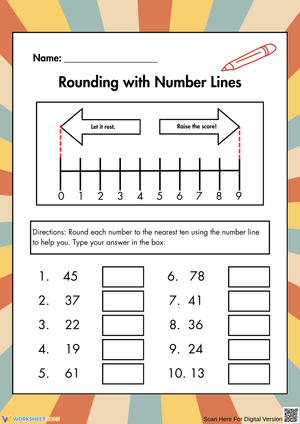
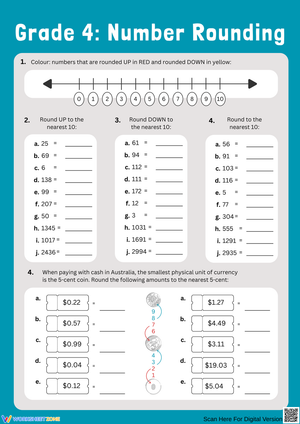
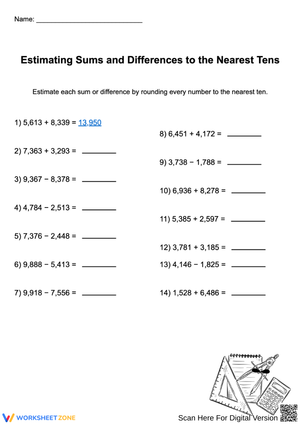
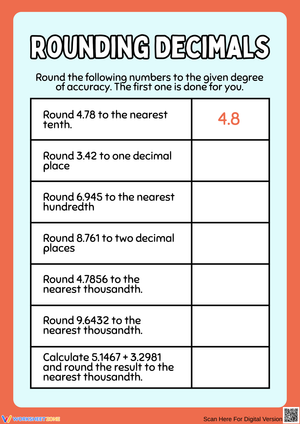
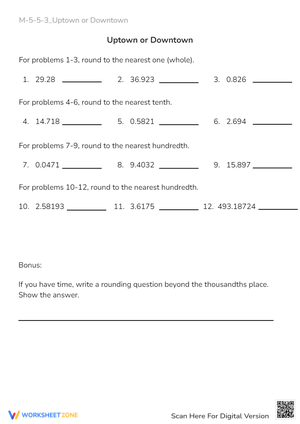
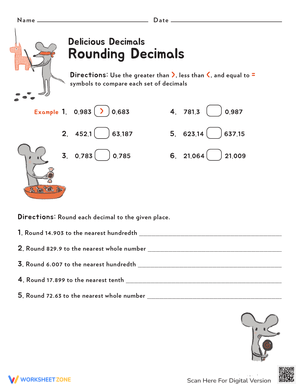
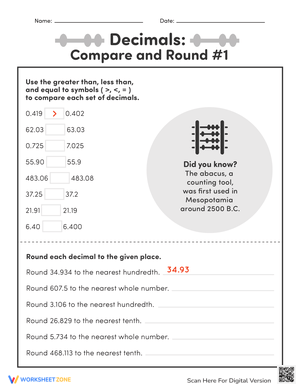
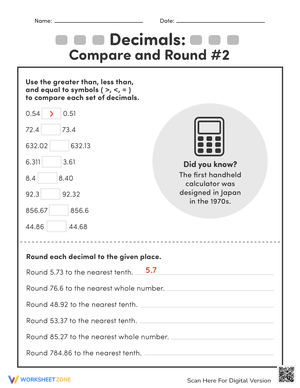
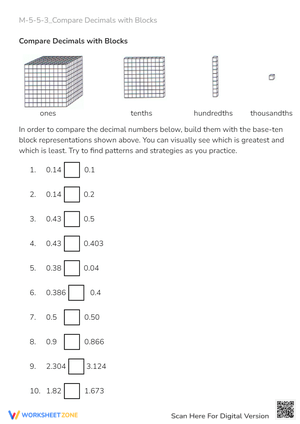
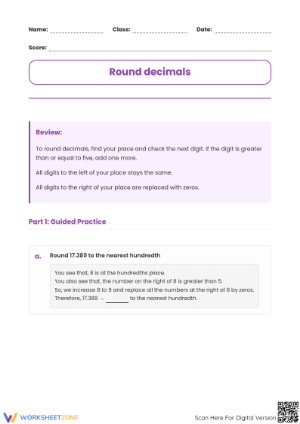
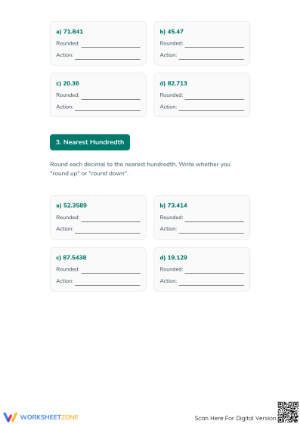
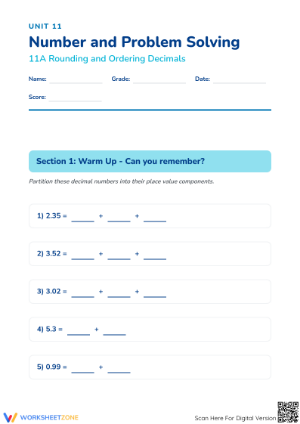
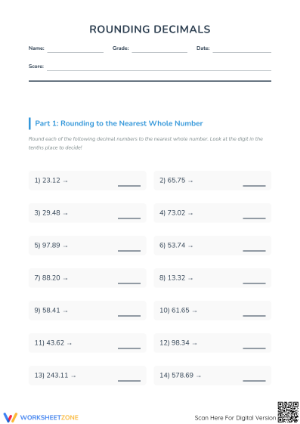
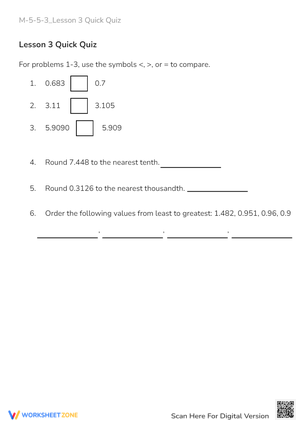
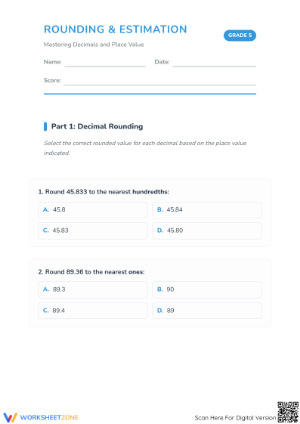
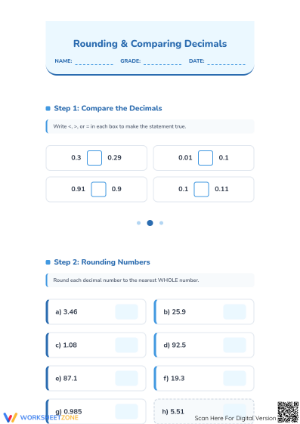
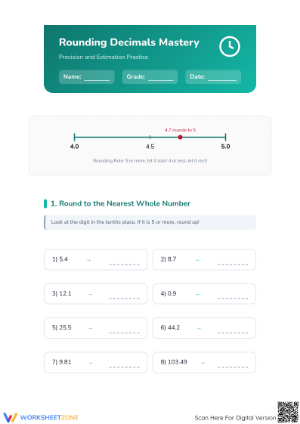
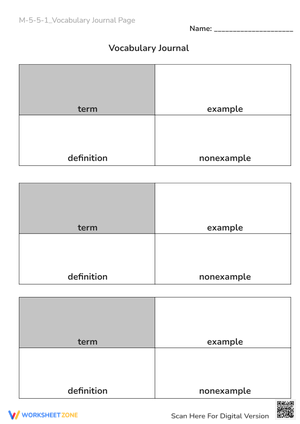
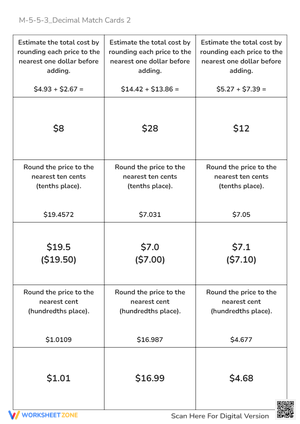
These rounding decimals worksheets for 5th grade target the three place-value checkpoints grade 5 students work through most directly: the nearest whole number, the nearest tenth, and the nearest hundredth. Each worksheet prints cleanly, runs enough problems for real repetition, and includes answer support so checking during centers or a reteach block stays efficient. The set moves from focused, single-target practice into mixed review and short application items — the full arc teachers need to track skill development across a unit.
What's Inside the Set
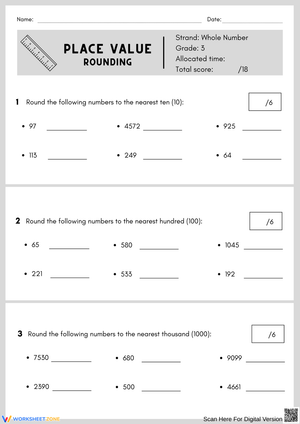
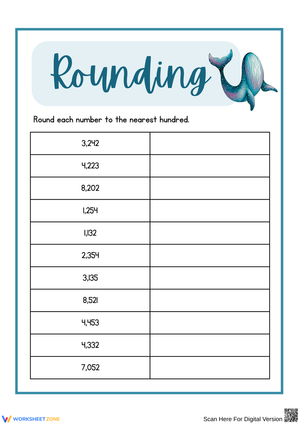
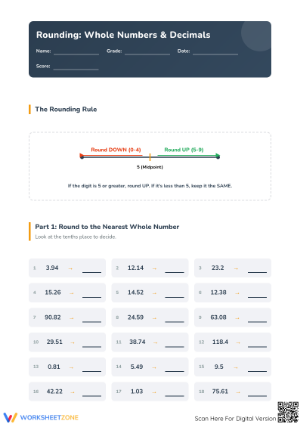
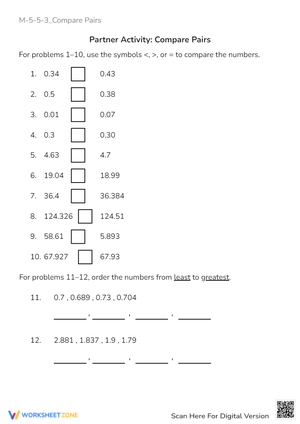
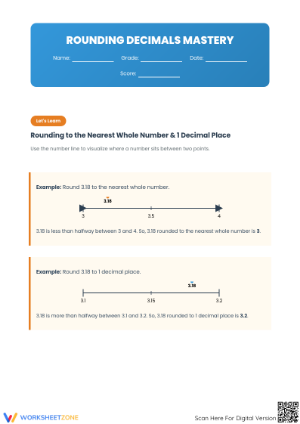
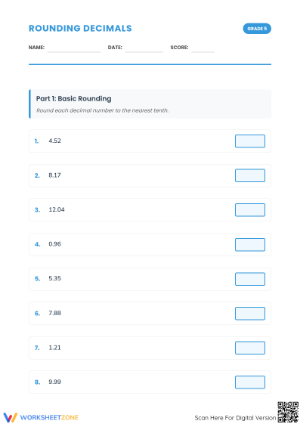
The worksheets divide naturally into a progression. Earlier worksheets ask students to round to a stated place using clearly formatted number lists. That direct practice matters because students who cannot yet isolate the correct digit need repetition before encountering more complex formats. Later worksheets mix the rounding targets — whole number, tenth, hundredth — within the same set of problems, which is where genuine reasoning shows up. A student who handles a sorted list confidently may still slow down when the target changes every few rows.
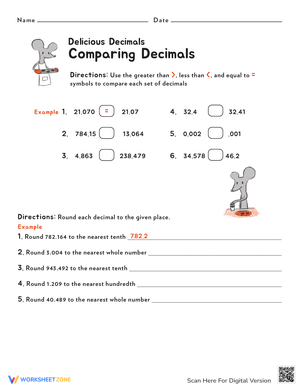
Some worksheets include a small number of word problems or compare-and-round items. Those are not extras — they serve a diagnostic function. A student who rounds 3.67 to the nearest tenth without hesitation may still read "which measurement rounds to 4.5?" as a completely different kind of task. That gap tells a teacher more than any right-or-wrong tally.
- Nearest whole number practice: Students connect decimal parts to benchmark integers and build intuition for magnitude.
- Tenths-focused worksheets: Precision work begins here. Students must track the hundredths digit to make the correct decision at the tenths place.
- Hundredths-focused worksheets: Adds one more layer of attention. Errors at this level usually reveal place-position confusion, not process confusion.
- Mixed-target review: Students reason across place values instead of executing the same move repeatedly.
- Application items: Short word problems and comparison tasks that show whether rounding has moved from procedure to understanding.
Mistakes Students Make That These Worksheets Help You Catch
The most telling error in grade 5 rounding is the place-position slip: a student who rounds 6.284 to 6.3 when the problem asks for the nearest hundredth is not failing the rounding rule — the student is misidentifying which digit holds the hundredths value. That mistake looks identical on a right-or-wrong record to a student who simply guessed, but it points to a different instructional need. Deliberately mixing target places within the mixed-review sections surfaces that confusion in a way that a single-target practice set never does.
A second common error involves the digit 5. Students who have internalized "5 rounds up" sometimes apply that rule too broadly. When asked to round 4.850 to the nearest tenth, they round to 4.9 — correct — but then explain that "the 5 always goes up." That reasoning breaks down at the hundredths level when the context shifts slightly. Worksheets that include numbers ending in 5 at several different positions give teachers real data on whether students are reasoning or pattern-matching.
Smart Ways to Work These Worksheets Into Your Week
Short and repeated works better than long and occasional for this skill. One reliable structure: use one worksheet as a five-minute warm-up on Monday to reactivate place value vocabulary, run a second worksheet during math workshop time midweek with partner comparison, and pull a mixed-review worksheet on Friday as a quick exit check before moving to the next unit focus. That spacing gives students three distributed encounters with the same skill without consuming an entire lesson on rounding alone.
For intervention blocks, assign worksheets by target place. If a student is still uncertain about tenths, there is no value in sending hundredths work home. Narrow the task, listen to the student's language during a brief check-in — are they correctly naming the place they are inspecting? are they moving to the digit on the right? — and then introduce hundredths work once the tenths reasoning is stable. These rounding decimals worksheets for 5th grade are organized so that intervention teachers can pull exactly what a student needs without trimming or adapting a larger packet.
For centers, the most effective protocol is also the simplest: students complete the worksheet, compare answers with a partner, and then explain their reasoning on at least two problems aloud. That verbal component keeps the skill from becoming purely mechanical. For homework, a focused worksheet travels well — families can usually read the task format even without deep math vocabulary, which reduces the frustrated-kid-at-the-table-at-night problem.
Standard Alignment
Common Core State Standards for Mathematics — 5.NBT.A.4 asks fifth graders to use place value understanding to round decimals to any place. That standard sits inside the Number and Operations in Base Ten domain, which in grade 5 extends place value work to the thousandths. Rounding is the procedural application of that understanding: students must know what a place means before they can make the round-up or stay-the-same decision accurately. The worksheets address the standard at the whole number, tenth, and hundredth levels — the places most consistently assessed and most directly connected to the rest of 5th grade decimal work, particularly addition and subtraction of decimals where place-value control matters just as much.
Adjusting the Worksheets for a Range of Learners
Students who are still building place value confidence with decimals benefit from working the single-target worksheets before mixing targets. That is not a slower track — it is the right sequence. Pairing those worksheets with a place-value chart students keep at their desk gives them a reference to consult without requiring teacher intervention on every problem. Once they are making correct decisions independently on tenths, moving to hundredths follows naturally.
For students who have the procedure but are ready for harder thinking, the application items in the mixed-review worksheets are the right entry point. Ask those students to write a second acceptable answer — a number that would also round to the same value — or to create their own compare-and-round problem. Both tasks require reasoning backwards from a rounded value, which is a meaningfully different cognitive job than rounding forward. The rounding decimals worksheets for 5th grade that include those problem types give advanced students something to work with beyond finishing early and waiting, and the student-generated problems often become useful discussion material for the whole class.
Frequently Asked Questions
Which decimal places should 5th graders be rounding to?
The standard expectation at grade 5 is whole numbers, tenths, and hundredths — though 5.NBT.A.4 technically covers rounding to any place. For most classroom units, tenths and hundredths get the most instructional time because those are the places students encounter in measurement, money, and later decimal computation work.
Do these worksheets include answer keys?
Yes. Answer support is built into the set. During centers or intervention, quick answer-checking matters — a paraprofessional running a small group should not have to stop and verify each answer manually. Having keys also makes the worksheets more practical for substitute teachers and families reviewing homework.
How do I know when a student is ready to move from tenths to hundredths?
Use error type as the signal, not completion. If a student finishes a tenths worksheet but is consistently misidentifying the place position — rounding to the wrong digit rather than making minor arithmetic slips — that student needs another round of guided practice before moving forward. A student who makes two or three errors clearly caused by rushing is in a different category than one making the same place-position mistake across six problems.
Can these worksheets double as test prep?
The rounding decimals worksheets for 5th grade that include word problems and mixed-target items align well with the kinds of decimal tasks that appear on standardized assessments. Assessments rarely present rounding in clean, sorted lists — they embed it in measurement or number sense questions. Using mixed-review worksheets in the weeks before testing gives students exposure to those formats without turning every lesson into test practice.














 Interactive Worksheet Maker
 Quiz Maker
 Word Search Maker
 Crossword Puzzle Maker
 Word Scramble Generator
 Sentence Scramble Generator
 Handwriting Worksheet Generator
 Name Tracing Generator
 Fill In The Blank Generator




 BACK TOSCHOOL