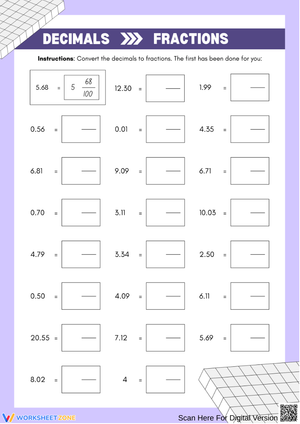
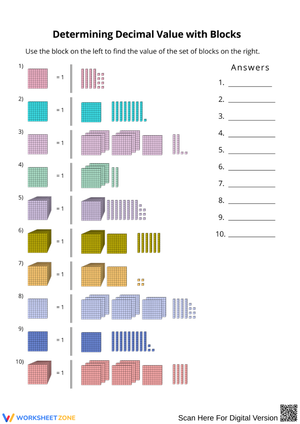
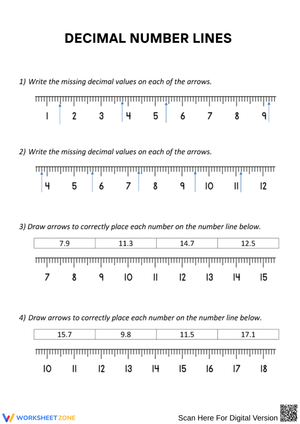
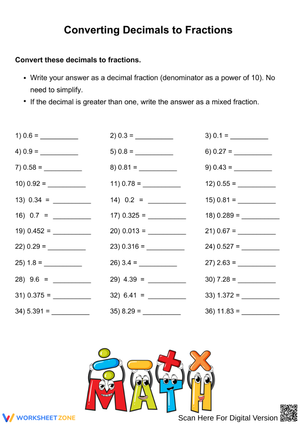
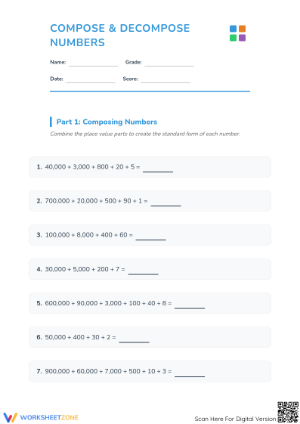
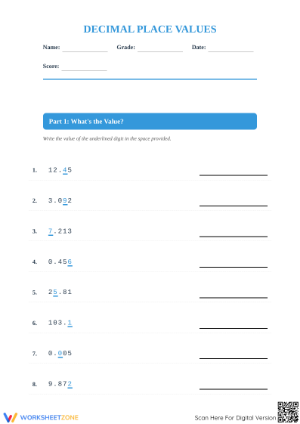
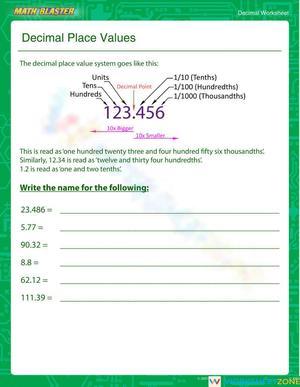
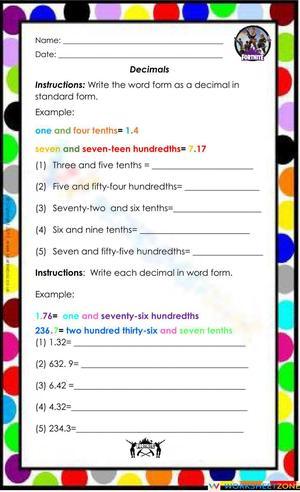
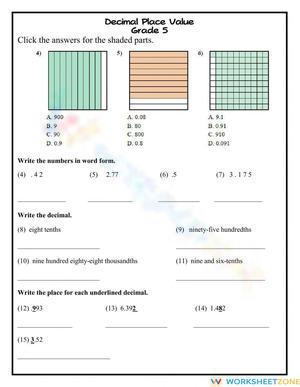
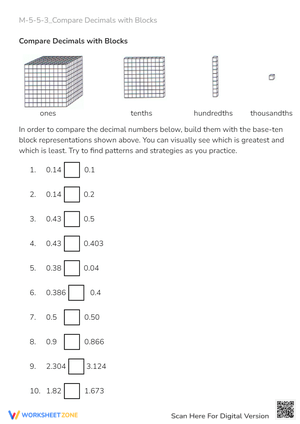
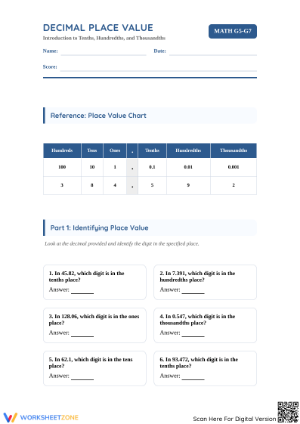
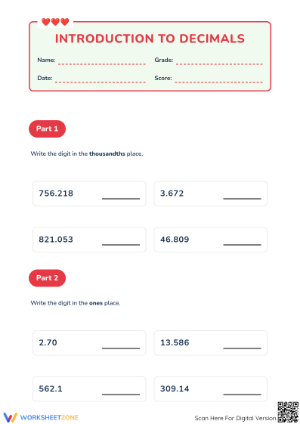
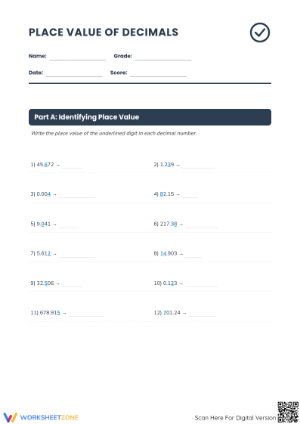
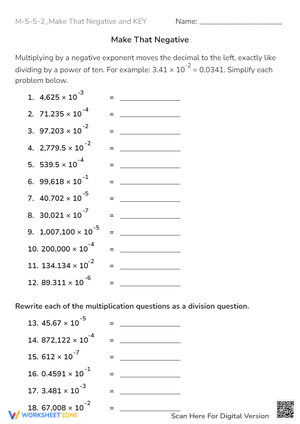
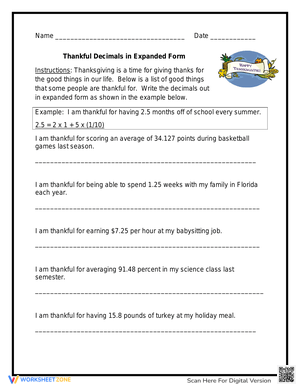
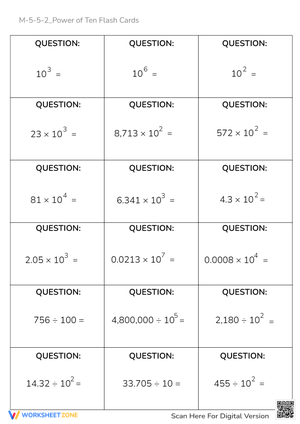
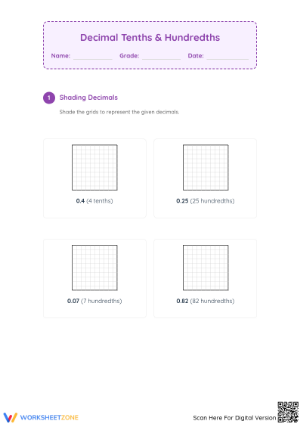
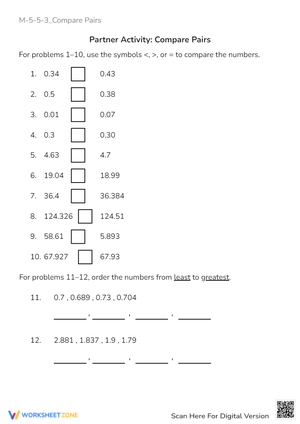
These 5th grade decimal place value worksheets resources give fifth-grade teachers print-ready practice across the full scope of CCSS 5.NBT.A.3 — reading, writing, and comparing decimals through the thousandths. The set addresses all three decimal representations students are expected to control: standard form, word form, and expanded form using both fraction and decimal notation.
The Three Representations Students Work Through
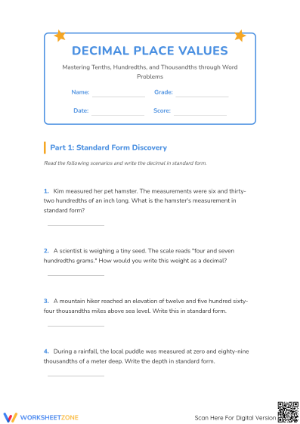
Standard form is the most familiar starting point — students see 0.725 and recognize it as a decimal without much trouble. Word form is where the real conceptual work begins. Writing "seven hundred twenty-five thousandths" or "three and forty-five hundredths" requires students to track what the decimal point signals, apply the correct place value names to the right of it, and use "and" accurately to mark the decimal's position. That word gets dropped constantly, particularly when students have developed the habit of saying "three point four five" out loud — a reading shortcut that sounds natural but produces an incorrect written form on any assessment.
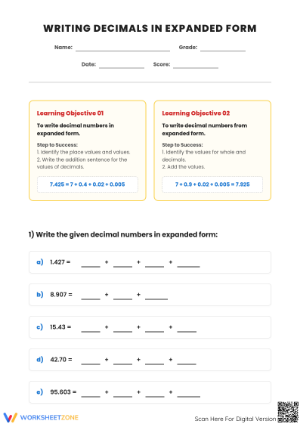
Expanded form is the most revealing of the three. Writing (7 × 0.1) + (2 × 0.01) + (5 × 0.001) — or its fraction equivalent — forces students to state what each digit is actually worth rather than just name its position. Many students can locate a digit in a place value chart correctly but cannot write its value as a multiplication expression, which signals that the understanding is positional rather than quantitative. Some worksheets run the standard-to-all-three-forms direction. Others run the reverse: given an expanded expression, write the standard numeral. That second direction separates students who understand the base-ten structure from those who have practiced a memorized sequence.
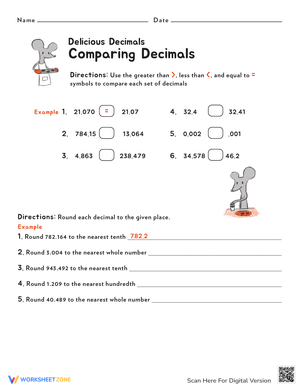
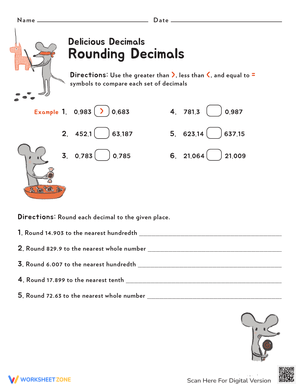
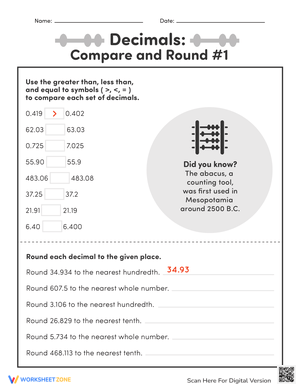
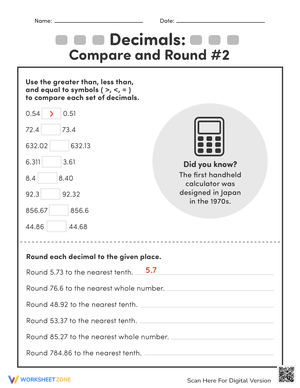
Comparing and ordering work makes up the third category. Students mark greater than or less than between decimal pairs and sort sets of four to six decimals from least to greatest. Each worksheet in this group includes a place value chart as a structural anchor — students who use it consistently make significantly fewer column-alignment errors than those who try to compare mentally before the logic is internalized.
Errors That Show Up Even After Initial Instruction
The most persistent mistake is what teachers sometimes call the "longer means larger" error. A student who has correctly labeled digits on a place value chart will still mark 0.385 as greater than 0.4 because 385 looks like a bigger number than 4. This is not carelessness — it is the whole-number comparison strategy being applied in a context where it fails. It persists even after direct correction, which is why the comparing worksheets include pairs specifically constructed to trigger it. Seeing the error during independent practice gives teachers a chance to address it before it costs students points on a unit test.
Expanded form produces a second, harder-to-anticipate category of mistake. Students regularly reverse the place value multipliers for decimal positions, writing (3 × 1) + (4 × 10) + (5 × 100) for 3.45 — carrying over the whole-number pattern where places to the left have larger multipliers. The fraction version compounds this: students will correctly write 4/10 for the tenths digit and then write 5/10 for the hundredths digit, copying the denominator rather than advancing it. Worksheets that present a partially completed expanded expression with one term missing isolate that specific error very cleanly.
Word form has a quieter error pattern. Students who write "three forty-five hundredths" instead of "three and forty-five hundredths" are not making a transcription slip — they are showing that they do not understand what "and" marks. Each word form worksheet asks students to produce the form in writing, not just circle the correct version from options, because active production makes the missing "and" visible in a way that recognition tasks do not.
Building These Worksheets Into Your Lesson Sequence
The most reliable placement is as a pre-instruction probe. On the day before you introduce expanded form, give students six problems from that worksheet — no instruction, no worked examples. Collect them and look at the results that evening. That five-minute step tells you which students already have partial understanding of place value notation, which have fundamental misconceptions worth naming explicitly in the lesson, and which will need the fraction version addressed as a separate discussion. It removes guesswork from pacing decisions.
Exit tickets are the other natural home. The comparing and ordering exercises work especially well at the end of a lesson — a quick scan of exit tickets from those problems tells you whether the class is ready to move toward decimal addition or needs another day on comparison before that door opens. Six well-chosen problems from one worksheet give you more actionable data in the final four minutes of class than a full-period review day.
For homework, the standard and word form exercises travel better than expanded form. Students can convert between those two representations at home with reasonable independence. Using a 5th grade decimal place value worksheets resource selectively for homework — assigning what students can genuinely self-monitor rather than exercises that invite twenty minutes of undetected error — keeps the practice productive on both ends.
Standard Alignment
These worksheets address CCSS 5.NBT.A.3, which requires students to read, write, and compare decimals to thousandths using base-ten numerals, number names, and expanded form, and to compare decimal pairs using greater than, less than, and equal to notation. The standard appears early in the Grade 5 sequence for a reason: the place value fluency it builds is a prerequisite for the decimal multiplication and division work under 5.NBT.B.7. Teachers who use a 5th grade decimal place value worksheets set during the fall place value unit can identify students whose understanding is fragile before those students reach decimal operations — where the same gap shows up looking like a computation problem rather than a place value problem. Catching it in October is far less disruptive than reteaching it in February.
Adjusting the Work for a Range of Learners
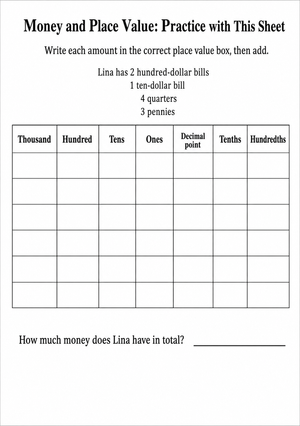
Students who are still unsteady on whole-number place value benefit from a constrained start. The place value chart worksheets let a teacher fold or cover the decimal columns — tenths, hundredths, thousandths — and have students work only in the whole-number section first. Once that section feels solid, uncover one decimal column at a time. That gradual expansion of the task keeps cognitive demand at a workable level without altering the structure of the problem or requiring a different worksheet entirely.
Students who move through the basic conversion exercises quickly need a different kind of challenge. The fraction notation version of expanded form — (7 × 1/10) + (2 × 1/100) + (5 × 1/1000) — is harder than the decimal multiplier version and reveals a deeper layer of understanding. Beyond that, asking students to generate their own comparison problems — write a decimal that is greater than 0.56 but less than 0.6 — is deceptively difficult. Students who answer that question fluently understand the density of the decimal number line in a way that no fill-in-the-blank exercise can confirm on its own.
Frequently Asked Questions
What does each worksheet in the set focus on?
Each worksheet targets a specific skill within 5.NBT.A.3: standard form identification, word form writing and reading, expanded form using decimal or fraction notation, place value chart completion, decimal comparison using greater than and less than symbols, or ordering sets of decimals from least to greatest. The skill separation lets teachers assign exactly what a lesson or intervention session calls for rather than printing exercises that cover ground students do not need to revisit.
How do these resources work for small-group intervention?
The structure makes targeted intervention straightforward. Because each worksheet covers one skill type rather than combining several at once, a teacher running a small group on expanded form can pull just that worksheet and nothing else. The 5th grade decimal place value worksheets format means reprinting a single worksheet takes under a minute — if a group needs a second round on the same skill, that is not a logistical obstacle.
What do students find hardest about working in the thousandths place?
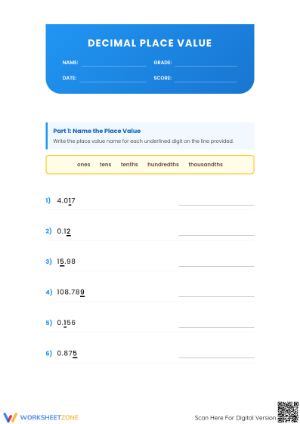
Locating the thousandths column is not the hard part — three places to the right of the decimal point is a rule students learn quickly. What breaks down is matching the digit to its full place value name under time pressure. The three suffixes — tenths, hundredths, thousandths — blur together in student writing, particularly in word form and in the denominator of expanded fraction expressions. Worksheets that require students to write both the digit and its complete place value name on the same problem line — rather than only one or the other — are the ones that close that gap most consistently.
Do these worksheets work alongside hands-on place value models?
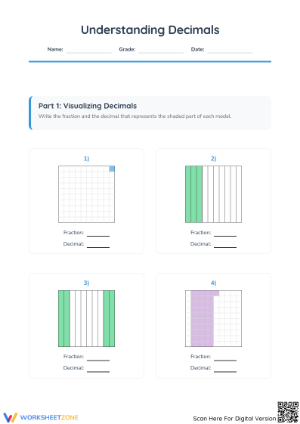
They pair well with physical models. If you are using a meter stick where the full length represents one whole — each decimeter a tenth, each centimeter a hundredth, each millimeter a thousandth — students who hold that visual before sitting down with a worksheet carry a concrete reference that keeps the notation grounded. The abstract expressions on each worksheet become easier to interpret when students have a physical sense of how much smaller a thousandth is relative to a tenth.














 Interactive Worksheet Maker
 Quiz Maker
 Word Search Maker
 Crossword Puzzle Maker
 Word Scramble Generator
 Sentence Scramble Generator
 Handwriting Worksheet Generator
 Name Tracing Generator
 Fill In The Blank Generator




 BACK TOSCHOOL