


























Views
Downloads

Printable Fraction to Decimal Worksheet | Grade 4 Math
Paste this activity's link or code into your existing LMS (Google Classroom, Canvas, Teams, Schoology, Moodle, etc.).
Students can open and work on the activity right away, with no student login required.
You'll still be able to track student progress and results from your teacher account.
Mastering the transition between fractional and decimal representations is a cornerstone of upper elementary mathematics. This Grade 4 worksheet provides students with a clear pathway to convert fractions into decimals by first expressing them as equivalent hundredths. By bridging this gap, learners build a deeper understanding of place value and base-ten numerical structures.
At a Glance
- Grade: 4 · Subject: Math
- Standard:
CCSS.MATH.CONTENT.4.NF.C.6— Express fractions with denominators of 100 as decimals using place value- Skill Focus: Fraction to decimal conversion
- Format: 5 pages · 24 problems · Answer key included · PDF
- Best For: Independent practice and decimal mastery
- Time: 25–35 minutes
What's Inside
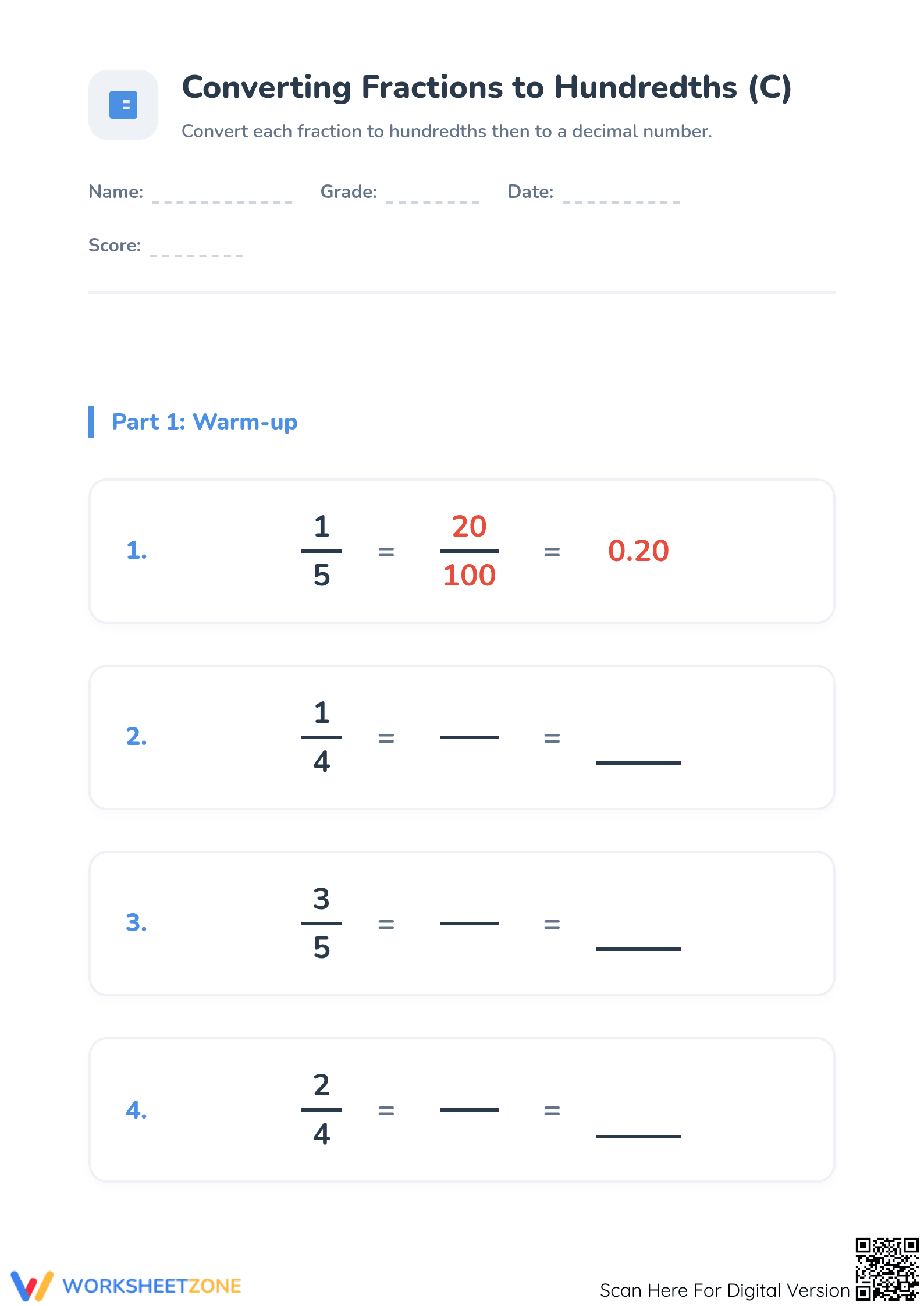
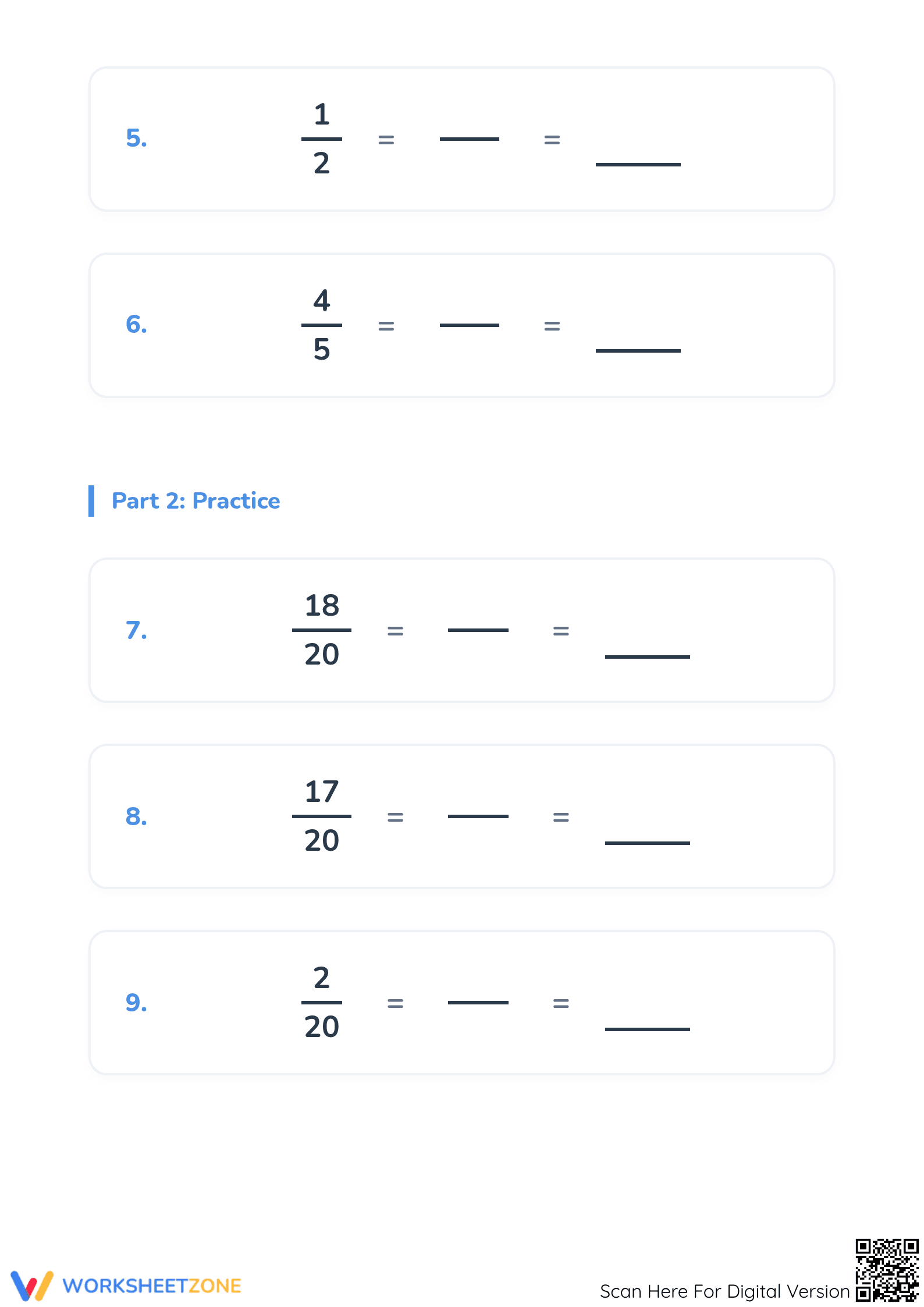
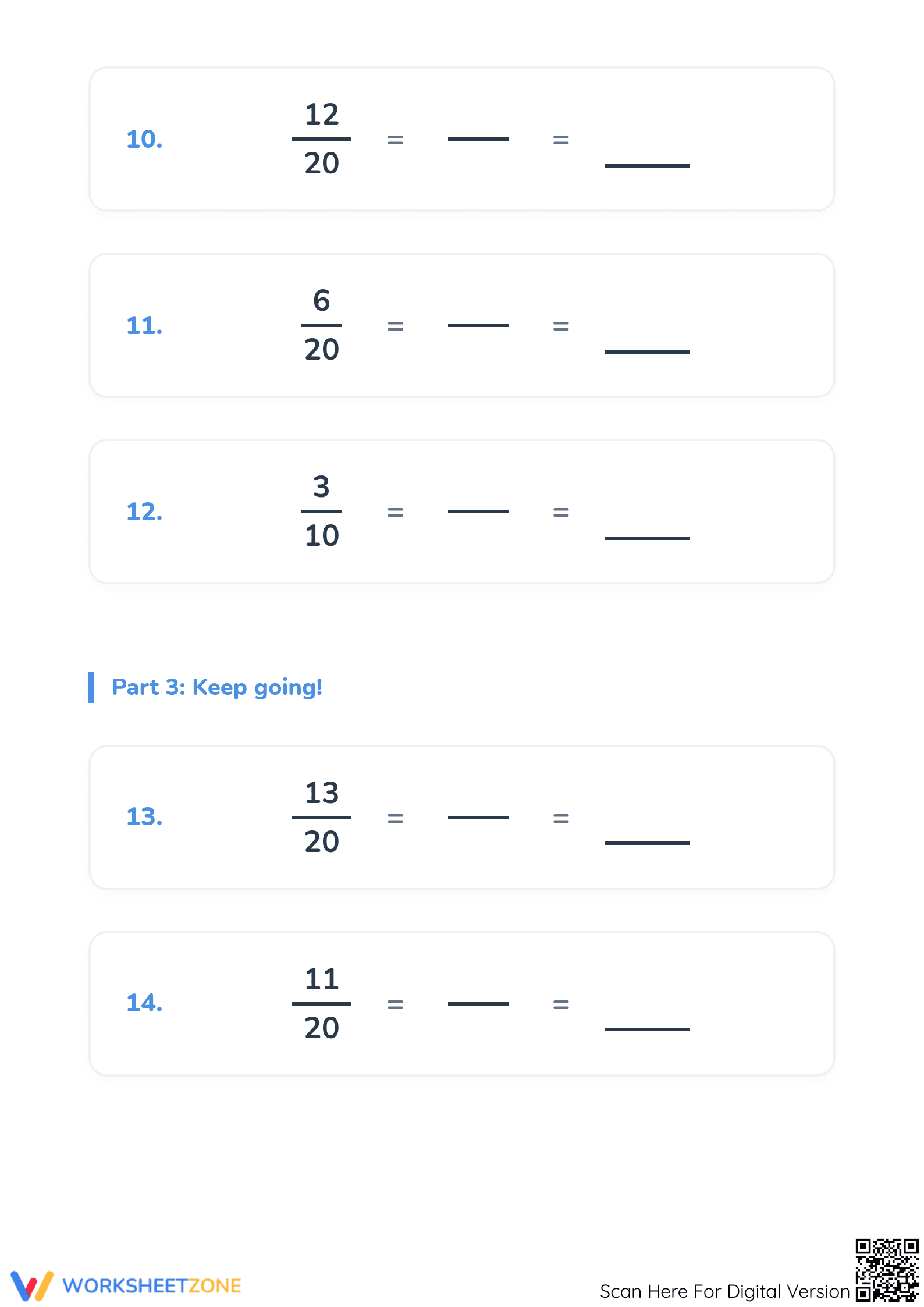
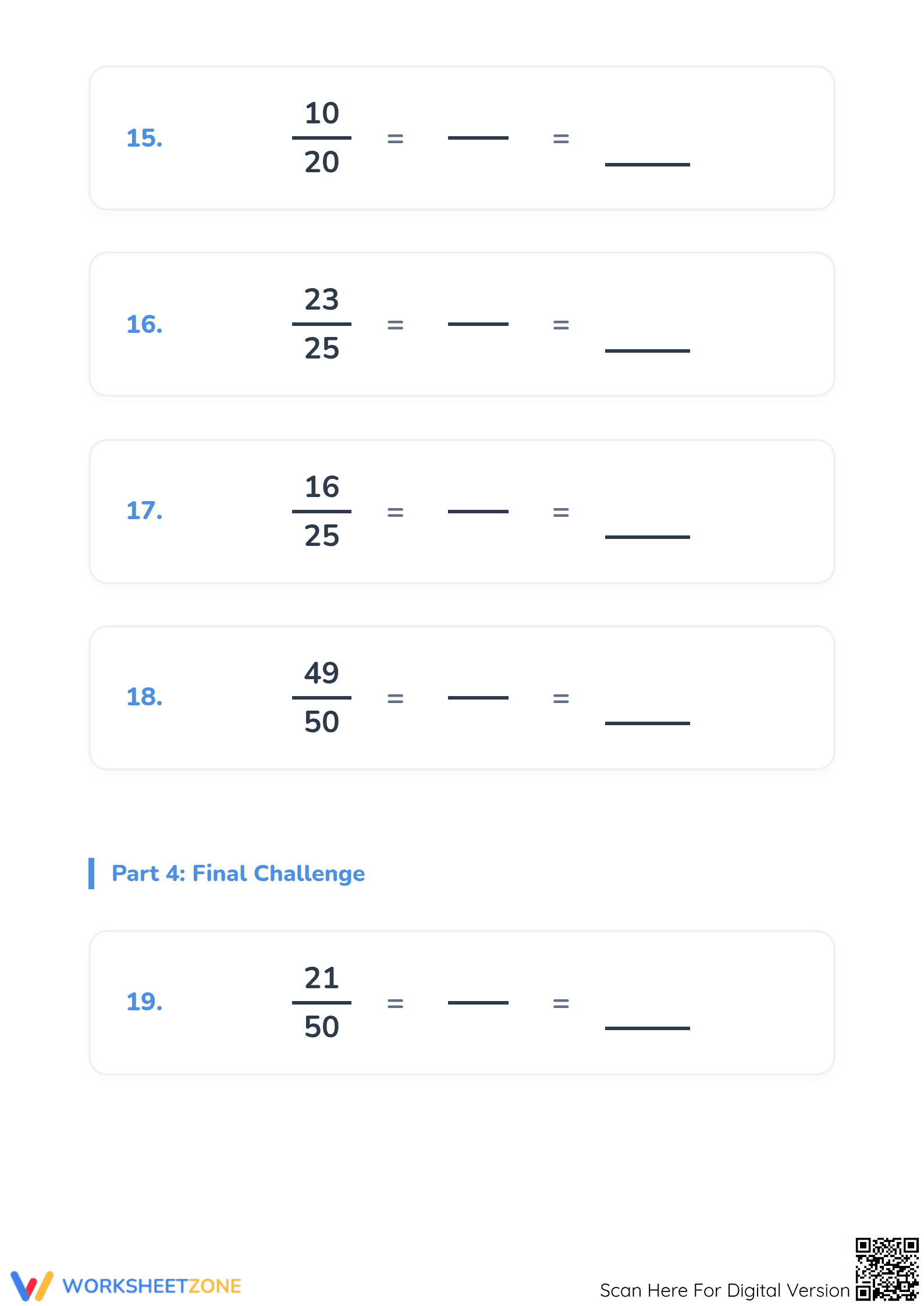
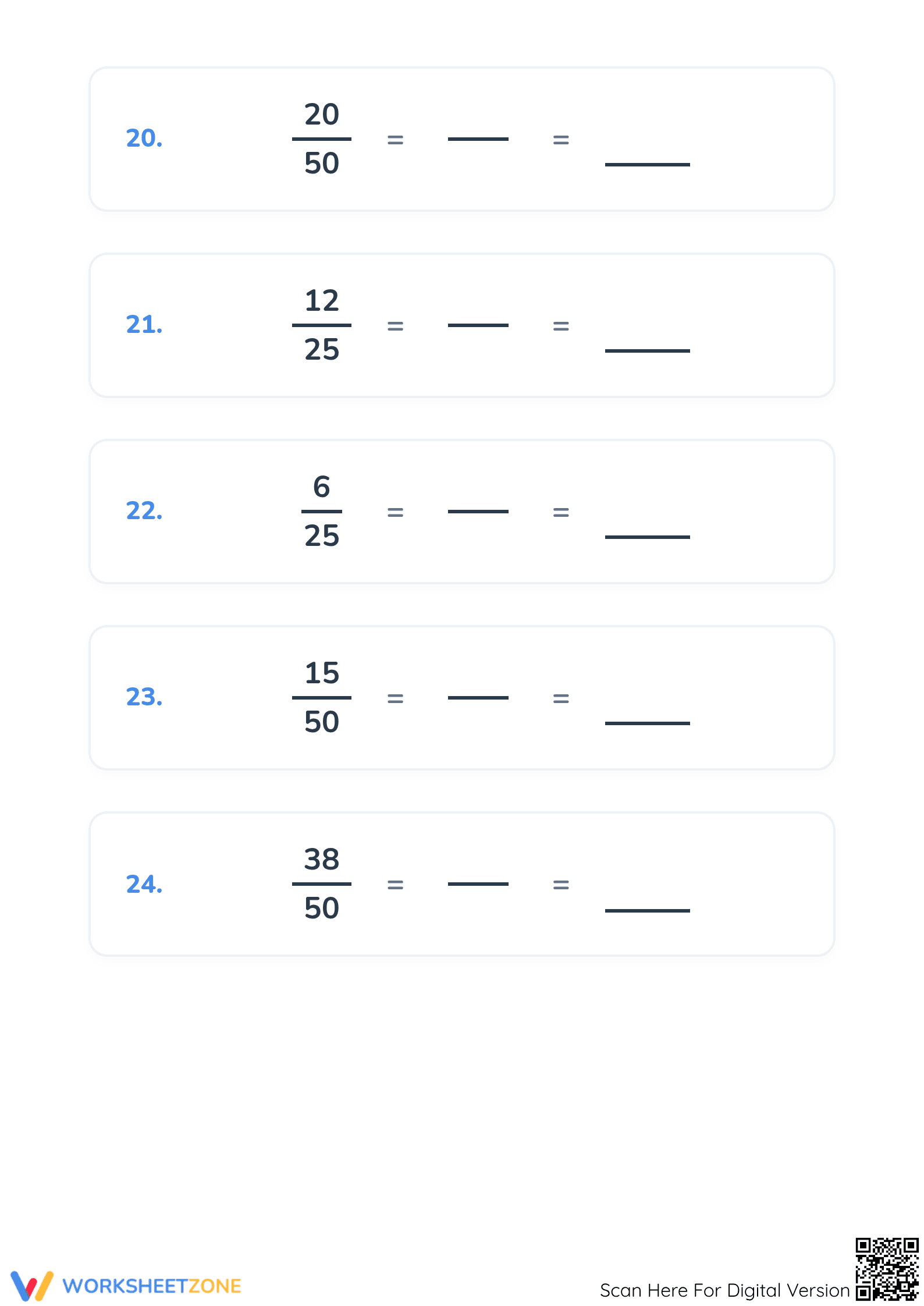
This 5-page PDF package includes a warm-up section with worked examples, multiple practice sets with progressive difficulty, and a final challenge. 24 problems require students to show the intermediate step of converting to hundredths, reinforcing the base-ten conceptual model. A complete answer key is provided for immediate grading or self-correction.
Skill Progression
- Guided practice: Six warm-up problems including a worked example for 1/5 to establish the three-step conversion logic and required formatting.
- Supported practice: Twelve mid-level problems using denominators of 10 and 20 to bridge the conceptual gap to hundredths.
- Independent practice: Six high-level tasks with denominators of 25 and 50 requiring students to identify multipliers independently without prompts.
The worksheet follows a gradual release of responsibility model to ensure students move from teacher-led modeling to independent mastery.
Standards Alignment
This resource is primarily aligned to `CCSS.MATH.CONTENT.4.NF.C.6`, which requires students to use decimal notation for fractions with denominators 10 or 100. It also supports `CCSS.MATH.CONTENT.4.NF.C.5` by asking students to express fractions with one denominator as an equivalent fraction with a denominator of 100. Both standard codes can be copied directly into lesson plans, IEP goals, or district curriculum mapping tools.
How to Use It
Use this worksheet as a focused practice set after a lesson on equivalent fractions and place value. It works exceptionally well as a formative assessment tool; teachers should observe if students can correctly identify the multiplier needed to reach a denominator of 100. The worksheet typically takes 25 to 35 minutes to complete and can be assigned as homework or in-class seatwork.
Who It's For
This material is designed for Grade 4 students but serves as an excellent review for Grade 5 and 6 learners who need to strengthen their rational number foundations. It is helpful for students who struggle with the abstract nature of decimals. Pair this resource with a visual place value chart or hundredths grid to provide additional concrete support for visual learners.
According to the RAND AIRS 2024 analysis of mathematics instructional materials, the ability to bridge representational gaps between fractions and decimals is a primary indicator of middle-school algebraic readiness. This worksheet addresses that transition through the explicit use of hundredths as a conceptual bridge, aligning with CCSS.MATH.CONTENT.4.NF.C.6. By requiring students to express fractions as equivalent fractions with a denominator of 100 before performing the final decimal conversion, the resource builds a robust mental model of place value that persists beyond simple rote memorization. This scaffolding is critical for internalizing the base-ten structure of our number system. Research indicates that students who master these equivalent fraction conversions demonstrate significantly higher accuracy when moving into complex percentage operations and data analysis in later grades. This worksheet provides the high-repetition, focused practice necessary to move these foundational conversion skills from labor-intensive calculation to fluent procedural knowledge, ensuring a smooth transition into advanced rational number theory and multi-step mathematical problem-solving.


