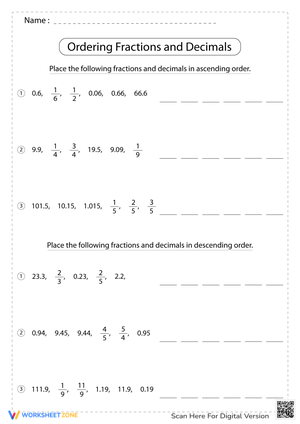
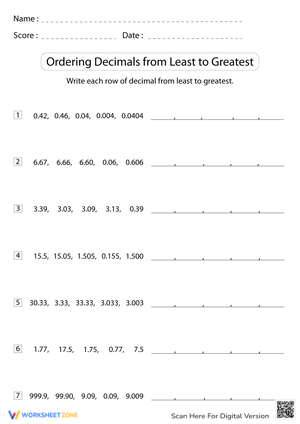
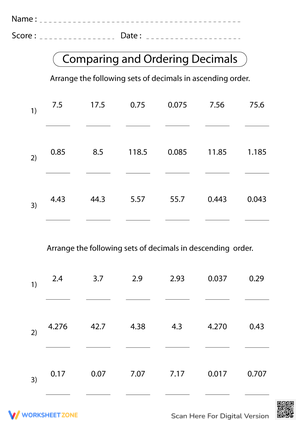
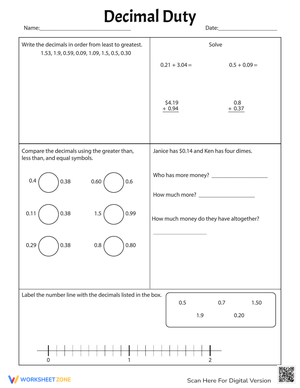
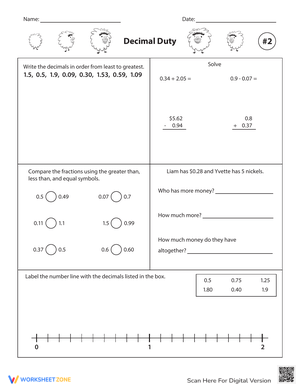
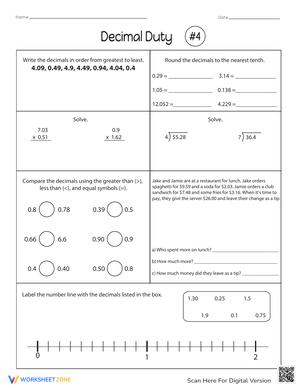
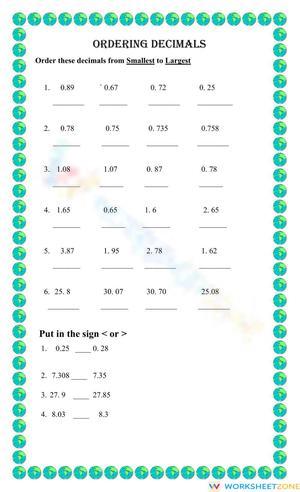
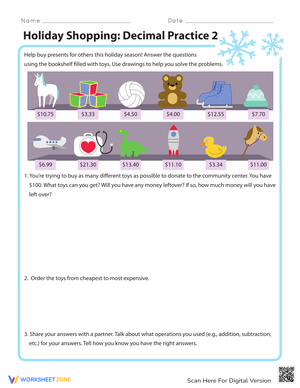
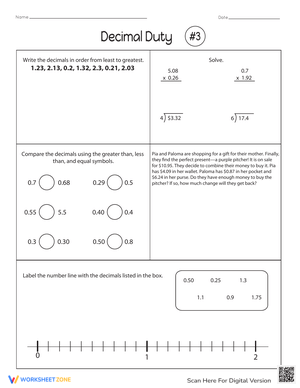
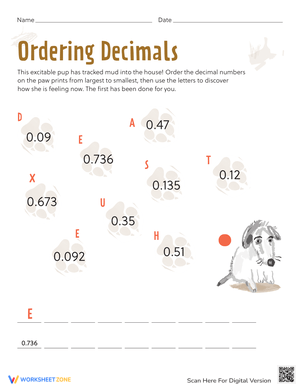
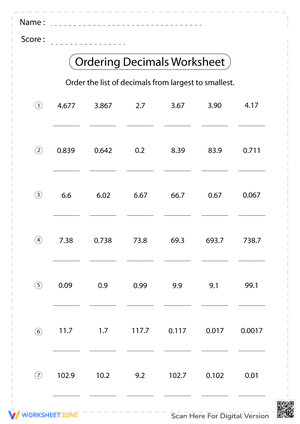
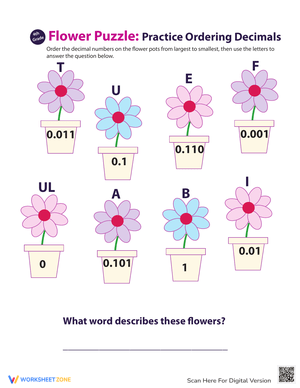
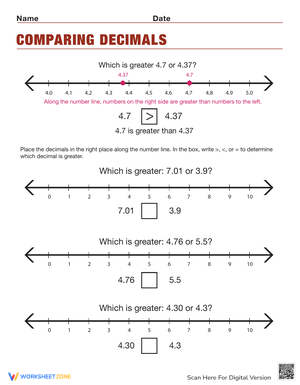
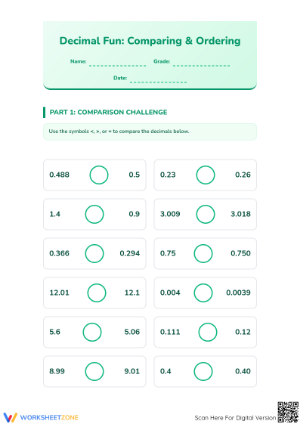
The 5th grade ordering decimals printable worksheets in this set target comparison reasoning at the thousandths level — not the simplified money-based practice most students already covered in earlier grades. Each worksheet puts near-miss numbers in the same item so teachers can see whether students are comparing by place value or relying on a visual shortcut. At Grade 5, that distinction matters: students who appear competent on simple ordering often fall apart when decimal lengths vary within the same set.
Mistakes Students Make That These Worksheets Help Surface
The most consistent error at this grade level is treating a longer decimal as automatically greater. A student who confidently places 0.3 below 0.7 on a number line may still write that 0.345 is greater than 0.8 — because 345 looks bigger than 8. That is not really a decimal-specific mistake. It is a place value error wearing decimal clothes, and it persists until students are forced to compare digit by digit rather than eyeball the whole number.
A second pattern shows up with trailing zeros. Students who know that 0.5 and 0.50 are equivalent in a review problem will sometimes assign them separate positions in a least-to-greatest task because the task format makes them look like distinct numbers. Putting 0.500, 0.50, and 0.5 inside the same comparison set makes that confusion visible immediately.
The most revealing items are close sets: 0.6, 0.59, and 0.605 in the same row require students to compare place by place — tenths first, then hundredths, then thousandths. Students who succeed on basic tenths work but miss these sets are not confused about ordering direction. The gap is in precision — they stop comparing after the first differing digit and do not check further. A worksheet that includes several near-miss sets gives teachers real information about exactly where the reasoning breaks down, not just that something went wrong.
The Specific Skills Each Worksheet Builds
Each worksheet in the set is focused enough to serve a distinct role in a lesson sequence. Teachers can move through them as instruction deepens or pull individual worksheets to address a specific gap:
- Single-length ordering — sets where all decimals share the same number of places. Students practice comparison direction and confirm they are reading digits by position before moving to harder sets.
- Mixed-length comparison — tenths, hundredths, and thousandths appear in the same row. Students must decide whether to annotate zeros or hold the place structure in their heads.
- Both ordering directions — least to greatest and greatest to least alternate across items so students cannot lock into a single mechanical response.
- Close-value sets — near-miss groups like 0.7, 0.69, and 0.702 require sustained place-by-place comparison rather than a first-digit shortcut.
- Written justification prompts — selected items include a short reasoning box so teachers can assess the thinking behind an answer, not just its correctness.
Standard Alignment
Common Core State Standards for Mathematics: 5.NBT.A.3 expects Grade 5 students to read, write, and compare decimals to thousandths using place value understanding and inequality notation. In practical classroom terms, a worksheet that stays at tenths and hundredths works as a review warm-up but does not represent the full comparison demand students face at this grade level. The worksheets in this set move into thousandths systematically — so by the time students work through the more challenging items, they are practicing the exact comparison depth the standard requires, not an easier approximation of it.
How to Build These Worksheets Into Your Lesson Plans
After whole-group instruction on decimal comparison, start with a controlled worksheet — three or four comparison sets, consistent decimal lengths, no curveballs. Before releasing students to work independently, have them explain one answer aloud or in writing. That five-minute debrief at the start identifies students who can rank numbers correctly but cannot yet articulate the place value reasoning behind the ranking — which is a different instructional problem than simply ordering incorrectly.
Later in the week, use a mixed worksheet at math centers paired with a place value chart students keep at their desk. The chart reduces the mental effort of recalling place names so students can focus on the comparison itself. For homework, a short worksheet with familiar directions works better than something introducing a format students have not yet encountered in class.
The 5th grade ordering decimals printable worksheets in this set also fit small-group intervention well. Pull a controlled tenths-and-hundredths worksheet for students still hesitating on basic comparison while the rest of the class works on a mixed set that includes thousandths. That separation does not require redesigning anything — just selecting the right worksheet from what is already here. For exit tickets, one least-to-greatest item and one greatest-to-least item take about three minutes and tell you immediately who is ready to move into decimal operations.
Adjusting the Worksheets for a Range of Learners
Students who still confuse basic place value positions do better with worksheets that limit each set to two decimal lengths and leave white space for annotating zeros or sketching a quick number line. Those markings are a thinking tool, not a shortcut — letting students annotate the worksheet makes the comparison process visible in ways that reviewing a finished worksheet for wrong answers cannot replicate.
On-level students are ready for mixed-length sets and both ordering directions. A useful addition is asking them to check a neighbor's work on one item and explain any disagreement aloud, which forces active use of place value vocabulary — tenths, hundredths, thousandths — rather than just pointing at numbers.
For students who order accurately but rush, the written justification items do the most work. Asking a student to write one sentence about why 0.605 is less than 0.61 takes about ninety seconds and surfaces any gap between correct procedure and actual understanding. Students who cannot write that sentence usually cannot explain the answer when asked aloud, either. Across all levels, the 5th grade ordering decimals printable worksheets in this set are arranged so teachers can assign different worksheets from the same collection without visibly sorting students into separate tracks — each worksheet looks similar at a glance, so the differentiation stays quiet.
Frequently Asked Questions
What decimal concepts should students already know before using these worksheets?
Students need to read a decimal number, name each digit's position through thousandths, and understand that trailing zeros do not change a decimal's value. If a student is still uncertain whether 0.7 means seven tenths or seven hundredths, ordering practice alone will not fix that — a short place value review should come first before assigning comparison work.
How do you handle students who order correctly but cannot explain their thinking?
Use the written justification items and have students defend one comparison aloud before moving on from a missed problem. If a student can say "I compared the tenths digits first, and since they matched, I moved to the hundredths," the understanding is there. If they say "it just looked smaller," the comparison is likely procedural — they are applying a sequence without understanding what the digits represent.
Do these worksheets go beyond what a money-based decimal lesson covers?
The 5th grade ordering decimals printable worksheets in this set push into thousandths and include comparisons with no clean money equivalent — 0.003, 0.03, and 0.3 do not map to anything students spend at a store. That shift is intentional. Students need to hold place value in their heads without the money anchor before they reach decimal multiplication and division, where the money connection breaks down entirely.
How many items per worksheet is enough for a useful practice session?
Six to eight well-chosen comparison sets give more usable information than twenty repetitive ones. Variety in decimal length, item direction, and proximity of values tells a teacher far more about student understanding than sheer volume does. If students miss only the close-value sets, the reteach can focus on precision. If they miss nearly everything in mixed-length sets, returning to place value structure before pushing further into ordering makes more sense than assigning another full worksheet of the same kind.














 Interactive Worksheet Maker
 Quiz Maker
 Word Search Maker
 Crossword Puzzle Maker
 Word Scramble Generator
 Sentence Scramble Generator
 Handwriting Worksheet Generator
 Name Tracing Generator
 Fill In The Blank Generator




 BACK TOSCHOOL