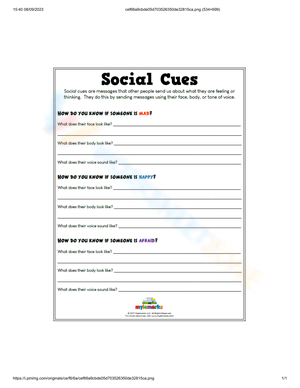
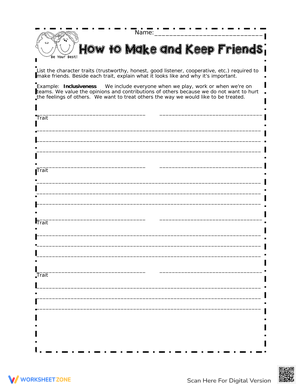
These social skills for kids worksheets for 3rd grade target the specific interpersonal friction that builds around ages 8 and 9—when peer belonging starts to outweigh almost every other concern in a child's school day. The set addresses five CASEL-aligned competency areas through scenario-based tasks, reflection prompts, and structured communication exercises, giving teachers something to point students toward before a conflict escalates and something to return to after one already has.
What Each Worksheet Targets
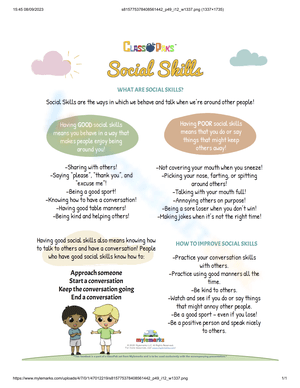
The skills covered map directly onto what third graders actually struggle with, not a generic list of social virtues. Each worksheet stays inside one specific competency rather than trying to teach several at once.
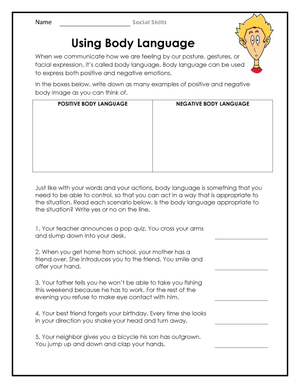
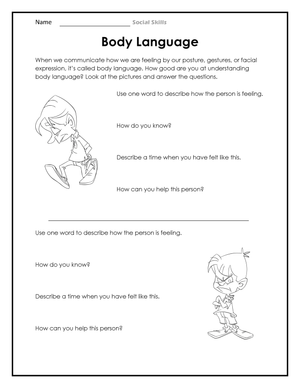
- Self-awareness: Students identify the physical signals their body sends before an emotion peaks—the tight chest, the heat in the face—rather than only labeling the emotion after the fact. Catching a feeling before it crests is a different skill than naming it afterward, and eight-year-olds need practice with both.
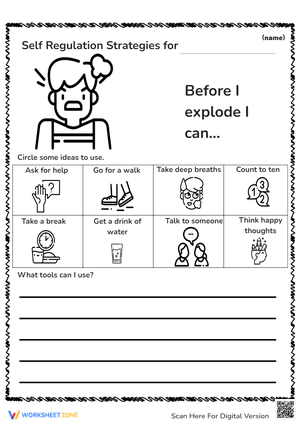
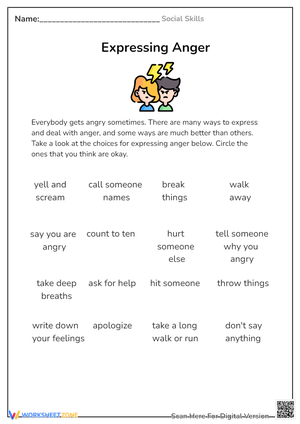
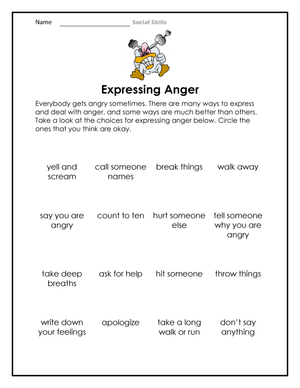
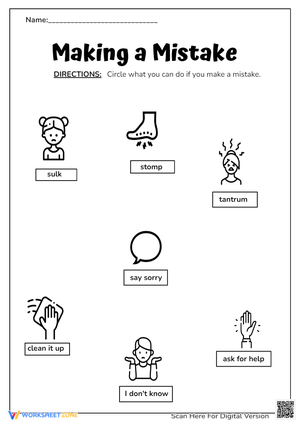
- Self-management: These worksheets walk students through cool-down strategies that are concrete and replicable: controlled breathing counts, a short mental reset, a brief movement break. Nothing abstract here.
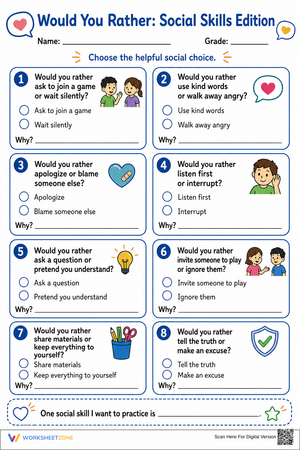
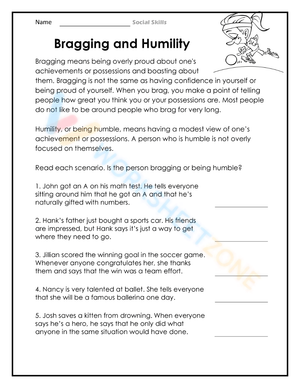
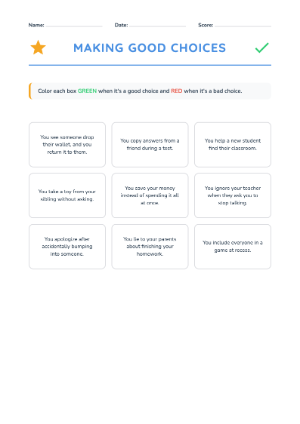
- Social awareness and empathy: "What Would You Do?" scenarios place students in situations they recognize—being left out of a game, watching someone drop their lunch tray in front of the class, seeing a classmate sit alone. Students identify how the person in the story feels and explain the reasoning behind that feeling, building the habit of looking outward before reacting.
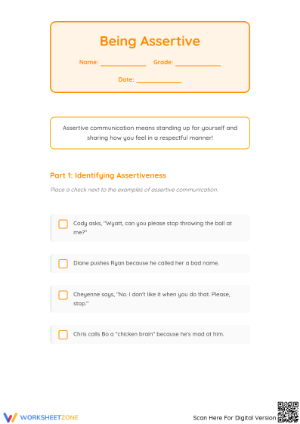
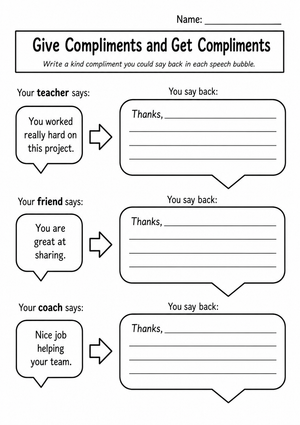
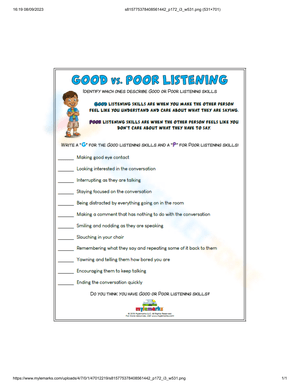
- Communication and active listening: Students rewrite accusatory statements as "I" statements. Instead of "You always take my pencil," the rewritten version becomes "I feel frustrated when my tools are borrowed without asking because I need them for my work." Then they practice summarizing what a partner said before responding—the step most third graders skip entirely.
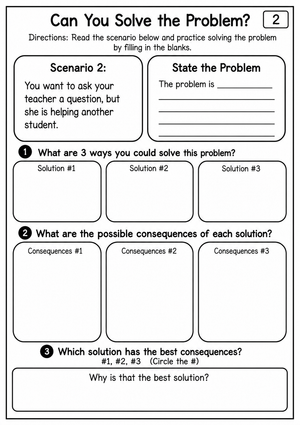
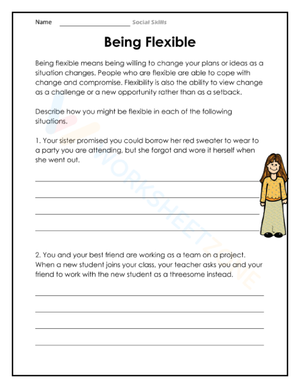
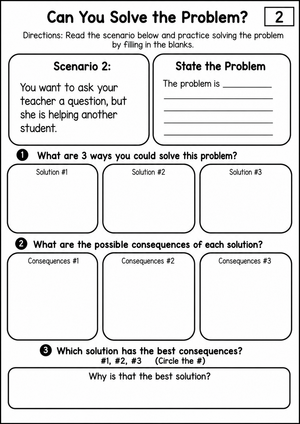
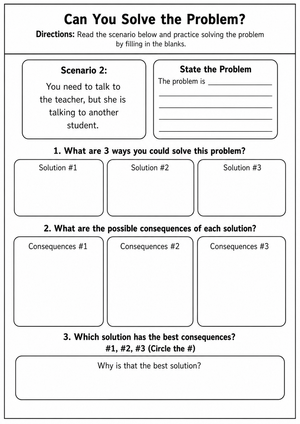
- Conflict resolution: A step-by-step format guides students through naming the problem, listing several possible solutions, and identifying which one is fair to both people involved. Practicing this when emotions are low makes the same sequence easier to reach when emotions are not.
Frequent Student Errors Worth Catching Before They Harden
The most predictable mistake in communication tasks is students writing "I feel like you…" and believing they have completed a proper "I" statement. The sentence starts right but pivots immediately back to the other person. If students practice this malformed version repeatedly without correction, it becomes their default phrasing—which makes actual de-escalation harder, not easier. Pointing this out before students attempt the worksheet cuts the error rate noticeably.
In perspective-taking work, students routinely substitute their own reaction for the character's. When a scenario describes a student whose face turns red and who goes quiet after dropping her lunch tray, several third graders will write that she "doesn't really care"—because that is how they imagine they would respond. Reading scenario details deliberately before guessing at emotion requires explicit modeling. Without it, most students treat empathy as projection.
Conflict resolution is where the step-by-step format shows its clearest limits. When students list possible solutions, the first two or three are almost always punitive: "The other kid apologizes," "They get in trouble," "The teacher decides." A solution that addresses both people's needs is a harder cognitive move for this age group. Naming that distinction before students begin the task—what makes a solution fair versus what makes it satisfying to one side—produces measurably better responses than letting students discover it on their own.
How to Work These Worksheets Into Your Lesson Plans
Morning meeting is the most natural entry point. A worksheet used at the start of the day sets a social focus students can carry into the first transition, the first group task, the walk to the cafeteria. If the worksheet was about including others, a ten-second reminder before recess—"Look for someone new today"—bridges the paper task to actual behavior without eating more instructional time.
The other placement that works consistently is the Calm Down Corner. When a student has just returned to their seat after a conflict or an emotional spike, a reflection worksheet gives them something to do with the experience rather than just sit in it. A student who is still re-regulating cannot process a conversation well—the worksheet slows things down and moves thinking from reactive to structured. What would have been a disciplinary moment becomes a genuine practice opportunity.
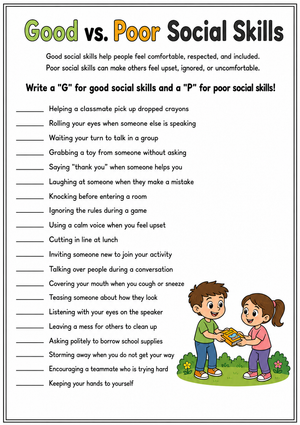
A strategy that gets underused: after a smooth group activity or a particularly clean recess, take five minutes and ask students what went well socially. Someone shared a ball without being asked. A group voted to settle a disagreement instead of arguing it out. Naming those specific moments—not just saying "great teamwork"—reinforces the behavior faster than corrective feedback alone does. These worksheets work best as part of that broader cycle of noticing, naming, and practicing, not as standalone assignments.
Standard Alignment
These social skills for kids worksheets for 3rd grade align to the CASEL framework's five core competency areas: self-awareness, self-management, social awareness, relationship skills, and responsible decision-making. Most U.S. states with formal SEL standards—including Illinois, California, and Washington—code their third-grade expectations directly against this framework. Teachers in states without standalone SEL standards frequently embed these resources in ELA standards related to perspective-taking and collaborative discussion. CCSS.ELA-LITERACY.SL.3.1, for instance, addresses collaborative conversations with diverse partners using agreed-upon rules and building on others' ideas—a standard that the communication and active listening worksheets directly support.
Adapting These Worksheets Across Ability Levels
Students who struggle with reading fluency can work with a partner or have scenarios read aloud; the thinking tasks do not depend on independent decoding. For students with autism or ADHD, the explicit step-by-step format of conflict resolution and emotion-identification tasks provides clarity that is typically absent from real social situations. These learners sometimes find the format more accessible than neurotypical peers who rely on intuition and miss the underlying logic entirely. Adding visual cue cards for emotion vocabulary alongside each worksheet strengthens the work further for this group.
For socially advanced students, the same scenarios extend well: instead of identifying one fair solution, they generate three and rank them by fairness to each person involved. Perspective-taking tasks become richer when students move beyond "how does the character feel" to "what might the character assume the other person meant"—introducing the gap between intent and impact, which is a genuinely complex idea that high-readiness third graders can examine and discuss.
The social skills for kids worksheets for 3rd grade format works especially well in small groups of three to four students led by a classroom teacher or school counselor. A shared worksheet gives the group common vocabulary and a concrete focus, which makes role-play debrief conversations more productive than open-ended discussion would be at this age.
Frequently Asked Questions
How often should these worksheets be used for results to show?
Short daily use—five to ten minutes during morning meeting or a dedicated SEL block—builds skills more reliably than a longer once-a-week session. Spaced, repeated exposure to the same vocabulary and strategies across the week gives students more chances to connect paper practice to real interactions before the week resets. One worksheet a week with no follow-up rarely moves behavior.
Are these worksheets appropriate for students with autism or ADHD?
Yes, and often more so than for neurotypical peers. Students with autism or ADHD frequently experience social expectations as opaque and inconsistently applied. A worksheet that makes the steps explicit—name the feeling, identify the cause, choose a response—gives those students a process they can actually apply, rather than expecting them to read cues that are unreliable for them. Pairing each worksheet with a visual support increases effectiveness further.
How do I assess growth when most answers aren't right or wrong?
The clearest indicators are behavioral: fewer conflicts reaching the teacher, more students using "I" statement language without prompting, groups settling small disagreements before an adult steps in. Within the worksheets themselves, look at the specificity of answers across the year. Early responses tend to read "she feels sad." Stronger responses later say "she feels embarrassed because her friends all watched it happen." That shift in precision reflects genuine development in social awareness. The social skills for kids worksheets for 3rd grade set includes self-reflection checklists that let students track the same growth independently, which adds a metacognitive dimension to the assessment without creating extra work for the teacher.












 Interactive Worksheet Maker
 Quiz Maker
 Word Search Maker
 Crossword Puzzle Maker
 Word Scramble Generator
 Sentence Scramble Generator
 Handwriting Worksheet Generator
 Name Tracing Generator
 Fill In The Blank Generator