


























Views
Downloads
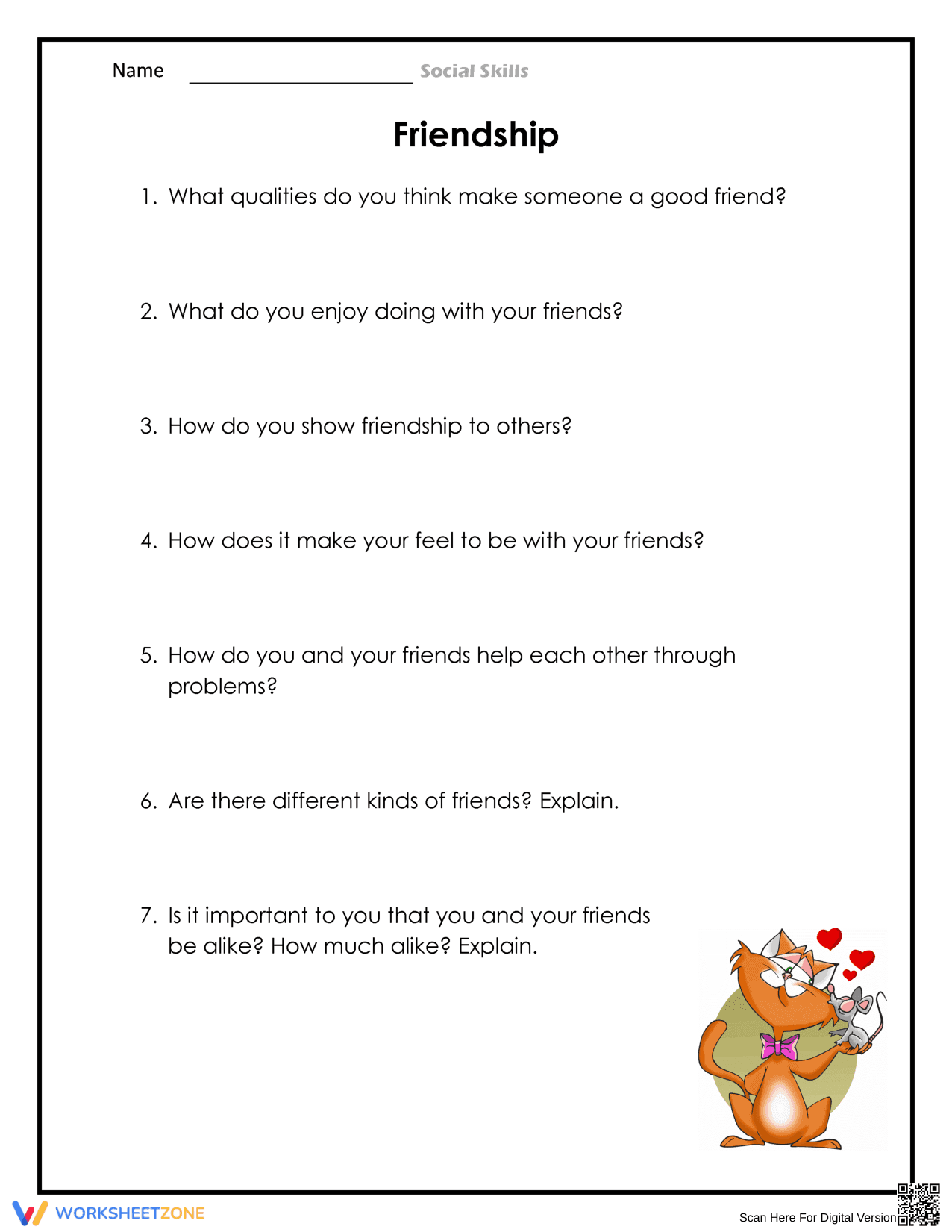

Printable Friendship Social Skills Worksheet
Paste this activity's link or code into your existing LMS (Google Classroom, Canvas, Teams, Schoology, Moodle, etc.).
Students can open and work on the activity right away, with no student login required.
You'll still be able to track student progress and results from your teacher account.
This ready-to-use social skills worksheet helps students articulate their thoughts on friendship and positive peer relationships. By answering seven reflective questions, learners explore what makes a good friend, how they show kindness, and why diverse friendships matter, fostering both emotional intelligence and expressive writing skills.
At a Glance
- Grade: 3 · Subject: Social Skills
- Standard:
CCSS.ELA-LITERACY.W.3.8— Recall experiences to answer questions- Skill Focus: Friendship qualities and self-reflection
- Format: 1 page · 7 problems · No answer key needed · PDF
- Best For: Morning work or SEL blocks
- Time: 15–20 minutes
Inside this single-page resource, educators will find seven open-ended prompts that guide students through a thoughtful exploration of peer dynamics. The questions range from identifying positive character traits to evaluating how friends support each other. Because the prompts rely on personal experiences, no answer key is required, making it an entirely student-driven reflection exercise.
Zero-Prep Workflow
This resource requires absolutely no teacher preparation. Follow these three simple steps:
- Print (1 minute): Download the PDF and print a class set. The clean layout ensures minimal ink usage.
- Distribute (1 minute): Hand out the worksheets during morning meeting or a social-emotional learning block.
- Review (3 minutes): Read the first question aloud to set the tone, then allow students to work independently.
With a total teacher prep time of under two minutes, this activity is an excellent addition to any emergency sub plan.
Standards Alignment
This activity aligns with CCSS.ELA-LITERACY.W.3.8, requiring students to recall information from experiences to answer a question. As students write about their personal interactions regarding friendship, they practice organizing their thoughts into coherent written responses. Both standard codes can be copied directly into lesson plans, IEP goals, or district curriculum mapping tools.
How to Use It
This worksheet serves as an excellent primer before a whole-class discussion on classroom community. Assign it as independent morning work, taking about 15 to 20 minutes to complete. Alternatively, use it during a dedicated SEL block to facilitate small-group sharing. As a formative assessment tip, observe how students articulate their feelings; this provides valuable insights into their social development and peer relationships.
Who It's For
This resource is designed for elementary students actively developing their social awareness and relationship skills. It naturally accommodates differentiation, as students can respond with simple sentences or detailed paragraphs depending on their writing proficiency. Pair this worksheet with a read-aloud book about friendship or a classroom anchor chart detailing positive character traits.
Integrating social-emotional learning activities into the daily curriculum significantly impacts student well-being and academic success. This worksheet targets CCSS.ELA-LITERACY.W.3.8, prompting learners to recall experiences to answer questions about peer relationships and personal boundaries. According to a comprehensive RAND AIRS 2024 report, students who consistently participate in structured SEL reflections demonstrate improved classroom behavior, stronger peer connections, and higher levels of academic engagement compared to their peers who lack such opportunities. By providing a dedicated space for students to articulate their thoughts on friendship, educators foster a supportive classroom environment that values empathy, active listening, and mutual respect. Activities that bridge personal experience with expressive writing not only build essential literacy skills but also equip children with the emotional vocabulary necessary to navigate complex social dynamics effectively throughout their educational journey and beyond.


