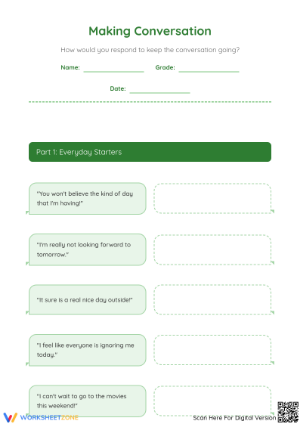
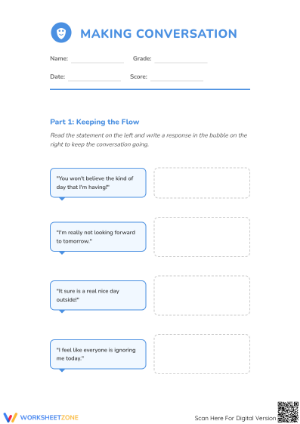
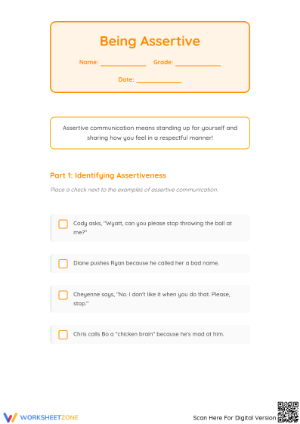
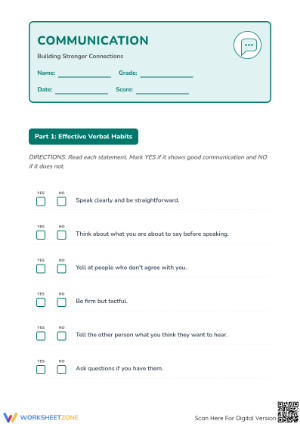
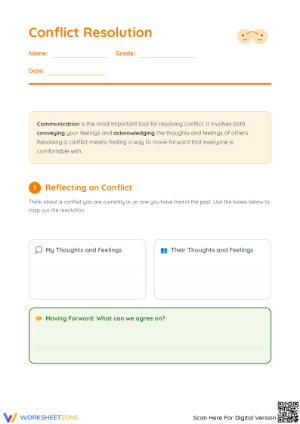
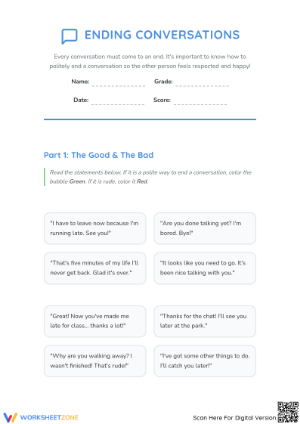
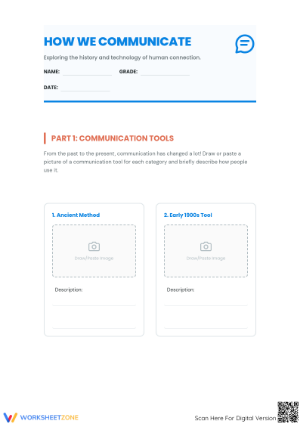
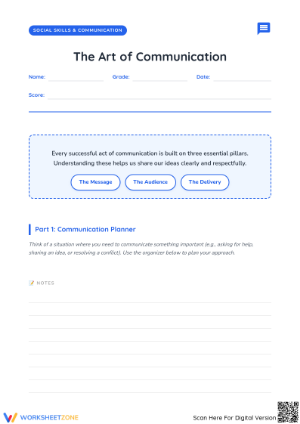
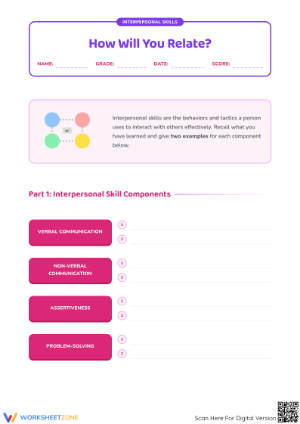
These 3rd grade teaching communication skills printable worksheets give teachers structured practice materials for the three areas where 8- and 9-year-olds most need direct instruction: active listening, expressing feelings through 'I' statements, and reading non-verbal cues. Third grade is when the CCSS Speaking and Listening standards first require students to come to collaborative discussions prepared and sustain a connected conversation — linking their own comments to what a peer just said — behaviors that require deliberate practice, not just repeated opportunity.
The Specific Skills Each Worksheet Targets
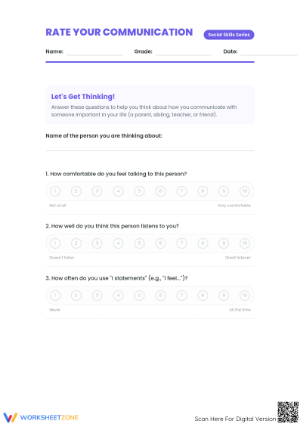
The active listening worksheets ask students to track their own behaviors during a partner conversation — not merely whether they stayed quiet, but whether they maintained eye contact, signaled understanding through small responses, and asked a follow-up question that connected to what the speaker actually said. Students underline the follow-up questions they used, then evaluate whether each question responded to the speaker's point or redirected to their own agenda.
'I' statement worksheets give students a three-part formula — I feel [emotion] when [action] because [reason] — and move through scenario-based fill-in practice before asking students to generate statements independently. Common scenarios include a classmate cutting in line, a partner not contributing to a group task, and a friend changing plans at the last minute. Students also mark each statement as genuine 'I' language or blame language wearing the formula as a disguise.
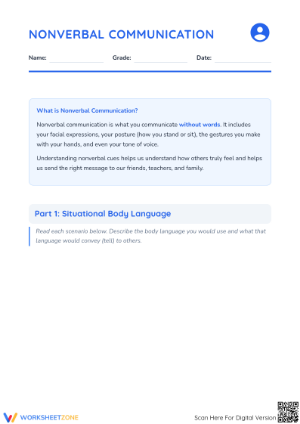
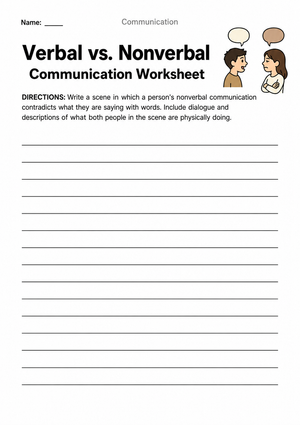
The non-verbal cue worksheets use image-based matching exercises where students connect facial expressions and body posture to emotional states, then add a context layer: the same crossed-arms posture might signal defensiveness in one scenario and simple physical cold in another. That distinction — that non-verbal communication is contextual, not fixed — is harder than it sounds for a typical 8-year-old and rarely gets taught explicitly.
Communication Errors That Come Up Across Student Work
The most predictable error with 'I' statements is what could be called the "I feel like you always" construction. Students hear the formula, practice it correctly on a worksheet, and then — the first time a real conflict arises — produce something like "I feel like you're always taking my stuff." The "like you" phrasing slides right back into accusation and tends to escalate rather than de-escalate. Worksheets that include a "blame check" step — students reread their statement and ask whether it names a behavior or assigns character — give students a concrete tool for catching this before it plays out in conversation.
Active listening errors are subtler. Students quickly learn that nodding signals attentiveness, so they nod continuously while mentally elsewhere. The listening worksheets surface this gap by requiring a one-sentence summary of the speaker's main point before students can move to their own response — which immediately reveals who was tracking and who was performing. Non-verbal cue exercises expose a parallel problem: students learn that crossed arms indicates defensiveness and apply that reading universally, regardless of context. The context-layer exercises in the set are built specifically to disrupt that overgeneralization.
Where These Worksheets Fit Best in a Classroom Week
The active listening checklist works best during an activity students are already doing — partner reading, think-pair-share, or small-group work — rather than as a standalone exercise. Clip it to the existing task. Monday morning circle time is a natural entry point: students use the checklist to self-assess their listening during the share-out, then set one listening goal for the week. Revisit briefly on Friday during the few minutes before pickup.
The 'I' statement worksheets land most effectively as front-loading before a collaborative project rather than as a response to a conflict that has already happened. Introducing them after a classroom argument works, but students are already dysregulated and the fill-in format can feel punitive. Front-loading gives students the language before they need it under social pressure — which is the only moment when it actually gets used.
Non-verbal cue exercises fit a calm, low-stakes block early in a lesson. They pair naturally with a class read-aloud: after reading a chapter, students annotate a worksheet by matching a character's described body language to an emotional state. That connection to literature makes the skill feel purposeful rather than abstract. The 3rd grade teaching communication skills printable worksheets in this set are built with that kind of cross-curricular embedding in mind — they don't require a dedicated SEL block to function.
Making These Worksheets Work for Every Student in the Room
For students who find the three-part 'I' statement formula overwhelming, reduce it temporarily to two parts: the emotion and the action. "I feel frustrated when you take my pencil" is accurate and useful even without the "because" clause. Add the third part once the two-part version is consistent. This gradual addition of complexity keeps students from abandoning the formula entirely because it felt too hard to produce under real social pressure.
Students who already write confident 'I' statements can move into generating their own conflict scenarios, then swap with a partner who writes the 'I' statement the first student should use. That requires genuine perspective-taking — a significantly harder cognitive task than formula application, and one that keeps advanced students meaningfully engaged.
For multilingual learners, the non-verbal cue worksheets reduce language demand considerably. Matching facial expressions to emotions works across proficiency levels and gives students a meaningful entry point into the communication curriculum that doesn't require producing written English first. Pair the image-based worksheet with an oral check-in rather than a written reflection where appropriate. The 3rd grade teaching communication skills printable worksheets in the set include enough visual-heavy tasks that students at earlier stages of English acquisition can engage with the core concepts without being locked out by vocabulary demands.
Standard Alignment
These worksheets address CCSS Speaking and Listening standards for grade 3, particularly SL.3.1, which requires students to engage effectively in collaborative discussions and express their own ideas clearly. Three sub-standards apply directly: SL.3.1a asks students to come to discussions prepared and draw explicitly on that preparation — a requirement that doesn't appear in the 2nd grade parallel standard; SL.3.1b addresses following agreed-upon discussion rules and sustaining a connected conversation by linking comments to what others have said; and SL.3.1c requires students to ask questions to check understanding and stay on topic. The 3rd grade standard emphasizes carrying on a conversation rather than simply taking a turn in one — which is precisely why students need deliberate practice with the listening and responding strategies these worksheets build.
Within the CASEL framework, these worksheets address the Relationship Skills competency — specifically communicating clearly, listening actively, and resolving conflict constructively. Schools with formal SEL implementation can use the set as direct instructional materials for that domain, mapped to the relationship skills strand.
Frequently Asked Questions
How do I introduce 'I' statements to students who have never encountered the concept?
Start with a modeling sequence before any worksheet comes out. Act out a short conflict with a student volunteer — first using blame language, then using an 'I' statement for the exact same situation. Ask the class what felt different. Students notice the shift in tone almost immediately, even before they can say why. Then work through the first two fill-in scenarios as a whole group before releasing students to practice independently. At that point the worksheet functions as a practice record, not as the primary introduction to the language.
What do I do when students say this work feels too easy or too young for them?
Reframe the task: they're not learning what 'I' statements are — they're building the speed to use them during an actual conflict without having to think about the formula mid-conversation. Compare it to an athlete running passing drills, not because the drill is the point, but because automaticity under pressure is. Students who accept that framing typically engage more seriously. If they still resist, move them to the advanced extension: generating conflict scenarios and writing the 'I' statement a classmate should use — which is demanding enough that it tends to hold their attention.
Can I use these as formative checks rather than graded assignments?
That's the most effective use of them. The listening checklists and 'I' statement sheets give a quick read on which students are internalizing the formula and which are producing surface-level responses. Collect them after a partner activity, look specifically at the "blame check" responses, and you have a clear picture of who needs a small-group session before the class moves into open-ended discussion work. The 3rd grade teaching communication skills printable worksheets in this set are built for that formative loop — they generate information about student thinking, not just evidence of task completion.












 Interactive Worksheet Maker
 Quiz Maker
 Word Search Maker
 Crossword Puzzle Maker
 Word Scramble Generator
 Sentence Scramble Generator
 Handwriting Worksheet Generator
 Name Tracing Generator
 Fill In The Blank Generator