


























Views
Downloads

Personal Responsibilities Printable Worksheet | Grade 2
Paste this activity's link or code into your existing LMS (Google Classroom, Canvas, Teams, Schoology, Moodle, etc.).
Students can open and work on the activity right away, with no student login required.
You'll still be able to track student progress and results from your teacher account.
This Grade 2 and Grade 3 social skills worksheet helps students identify and categorize their daily obligations. By completing a four-quadrant graphic organizer, learners actively reflect on their roles across different environments, fostering self-awareness and accountability. The open-ended format encourages thoughtful brainstorming and personal connection to the material.
At a Glance
- Grade: 2 · Subject: Social Skills
- Standard:
CCSS.ELA-LITERACY.W.2.8— Recall information from personal experiences to answer questions- Skill Focus: Identifying personal responsibilities
- Format: 1 page · 4 tasks · No answer key · PDF
- Best For: Morning work or SEL blocks
- Time: 15–20 minutes
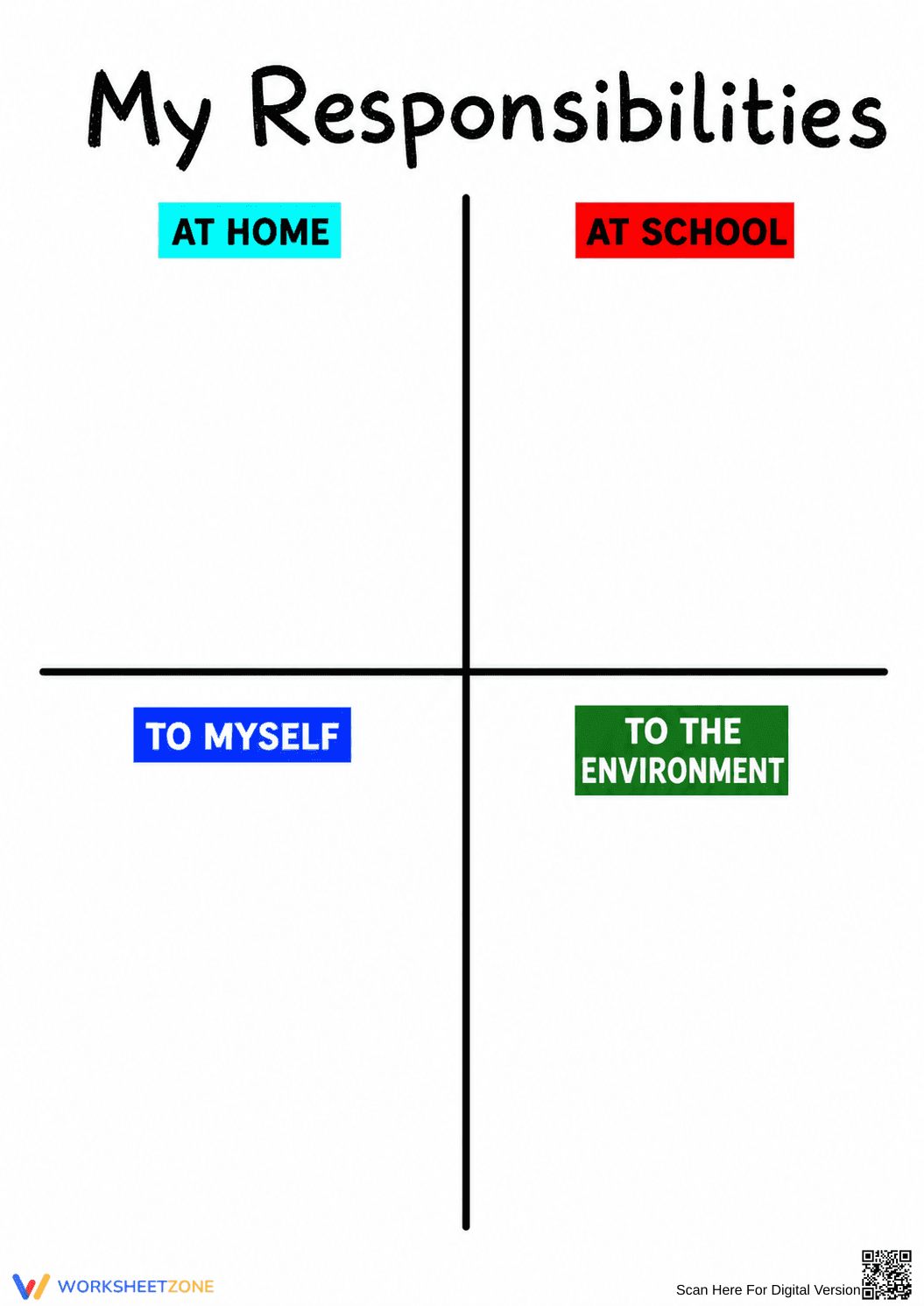
This single-page resource features a clear, four-quadrant chart titled "My Responsibilities." The graphic organizer is divided into four distinct categories: At Home, At School, To Myself, and To The Environment. Because the prompts are entirely open-ended, there is no answer key required; instead, students draw upon their own lived experiences to populate each section with relevant examples, drawings, or short sentences.
This resource is designed for immediate classroom implementation with a highly efficient zero-prep workflow.
- Print (1 minute): Simply download the PDF and print a class set. The black-and-white design is ink-friendly and requires no special formatting.
- Distribute (1 minute): Hand out the graphic organizers during morning meeting, advisory, or a dedicated social-emotional learning block.
- Review (3 minutes): Briefly explain the four categories and model one example for each quadrant before releasing students to work independently.
Total teacher preparation time is under two minutes, making this an excellent, reliable option for emergency sub plans or quick transitions.
This activity aligns directly with CCSS.ELA-LITERACY.W.2.8: "Recall information from experiences or gather information from provided sources to answer a question." By asking students to reflect on their daily routines and categorize their duties, the worksheet reinforces foundational writing and cognitive organization skills. Both standard codes can be copied directly into lesson plans, IEP goals, or district curriculum mapping tools.
Teachers can utilize this graphic organizer as a foundational activity before introducing a broader unit on community and citizenship. It works exceptionally well as an independent reflection exercise following a whole-class read-aloud about helping others. As a formative assessment observation tip, educators can circulate the room while students write, noting which learners easily identify self-care tasks versus environmental duties, providing targeted prompts to those who get stuck. Expected completion time ranges from 15 to 20 minutes.
This resource is primarily designed for second and third-grade students developing their social-emotional competencies. The visual, compartmentalized layout naturally supports neurodivergent learners who benefit from chunked information and clear boundaries. It pairs perfectly with a classroom anchor chart detailing classroom rules and expectations, allowing students to transfer shared agreements into personal commitments.
Integrating structured reflection tools like this graphic organizer supports both academic and social-emotional development in early elementary classrooms. Aligned with CCSS.ELA-LITERACY.W.2.8, this activity requires students to recall information from personal experiences to answer questions about their daily roles. According to a recent RAND AIRS 2024 report, embedding self-awareness and self-management exercises into routine academic tasks significantly improves student engagement and classroom climate. By categorizing their duties into distinct domains—home, school, self, and environment—children build cognitive flexibility and a stronger sense of personal agency. This targeted practice not only reinforces foundational writing and recall skills but also establishes the behavioral expectations necessary for a collaborative learning environment.


