


























0
Views
0
Downloads

0.0
0
Save
0 Likes
Share
Using Body Language Effectively
0 Views
0 Downloads
Paste this activity's link or code into your existing LMS (Google Classroom, Canvas, Teams, Schoology, Moodle, etc.).
Students can open and work on the activity right away, with no student login required.
You'll still be able to track student progress and results from your teacher account.
Information
Description
What It Is:
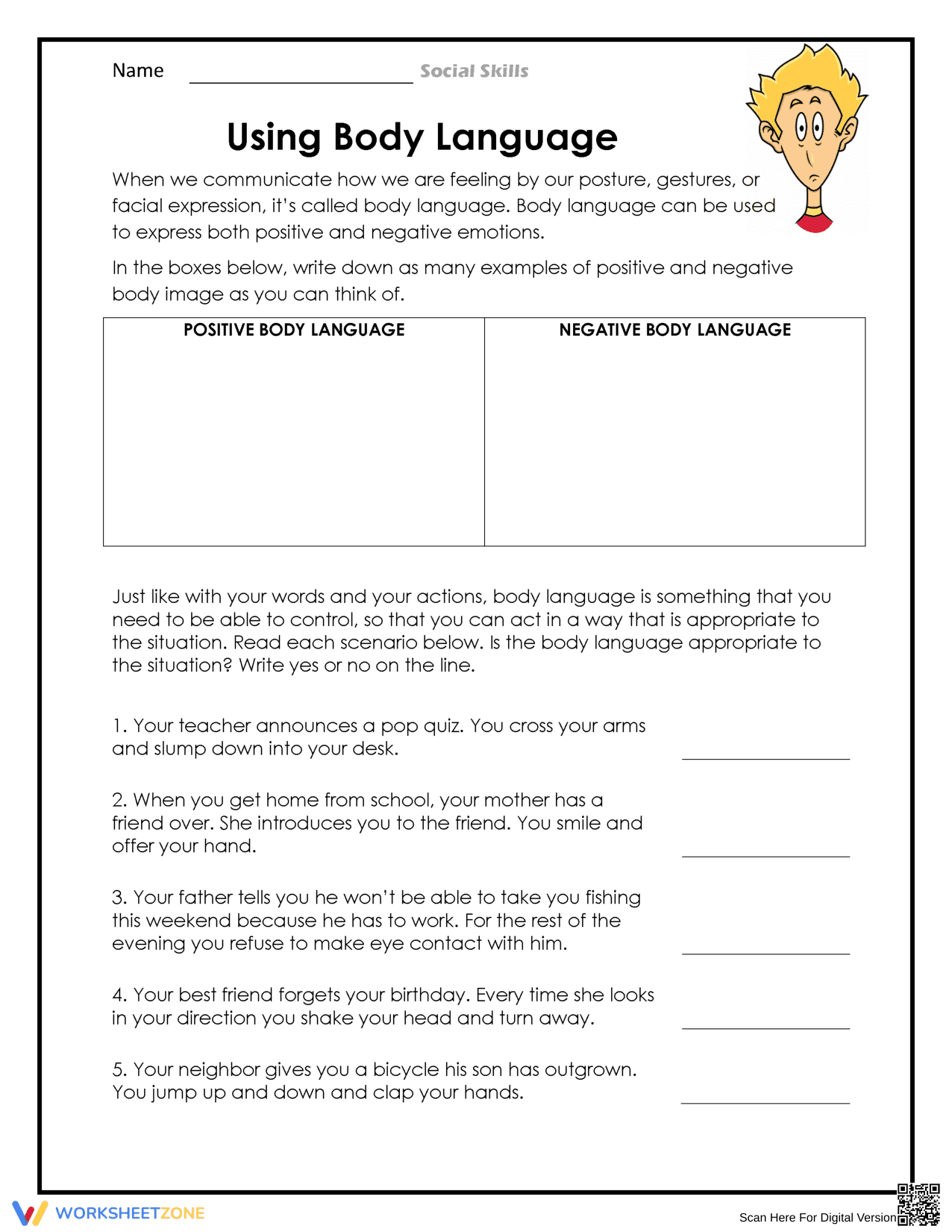
This is a social skills worksheet titled 'Using Body Language.' It defines body language as communication through posture, gestures, and facial expressions, and explains that it can express positive and negative emotions. The worksheet includes two sections: one where students write examples of positive and negative body language in designated boxes, and another where they read scenarios and determine if the body language described is appropriate, answering 'yes' or 'no.' The scenarios involve situations like a pop quiz, meeting a friend's mother, a parent being unable to go fishing, a friend forgetting a birthday, and receiving a used bicycle.
Grade Level Suitability:
This worksheet is suitable for grades 2-5. The concepts are simple to grasp, the vocabulary is accessible, and the scenarios are relatable to this age group. The writing tasks require basic sentence construction and comprehension skills appropriate for these grades.
Why Use It:
This worksheet helps students develop social-emotional learning skills by understanding how body language communicates emotions. It encourages them to identify and differentiate between positive and negative body language cues. It also promotes critical thinking by requiring them to analyze scenarios and assess the appropriateness of different body language responses.
How to Use It:
Begin by reviewing the definition of body language and discussing examples of positive and negative expressions. Have students brainstorm and write their own examples in the provided boxes. Then, read each scenario aloud and guide students to analyze the body language described. Students should write 'yes' or 'no' to indicate if the body language is appropriate for the situation.
Target Users:
This worksheet is ideal for elementary school students, special education students, and students learning English as a second language who need to develop social skills and emotional awareness. It can be used by teachers, counselors, or parents looking for resources to teach nonverbal communication.
This is a social skills worksheet titled 'Using Body Language.' It defines body language as communication through posture, gestures, and facial expressions, and explains that it can express positive and negative emotions. The worksheet includes two sections: one where students write examples of positive and negative body language in designated boxes, and another where they read scenarios and determine if the body language described is appropriate, answering 'yes' or 'no.' The scenarios involve situations like a pop quiz, meeting a friend's mother, a parent being unable to go fishing, a friend forgetting a birthday, and receiving a used bicycle.
Grade Level Suitability:
This worksheet is suitable for grades 2-5. The concepts are simple to grasp, the vocabulary is accessible, and the scenarios are relatable to this age group. The writing tasks require basic sentence construction and comprehension skills appropriate for these grades.
Why Use It:
This worksheet helps students develop social-emotional learning skills by understanding how body language communicates emotions. It encourages them to identify and differentiate between positive and negative body language cues. It also promotes critical thinking by requiring them to analyze scenarios and assess the appropriateness of different body language responses.
How to Use It:
Begin by reviewing the definition of body language and discussing examples of positive and negative expressions. Have students brainstorm and write their own examples in the provided boxes. Then, read each scenario aloud and guide students to analyze the body language described. Students should write 'yes' or 'no' to indicate if the body language is appropriate for the situation.
Target Users:
This worksheet is ideal for elementary school students, special education students, and students learning English as a second language who need to develop social skills and emotional awareness. It can be used by teachers, counselors, or parents looking for resources to teach nonverbal communication.


