


























Views
Downloads
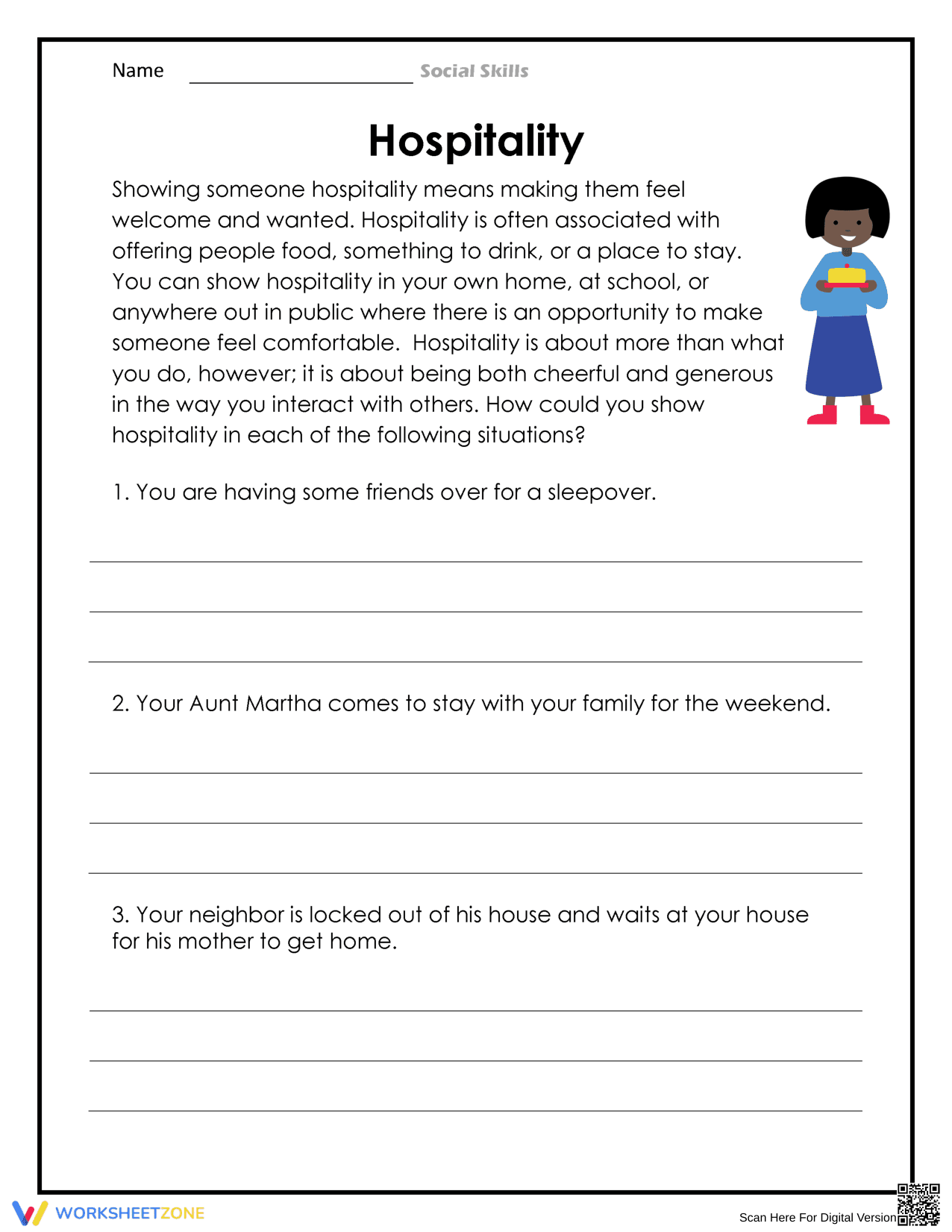

Hospitality Social Skills Printable | Grade 3
Paste this activity's link or code into your existing LMS (Google Classroom, Canvas, Teams, Schoology, Moodle, etc.).
Students can open and work on the activity right away, with no student login required.
You'll still be able to track student progress and results from your teacher account.
This social skills worksheet helps students understand and practice the concept of hospitality by responding to real-world scenarios. Students read a brief text explaining how to make others feel welcome, then write practical solutions for three specific situations, building empathy and clear written communication skills.
At a Glance
- Grade: 3 · Subject: Social Skills
- Standard:
CCSS.ELA-LITERACY.W.3.4— Produce writing appropriate to task and purpose- Skill Focus: Empathy and Scenario Response
- Format: 1 page · 3 problems · No answer key · PDF
- Best For: Morning work or character education
- Time: 15–20 minutes
Inside this single-page resource, educators will find a short, student-friendly reading passage defining hospitality, followed by three open-ended writing prompts. The prompts ask students to imagine hosting friends for a sleepover, welcoming a visiting relative, and helping a locked-out neighbor. Ample lined space is provided for students to draft their responses. Because the questions are subjective and based on personal empathy, no formal answer key is required.
This resource is designed for immediate classroom implementation with a streamlined workflow:
- Print (1 minute): The single-page layout requires minimal paper and ink, making it easy to run off a class set right before the bell rings.
- Distribute (1 minute): Hand out the sheets during morning meeting, advisory, or a dedicated character education block.
- Review (3 minutes): The instructions are completely self-explanatory, allowing students to begin working independently while the teacher handles attendance or other administrative tasks.
Total teacher prep time is under two minutes, making this an excellent emergency sub plan or quick filler activity.
This activity aligns with CCSS.ELA-LITERACY.W.3.4, requiring students to produce writing in which the development and organization are appropriate to task and purpose. By responding to specific social scenarios, students practice tailoring their written communication to address distinct interpersonal challenges. Both standard codes can be copied directly into lesson plans, IEP goals, or district curriculum mapping tools.
Teachers can use this worksheet as a standalone morning work assignment to set a positive tone for the day, or as an independent reflection activity after a whole-group discussion on kindness and community. As students write, circulate the room to observe their problem-solving approaches; this serves as an excellent formative assessment of their social-emotional awareness. Expect most students to complete the reading and writing tasks within 15 to 20 minutes.
This resource is ideal for elementary students in grades 2 through 4 who are developing their social-emotional competencies. For students who struggle with writing, teachers can allow oral responses or provide sentence starters to scaffold the activity. It pairs perfectly with a read-aloud book about friendship or a classroom anchor chart detailing ways to show respect to guests.
Integrating character education into daily literacy practice yields significant benefits for student development across multiple domains. According to a 2024 report by EdReports, combining social-emotional learning prompts with standard writing tasks improves both academic engagement and overall classroom climate. This worksheet supports that methodology by asking students to produce writing appropriate to task and purpose, directly targeting CCSS.ELA-LITERACY.W.3.4. When young learners articulate exactly how they would handle real-world situations like a locked-out neighbor or a visiting relative, they actively bridge the gap between abstract concepts and concrete behaviors. Regular practice with scenario-based writing not only strengthens foundational composition skills but also fosters a much more inclusive, empathetic school environment. By dedicating brief, focused instructional time to these dual-purpose activities, educators can effectively nurture both academic proficiency and essential life skills without sacrificing rigorous standards.


