


























Views
Downloads

Essential Social Skills Worksheet | Grades 1-3 Ready
Paste this activity's link or code into your existing LMS (Google Classroom, Canvas, Teams, Schoology, Moodle, etc.).
Students can open and work on the activity right away, with no student login required.
You'll still be able to track student progress and results from your teacher account.
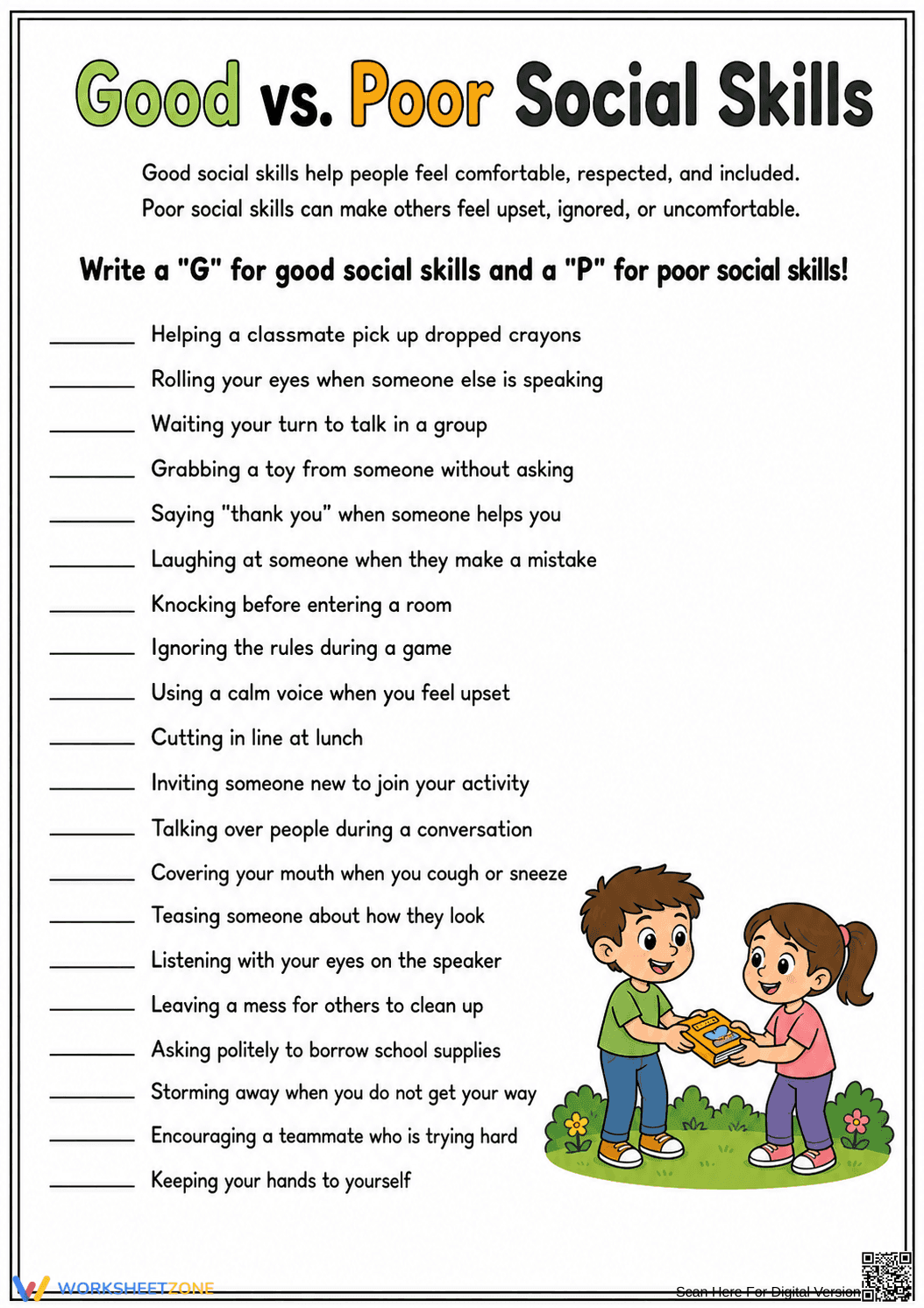
This social skills worksheet helps elementary students distinguish between positive and negative interpersonal behaviors. By categorizing 20 different scenarios, learners develop the self-awareness necessary for successful classroom interactions and peer relationships. It provides a clear framework for understanding how specific actions impact the feelings of others in a social environment.
At a Glance
- Grade: 1-3 · Subject: Social Skills
- Standard:
CCSS.ELA-LITERACY.SL.2.1— Follow agreed-upon rules for discussions and carry out social interactions respectfully- Skill Focus: Behavioral differentiation
- Format: 1 page · 20 problems · Answer key included · PDF
- Best For: Morning meetings or small group counseling
- Time: 10–15 minutes
What's Inside
The worksheet features a clean, one-page layout with a clear instructional header. It lists 20 distinct behavioral prompts ranging from "Helping a classmate" to "Rolling your eyes." Students use a simple "G" or "P" coding system to evaluate each item. The page includes a friendly illustration of children sharing a book to reinforce the positive theme of the lesson.
Zero-Prep Workflow
- Print: Open the PDF and print the single-page sheet for your entire class (30 seconds).
- Distribute: Hand out the worksheets and read the introductory definitions of good and poor skills aloud (1 minute).
- Review: Go over the 20 items as a whole group to facilitate a discussion on why certain behaviors are helpful or hurtful (5 minutes).
Standards Alignment
This activity aligns with `CCSS.ELA-LITERACY.SL.2.1`, which requires students to follow agreed-upon rules for discussions and participate in collaborative conversations. It also supports social-emotional learning (SEL) goals related to relationship skills and social awareness. Both standard codes can be copied directly into lesson plans, IEP goals, or district curriculum mapping tools.
How to Use It
Use this worksheet as a formative assessment during the first week of school to establish classroom expectations. It also works well as a "check-in" tool after a playground conflict to help students reflect on their choices. Expect students to complete the categorization in 10 minutes, followed by a 5-minute teacher-led reflection on the impact of "poor" social skills.
Who It's For
This resource is ideal for general education students in grades 1 through 3, as well as special education students working on social-emotional IEP goals. It pairs naturally with an anchor chart about "Whole Body Listening" or a direct instruction lesson on empathy and perspective-taking.
Research from Fisher & Frey (2014) emphasizes that explicit instruction in social-emotional behaviors is critical for academic success, as students must first feel safe and respected to engage in complex cognitive tasks. This worksheet addresses CCSS.ELA-LITERACY.SL.2.1 by providing 20 concrete examples of social interactions, allowing students to practice the plain-English skill of identifying respectful behavior. By categorizing actions like "waiting your turn" versus "talking over people," learners build the foundational social awareness necessary for collaborative learning environments. According to recent NAEP data, classrooms with high levels of social-emotional support show significantly higher engagement rates. This printable resource serves as a structured intervention for students who struggle with impulse control or social cues, offering a low-stakes environment to analyze behavior before applying these skills in real-time peer interactions. It is a reliable tool for building a positive classroom culture.


