3rd Grade Social Skills for Autism PDF Worksheets
These 3rd grade social skills for autism pdf worksheets give teachers something verbal instruction alone rarely delivers at this age: a repeatable, visual format for making implicit social rules explicit. Third grade is the year peer dynamics shift hard — group projects replace parallel play, lunch table hierarchies solidify, and students are expected to read situations their autistic classmates often have no mental map for yet. Each worksheet targets one of four core competency areas, so teachers can match practice to whatever a student is working on most urgently.
What's Inside the Set
The four skill areas represented across these worksheets correspond to the competencies autistic 8- and 9-year-olds most often struggle with in real classroom conditions.
Conversational turn-taking worksheets use a sorting format where students categorize statements as conversation drivers — phrases that invite a response — or conversation stoppers — phrases that shut the exchange down. The binary structure reduces ambiguity, a feature that matters for autistic learners who freeze when asked to evaluate something on a spectrum rather than in two clear columns.
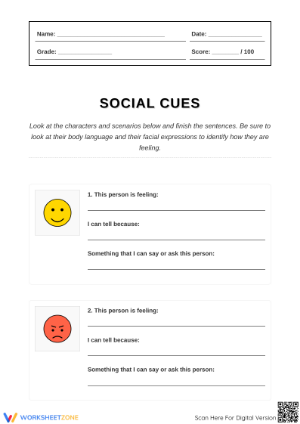
Perspective-taking worksheets present a short scenario and ask students to predict how two different characters might feel about the same event. The goal is not empathy as a vague concept but rather the concrete habit of checking whether someone else's reaction might differ from your own — a specific cognitive step that benefits from repeated, structured practice.
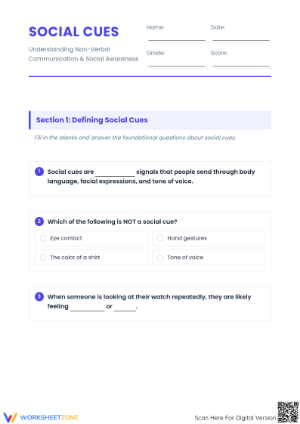
Non-verbal cue activities use illustrated characters in familiar settings — classroom, lunchroom, recess — and ask students to match facial expressions or body posture to labeled emotion words. At this grade level, a student might correctly read a cartoonish "happy face" but still miss a classmate's tight jaw and crossed arms signaling "leave me alone," so the illustrations are drawn from real peer situations rather than exaggerated icons.
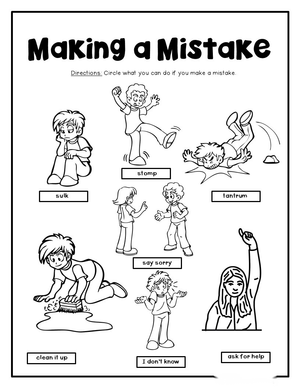
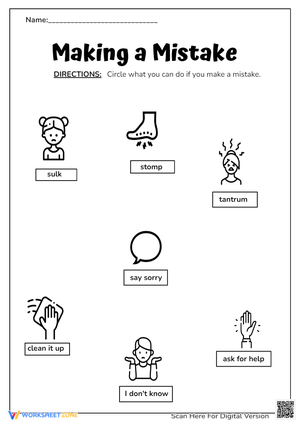
Self-regulation templates guide students through identifying personal triggers and selecting coping strategies from a preset menu — options like "ask for a break" or "take five deep breaths." A completed template at the student's desk becomes a quiet reference during difficult moments and gives the teacher a window into what the student believes helps them, which sometimes differs from what the IEP team has assumed.
Mistakes Students Make That These Worksheets Help You Catch
The most consistent error on the turn-taking sort is students placing empathy-adjacent phrases in the "stopper" column. A student will see "That sounds hard" and mark it as a stopper because it doesn't ask a question — even though in most conversations it functions as a driver by inviting the other person to keep talking. Catching this on a worksheet is easier than catching it mid-recess. Once the error is in writing, you can address it directly before the pattern calcifies in live interactions.
On perspective-taking worksheets, students often default to "sad" or "mad" as the only available emotions, writing the label they know is acceptable rather than reasoning through the scenario. The richer error appears when a student assigns the exact same emotion to both characters — correctly identifying that the situation is upsetting while missing that one character might feel relief rather than loss. A brief one-on-one verbal probe usually surfaces what the student actually understood versus what they guessed.
Building These Worksheets Into Your Weekly Routine
Two to three short sessions per week — ten to fifteen minutes each — produce better results than one longer block. Spreading practice across the week allows concepts to consolidate between sessions, which matters for autistic learners who often show gains when material is revisited with space in between rather than front-loaded all at once. Monday warm-ups after morning meeting and Thursday independent work blocks are natural slots many special educators use without disrupting the rest of the period.
The most effective implementation pairs worksheet completion with an immediate, low-stakes live application. After finishing a conversation drivers and stoppers sort, set a two-minute timer and have students try a partner exchange using only the driver phrases they identified. This is the move where 3rd grade social skills for autism pdf worksheets earn their place in the week — each worksheet builds shared vocabulary, and the live practice gives students somewhere to use it before the next session.
For students with social communication goals on their IEPs, completed worksheets work well as progress-monitoring artifacts. Date them, save them in the student's portfolio, and pull them out at IEP meetings. Families who receive a stack of data charts often respond more concretely to a single worksheet with the student's own handwriting showing what they could and couldn't articulate in October versus March.
Standard Alignment
These worksheets align with CASEL's core SEL competency domains of Relationship Skills — covering communication, turn-taking, and conflict resolution — and Social Awareness, which includes perspective-taking, recognizing non-verbal cues, and understanding others' emotional responses. For districts using CASEL-aligned SEL benchmarks, both domains appear in the grade 3–5 band with the expectation that students move from teacher-facilitated practice toward more independent application across settings. The non-verbal cue activities also address components of Common Core ELA Speaking and Listening standard SL.3.1, which calls for students to engage effectively in collaborative discussions and follow agreed-upon conversational norms. Teachers referencing the Indiana Resource Center for Autism guidelines or the Vanderbilt Kennedy Center social stories approach will find the visual scenario format in this set consistent with both frameworks.
Adjusting the Set for a Range of Learners
3rd grade social skills for autism pdf worksheets in this set hold up across a wider ability range than most teachers expect on first look. For students who are minimally verbal or use AAC devices, every open-ended written prompt has a workable alternative: students can circle a picture-based answer, point to the correct column, or use their device to respond. The social understanding being assessed doesn't require written language to demonstrate, and forcing writing into the response strips accuracy from what you're actually measuring.
For students who move quickly through the material, the perspective-taking worksheets extend naturally with one verbal follow-up question — not printed on the worksheet itself but posed directly: "What might the character do next, and how would that change how the other person feels?" That single oral extension pulls the work into more dynamic social reasoning without requiring a different worksheet entirely.
When these activities run whole-class, they work for neurotypical students as well. Running the activity with the full group removes any stigma from singling someone out and gives every student in the room explicit practice with skills most third graders are still developing — which means the autistic student is practicing alongside peers, not apart from them.
Frequently Asked Questions
Can these worksheets be used during small-group intervention rather than whole-class instruction?
Small-group delivery is often where 3rd grade social skills for autism pdf worksheets show the strongest results — groups of two to four students allow immediate discussion after each activity and make the live-practice transfer step far easier to facilitate. The conversation drivers and stoppers sort in particular benefits from having at least one partner present so students can test their categorizations in a real exchange right after completing the activity.
What's the right way to introduce a new worksheet format for the first time?
Model the first example as a whole-class think-aloud before releasing students to work independently. Walk through the comic strip or scenario, verbalize your reasoning about what a character might be feeling or saying, and complete one item together. Students who stall on an unfamiliar activity often aren't confused about the social concept — they're uncertain what a correct response looks like. One modeled example resolves that quickly and sets a clear task expectation for the rest of the worksheet.
How do completed worksheets connect to IEP documentation?
Completed worksheets function as work samples that document a student's current grasp of targeted social skills. Teachers can attach them to data collection sheets, reference specific student responses when writing present-level statements, and use them as concrete evidence during progress reviews. Aligning each worksheet topic directly to the student's active IEP objectives keeps instructional time purposeful — and it makes growth visible to families in a way that percentage-based data alone rarely does.
Clear All