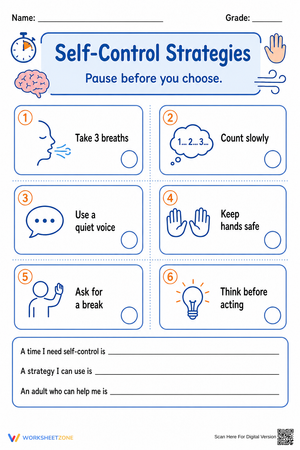
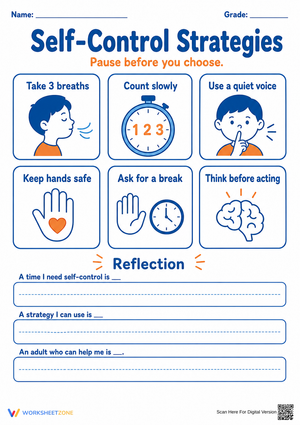
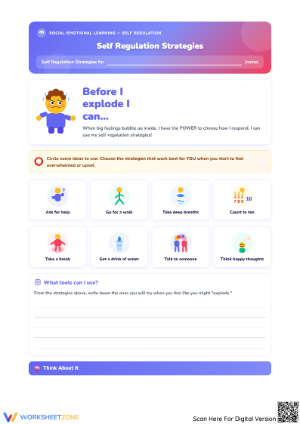
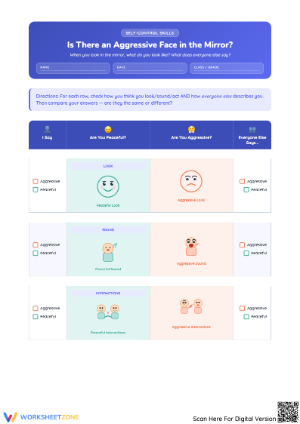
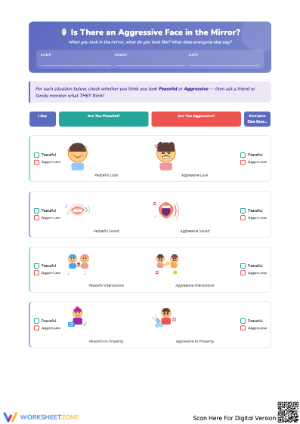
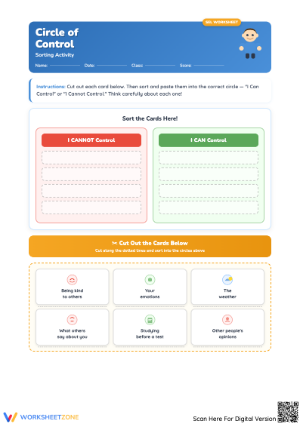
These self control worksheets for 3rd grade give teachers a direct starting point for SEL work at exactly the developmental moment when it matters most — the year students begin internalizing behavioral expectations rather than simply responding to adult supervision. The set covers physical body awareness, impulse-response sequencing, participation self-monitoring, and calming strategy selection, all framed in language that eight- and nine-year-olds can actually use.
The Skills Each Worksheet Targets
Third grade is the year many teachers start hearing "but I couldn't help it" as a genuine belief rather than a tactical excuse. Students this age are developmentally ready to understand that their brains can override a first reaction — they just haven't had enough structured practice doing it yet. Each worksheet in the set addresses one of four skill areas:
- Body cue identification — Students mark a body outline to locate where stress, frustration, or excitement builds before it spills into behavior. Common responses include tight chest, clenched jaw, and flushed face. Recognizing those signals before an outburst is the first real intervention point.
- Stop-Think-Act sequencing — Students write their impulse in the first box and a chosen response in the third. The middle step — actually stopping to think — is where most third graders need the most repetition.
- Participation self-monitoring — Tracking sheets where students tally raise-your-hand moments versus blurt-outs across a single class period. Counting their own behavior shifts attention from teacher correction to self-observation, which is the actual goal.
- Calming strategy rehearsal — Students choose from a menu of regulation strategies — deep breathing, counting backward, squeezing a fist — and write which one fits a specific scenario. Pre-selecting a strategy before a stressful moment is what makes it accessible when real pressure hits.
Fitting These Worksheets Into the School Week
The most reliable placement is the five minutes after morning meeting's opening ritual settles but before academic instruction begins. That window is low-stakes and calm — conditions where students can think honestly about their behavior rather than manage it defensively. Using one worksheet three mornings a week during that block produces more consistent retention than a dedicated thirty-minute SEL lesson done once.
The participation tracking sheets work best during a subject where talk is already high — reading discussion or math share-out. Hand a student the tracking worksheet at the start of the period and ask them to record honestly. Most take it seriously; a few will inflate their numbers early in the year, but a brief private conversation usually resolves that quickly. After recess is a natural second window: students come back activated, and a two-minute body-scan worksheet gives them a re-entry ritual before returning to seat work.
One technique worth pairing with any worksheet in the set: give each student a small "pause button" card — a circle of cardstock with PAUSE written on it — taped to their desk corner. When physical warning signs start climbing, touching the card is a tactile trigger to run through the Stop-Think-Act steps before speaking or acting. It reinforces the same language from the worksheet without requiring the student to pick up a pencil mid-impulse.
What Goes Wrong When Students Practice Self-Regulation
The most predictable misunderstanding at this grade level is students equating compliance with self-regulation. A student who stays quiet because the teacher is watching has not exercised self-control — they've responded to external pressure. This confusion surfaces clearly on the participation tracking worksheets: students sometimes count "I didn't blurt out during silent reading" as evidence of self-control. That tells you the concept of choosing hasn't clicked yet. A five-minute class discussion distinguishing "nothing happened to blurt about" from "I had something to say and decided to wait" usually untangles it.
A second pattern: students identify their calming strategy correctly on the reflection worksheet but abandon it the moment real pressure hits, because they've only practiced it during calm conditions. Reading "take three deep breaths" during a quiet writing period and actually slowing your breathing when a classmate just grabbed your pencil are different cognitive tasks. Brief scenario rehearsal — acting out the moment with a partner before writing the response — makes the worksheet practice transfer to actual situations far more reliably.
Standard Alignment
These worksheets align with CASEL's Self-Management competency, specifically the impulse control and stress management indicators at the late-primary level. Third grade represents the entry point in CASEL's developmental sequence where students begin identifying coping strategies proactively rather than only reflecting on behavior after the fact — which is why each worksheet in this set emphasizes planning and prediction rather than journaling about what went wrong. The Stop-Think-Act language integrates without translation into both Second Step and MindUp frameworks, which matters when a school is partway through adopting either curriculum.
Using These Worksheets With Students at Different Readiness Levels
Each worksheet in the self control worksheets for 3rd grade set can be adjusted with minimal prep to serve students across a wide range of readiness levels. For students who are further along in their SEL development, extend the body-scan worksheet by asking them to rate emotional intensity on a one-to-five scale and identify which specific situations reliably push them past a three. Students with strong writing fluency can also compose if-then plans — "If I feel my face getting hot during partner work, then I will..." — a strategy the research on executive function calls implementation intentions, which are consistently more effective than general goal-setting alone.
For students who need more structured support — particularly those with ADHD or significant working-memory challenges — the three-step decision map works better when reduced to two steps at first: Stop, then Act. The Think step is genuinely the hardest for students whose executive processing gets hijacked under emotional load. Clipping a small picture card of two pre-approved calming strategies to their worksheet removes the retrieval demand in the moment. Once the Stop-Act sequence is reliable, adding the Think step back in is a natural next move.
Frequently Asked Questions
Can these worksheets be used in individual student check-ins rather than whole-class lessons?
Yes — for many students, the self control worksheets for 3rd grade have their strongest impact during a brief one-on-one conversation rather than a group lesson. The body-scan and decision-map worksheets give a check-in a focus and a concrete product, which helps students who shut down during open-ended behavioral discussions. Keep printed copies in a folder so access doesn't depend on finding printer time mid-morning.
How do I reach a student who thinks self-control lessons don't apply to them?
The tracking sheets reach resistant students faster than discussion-based activities, because the data belongs to the student rather than coming from the teacher. A student who insists they never blurt out often surprises themselves when they actually count. Frame the tracking worksheet as curiosity rather than evaluation — "let's just find out what the number actually is" — and most third graders engage with the challenge of watching their own behavior objectively.
What should I do when a student fills out a worksheet dishonestly?
Expect it in the first few weeks. A reflection log that reads "I always used self-control today" from a student who had a rough recess is still useful information — it tells you the student either lacks awareness or doesn't yet feel safe being honest. Before assigning individual sheets, try using the self control worksheets for 3rd grade as a class-wide anonymous discussion tool: share a fictional student example and talk through it together. That builds the norm of honest self-reporting before students fill out their own.
Do families need preparation before students bring these worksheets home?
A short note home at the start of the unit prevents confusion. Parents who receive a worksheet with "Stop, Think, Act" written on it without context sometimes assume their child was in trouble that day. Two sentences — "We're practicing self-regulation strategies in class; if your child mentions these steps, they're the same ones from their worksheets" — aligns school and home language, which is when the skills transfer most reliably outside the classroom. Encouraging families to identify their own physical warning signs together over dinner reinforces the body-awareness work without asking parents to run a lesson.












 Interactive Worksheet Maker
 Quiz Maker
 Word Search Maker
 Crossword Puzzle Maker
 Word Scramble Generator
 Sentence Scramble Generator
 Handwriting Worksheet Generator
 Name Tracing Generator
 Fill In The Blank Generator