


























Views
Downloads

Bragging and Humility Worksheet | Grade 4 Essential
Paste this activity's link or code into your existing LMS (Google Classroom, Canvas, Teams, Schoology, Moodle, etc.).
Students can open and work on the activity right away, with no student login required.
You'll still be able to track student progress and results from your teacher account.
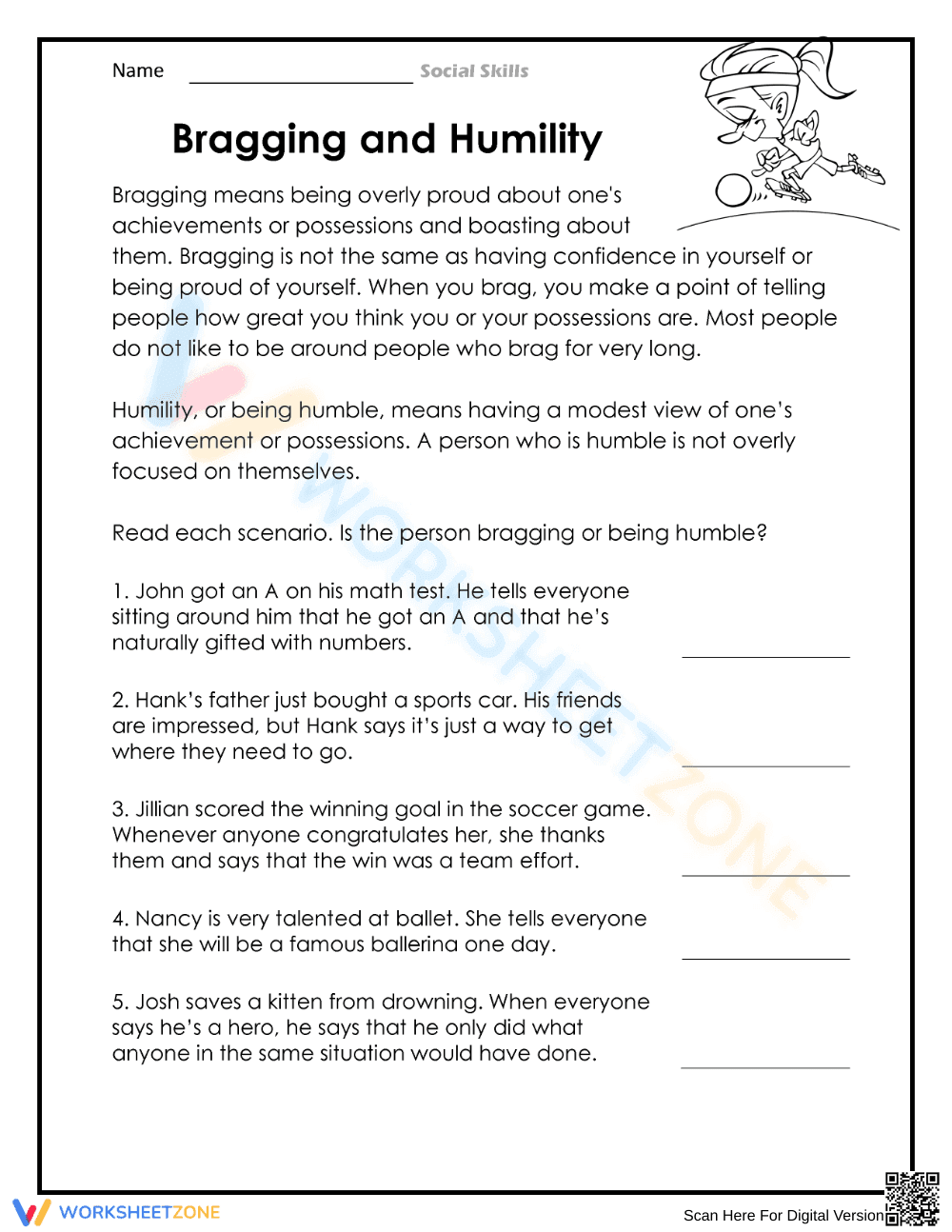
This Grade 4 social skills worksheet helps students distinguish between bragging and humility through clear definitions and relatable scenarios. By analyzing five specific social interactions, learners develop the self-awareness necessary to build positive peer relationships and understand the impact of their words on others. It provides an immediate, actionable framework for character development.
At a Glance
- Grade: 4 · Subject: Social Skills
- Standard:
CCSS.ELA-LITERACY.SL.4.1— Engage in collaborative discussions and follow agreed-upon rules for social interactions- Skill Focus: Identifying Bragging vs. Humility
- Format: 1 page · 5 problems · Answer key included · PDF
- Best For: Morning meetings or character education
- Time: 15–20 minutes
The worksheet begins with concise, student-friendly definitions of bragging and humility to establish a common vocabulary. Below the instructional text, students encounter five distinct scenarios involving academic success, sportsmanship, and personal achievements. Each scenario requires the student to evaluate the character's response and categorize it, reinforcing the conceptual difference between confidence and boasting.
This resource is designed for a zero-prep workflow to maximize instructional time. First, print the single-page PDF (30 seconds). Next, distribute the worksheet during a morning meeting or social-emotional learning block (1 minute). Finally, review the five scenarios as a whole class to facilitate a discussion on why certain behaviors are perceived as bragging (5-10 minutes). Total teacher preparation is under two minutes.
This activity aligns with CCSS.ELA-LITERACY.SL.4.1, which focuses on following agreed-upon rules for discussions and carrying out assigned roles. By learning the social rules of humility, students are better prepared for collaborative academic environments. Both standard codes can be copied directly into lesson plans, IEP goals, or district curriculum mapping tools.
Use this worksheet as a formative assessment after a lesson on character traits. It is particularly effective during the guided practice phase of a social skills lesson. Teachers should observe if students can explain why a scenario represents bragging, looking for mentions of boasting or overly proud language. Expect completion within 15 to 20 minutes.
This resource is ideal for general education students in grades 3-5, as well as small-group counseling sessions or speech-language therapy focusing on pragmatics. It pairs naturally with a classroom anchor chart on Social Filters or a read-aloud book focused on sportsmanship and modesty.
According to Fisher & Frey (2014), the explicit teaching of social-emotional vocabulary and situational analysis is critical for developing student agency and classroom community. This worksheet addresses the CCSS.ELA-LITERACY.SL.4.1 standard by providing concrete examples of social interactions that students must evaluate. Research indicates that when students can identify the difference between humility and bragging, they demonstrate higher levels of social competence and are more likely to be accepted by their peers. By utilizing these 5 targeted scenarios, educators provide the structured practice necessary for students to internalize these complex social nuances. This resource serves as a foundational tool for character education, ensuring that students not only recognize these traits in others but also reflect on their own communication styles during collaborative tasks.


