


























Views
Downloads

Essential Plant Life Cycle Worksheet | Grade 2 Science
Paste this activity's link or code into your existing LMS (Google Classroom, Canvas, Teams, Schoology, Moodle, etc.).
Students can open and work on the activity right away, with no student login required.
You'll still be able to track student progress and results from your teacher account.
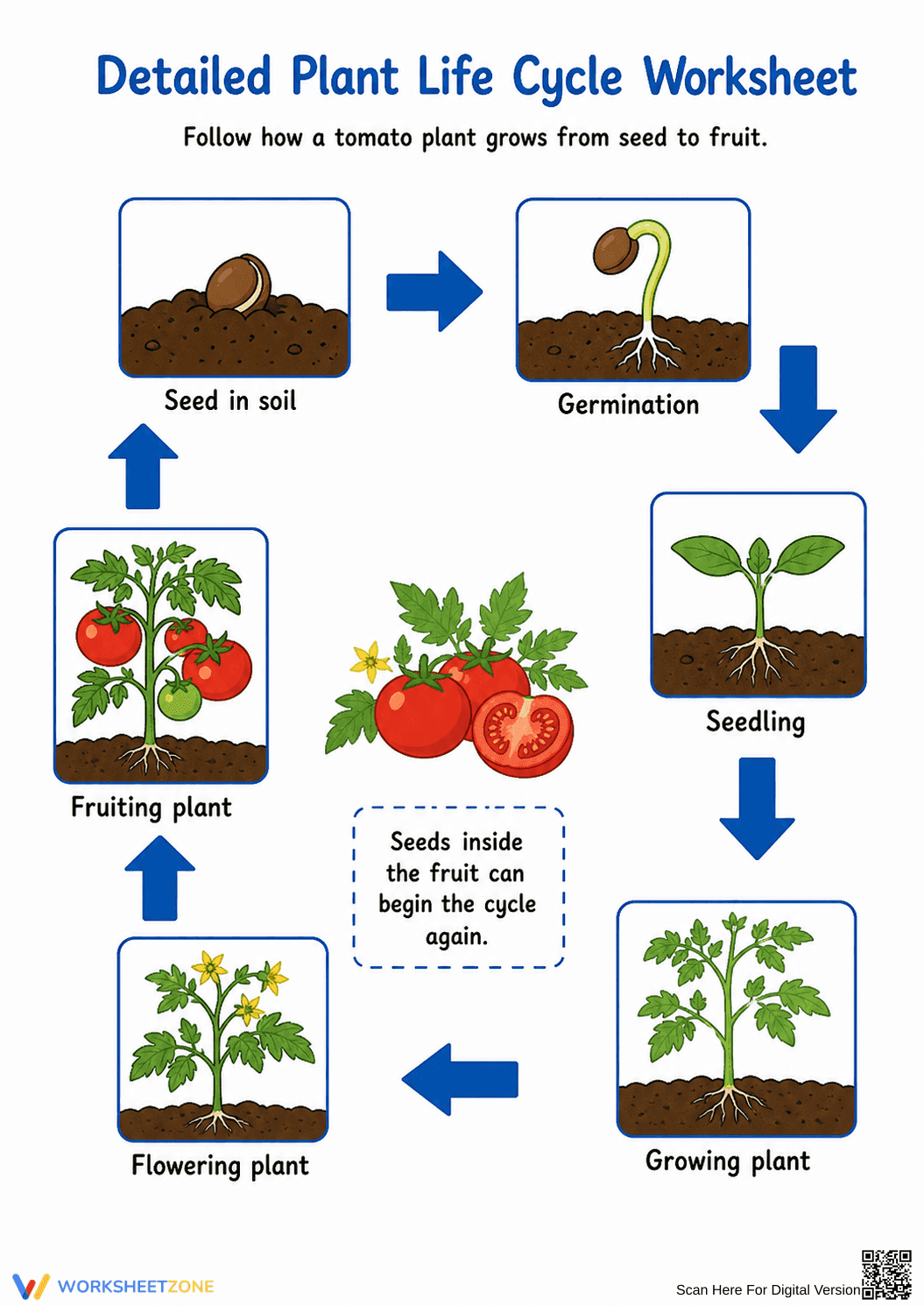
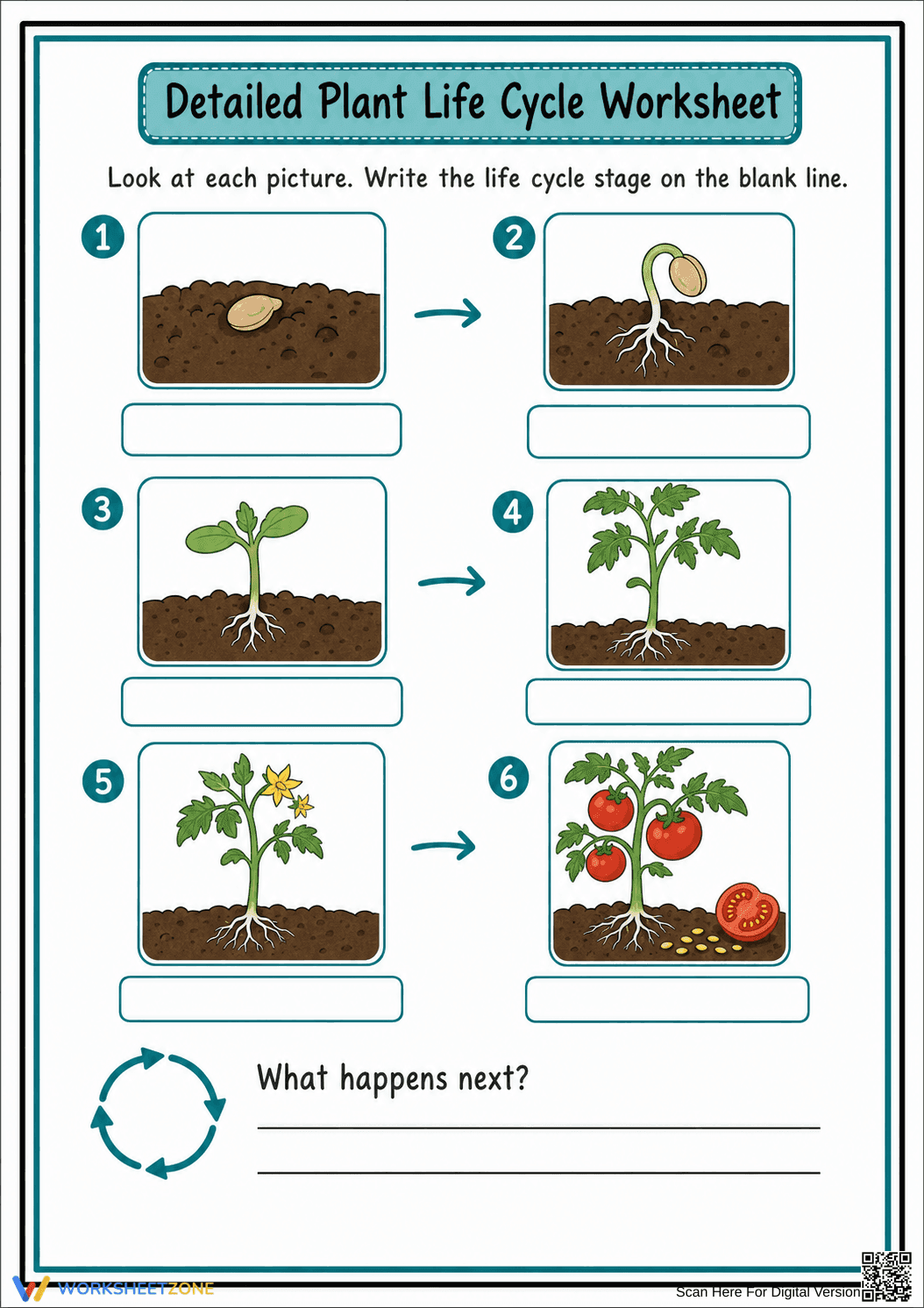
This Grade 2 science resource provides a comprehensive visual guide and practice sheet for understanding the tomato plant life cycle. Students first observe a detailed anchor chart before independently labeling the six critical stages of growth. This structured approach ensures students master biological sequencing and botanical vocabulary through clear, illustrative evidence.
At a Glance
- Grade: 2 · Subject: Science
- Standard:
2-LS2-1— Observe and describe how plants grow and change over time- Skill Focus: Plant life cycle sequencing
- Format: 2 pages · 7 problems · Answer key included · PDF
- Best For: Introduction to botany and life cycles
- Time: 15–20 minutes
The download contains two high-quality PDF pages. The first page serves as a "Detailed Plant Life Cycle" anchor chart, featuring vibrant illustrations of a seed in soil, germination, seedling, growing plant, flowering plant, and fruiting plant. The second page is a student activity sheet that mirrors these visuals, providing blank text boxes for labeling and a concluding question about the cycle's continuity.
Zero-Prep Workflow
- Print: Select the 2-page PDF and print enough copies for your class (30 seconds).
- Distribute: Hand out the reference diagram first for a 5-minute whole-group discussion, then provide the labeling sheet (1 minute).
- Review: Use the anchor chart to self-correct or peer-review the stage names (5 minutes).
Total teacher prep time is under 2 minutes, making this an ideal resource for morning work or emergency sub plans.
Standards Alignment
This resource is aligned with `2-LS2-1`, which emphasizes the observation of plant growth and the requirements for development. While it introduces the concept of life cycles typically found in `3-LS1-1`, it serves as an essential foundational tool for second-grade life science units. Both standard codes can be copied directly into lesson plans, IEP goals, or district curriculum mapping tools.
How to Use It
Use this worksheet during the "Explain" phase of a 5E lesson model to solidify vocabulary after an initial plant dissection or planting activity. It also functions as an excellent formative assessment; observe if students can correctly identify the "germination" and "seedling" stages without referring back to the first page. Expected completion time is 15 to 20 minutes.
Who It's For
This worksheet is ideal for general education second-grade students, as well as English Language Learners (ELLs) who benefit from the strong visual-to-text correlation. It pairs naturally with a classroom gardening project or a non-fiction reading passage about how food grows and the role of seeds in agriculture.
The "Detailed Plant Life Cycle Worksheet" aligns with the NGSS 2-LS2-1 standard, focusing on the observable growth patterns and developmental stages of flowering plants. By utilizing a visual anchor chart alongside a retrieval-based labeling task, the resource supports the "gradual release of responsibility" model. According to Fisher & Frey (2014), providing visual scaffolds before independent practice significantly improves the retention of scientific vocabulary in early elementary learners. This worksheet specifically targets the transition from seed germination to fruit production, allowing students to conceptualize the circular nature of biological life. The inclusion of a "What happens next?" prompt encourages higher-order thinking by requiring students to predict the restart of the cycle. This 2-page set is designed to reduce teacher cognitive load while maximizing student engagement through clear, high-contrast illustrations and structured response areas.


