


























Views
Downloads

Tomato Life Cycle Worksheet | Essential Grade K-2 Science
Paste this activity's link or code into your existing LMS (Google Classroom, Canvas, Teams, Schoology, Moodle, etc.).
Students can open and work on the activity right away, with no student login required.
You'll still be able to track student progress and results from your teacher account.
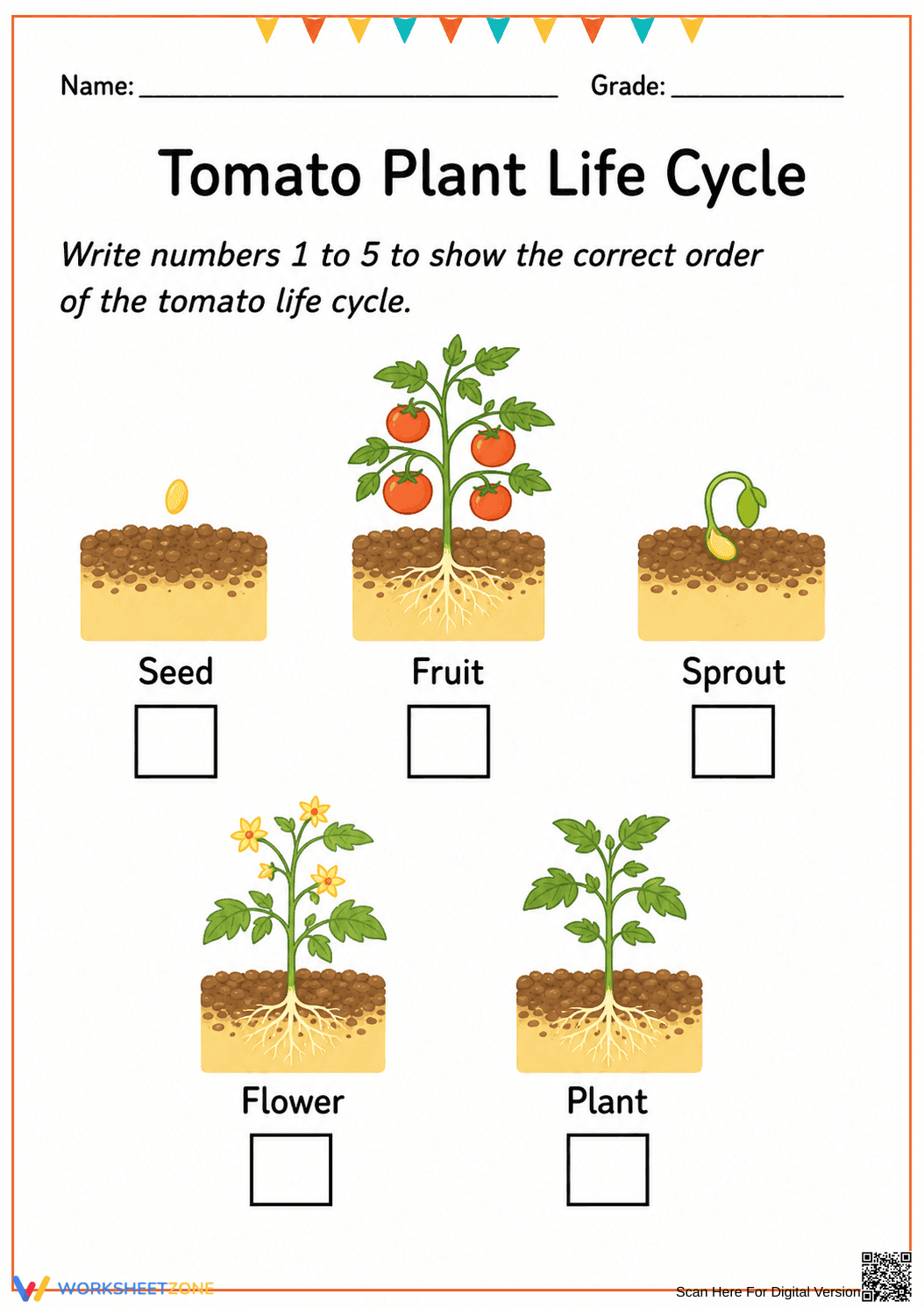
This Grade K-2 science worksheet provides a clear, visual framework for understanding the biological progression of a tomato plant. By sequencing five distinct growth stages, students develop a foundational understanding of how organisms change over time. This activity transforms abstract biological concepts into a concrete, manageable task for early learners.
At a Glance
- Grade: K-2 · Subject: Life Science
- Standard:
K-LS1-1— Observe and describe patterns of what plants and animals need to survive- Skill Focus: Chronological sequencing and plant development
- Format: 1 page · 5 problems · Answer key included · PDF
- Best For: Independent practice or science center activity
- Time: 10–15 minutes
What's Inside: The worksheet features five high-quality illustrations representing the seed, sprout, plant, flower, and fruit stages of a tomato. Each image is accompanied by a clear label and a dedicated input box for numbering. The layout is designed for high legibility, ensuring that young students can focus on the logic of the life cycle without visual clutter. A full answer key is provided for quick grading.
This resource is designed for a zero-prep workflow to maximize instructional time. First, print the single-page PDF in under 30 seconds. Second, distribute the sheets to students and provide a brief overview of the five stages (approximately 1 minute). Third, review the completed sequences as a whole group to reinforce the vocabulary (5 minutes). Total teacher preparation time is under 2 minutes, making it an ideal choice for sub plans or morning work.
Standards Alignment: This activity aligns with `K-LS1-1`, focusing on the observation of patterns in living things. By identifying the specific order of growth, students demonstrate an understanding that plants follow a predictable developmental path. Both standard codes can be copied directly into lesson plans, IEP goals, or district curriculum mapping tools.
How to Use It: Use this as a formative assessment after a classroom gardening project or a read-aloud about plants. Teachers can observe if students correctly identify the "flower" stage as preceding the "fruit" stage, which is a common point of confusion. Completion typically takes 10 to 15 minutes depending on the grade level and prior knowledge.
Who It's For: This is tailored for Kindergarten through 2nd-grade students, including English Language Learners who benefit from the strong visual cues. It pairs naturally with a "Parts of a Plant" anchor chart or a hands-on seed-planting lesson to provide a comprehensive view of elementary botany.
According to the RAND AIRS 2024 analysis of early childhood science materials, high-quality visual sequencing tasks are essential for developing the cognitive schemas required for later complex biological study. This worksheet utilizes the K-LS1-1 standard to bridge the gap between simple observation and scientific modeling. By requiring students to number the stages from seed to fruit, the activity reinforces the concept of linear time and biological necessity. Research from Fisher & Frey (2014) suggests that such scaffolded tasks allow students to internalize vocabulary like "sprout" and "fruit" more effectively than through rote memorization alone. This resource provides a structured environment for students to practice these skills, ensuring they meet foundational NGSS requirements. The inclusion of clear, distinct stages supports the development of observation skills that are critical for success in higher-grade life science modules and standardized assessments.


