




























Views
Downloads

Sex-Linked Traits Worksheet | Essential Grade 9-12 Biology

Paste this activity's link or code into your existing LMS (Google Classroom, Canvas, Teams, Schoology, Moodle, etc.).
Students can open and work on the activity right away, with no student login required.
You'll still be able to track student progress and results from your teacher account.
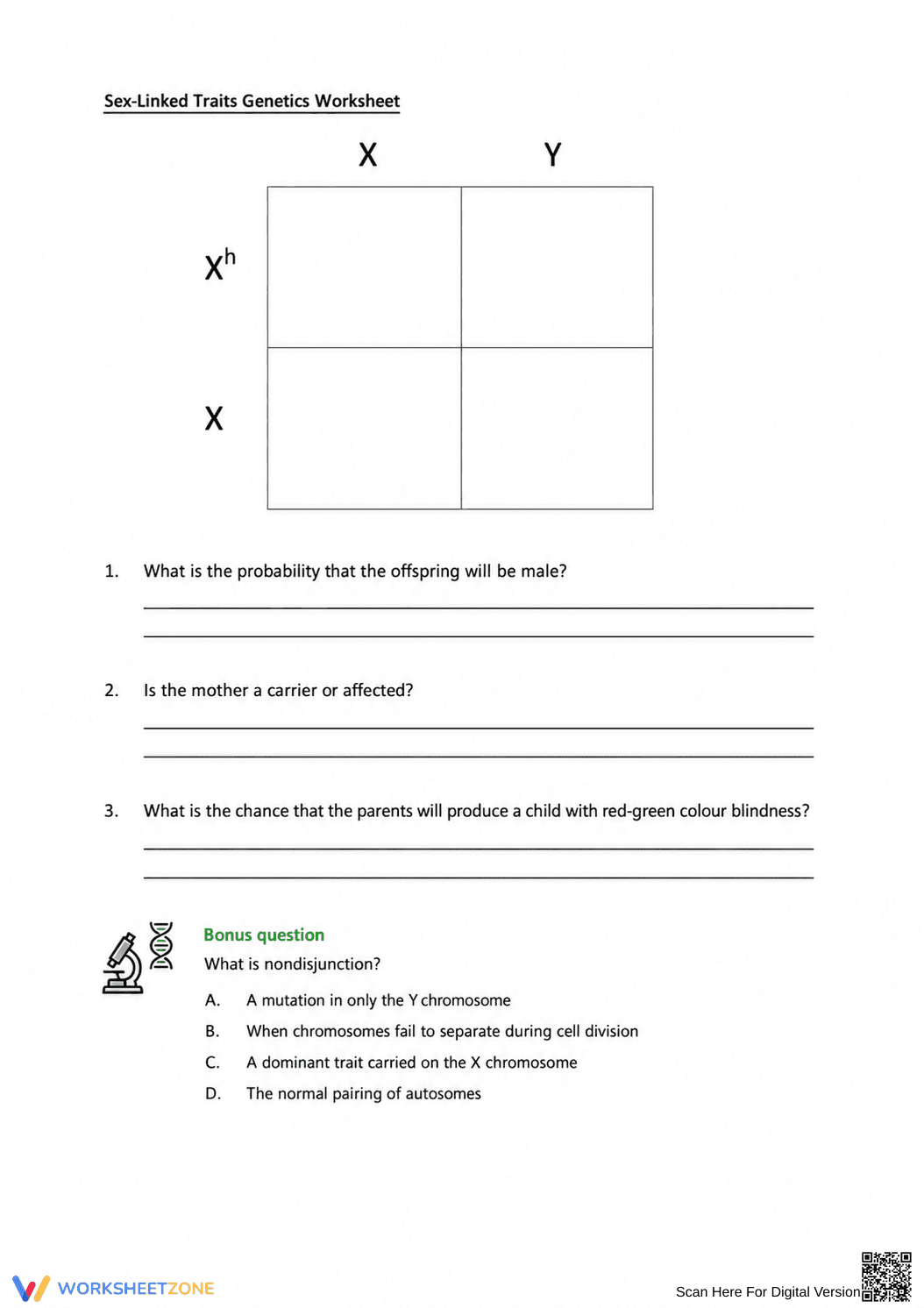
This high school biology worksheet provides targeted practice for analyzing sex-linked recessive inheritance patterns. Students use a Punnett square to determine the probability of offspring inheriting red-green color blindness based on parental genotypes. It effectively bridges the gap between theoretical genetics and practical probability calculations in a concise, one-page format.
At a Glance
- Grade: 9-12 · Subject: Biology
- Standard:
HS-LS3-3— Apply probability to explain the variation and distribution of expressed traits- Skill Focus: X-linked recessive inheritance
- Format: 1 page · 5 problems · Answer key included · PDF
- Best For: Quick formative assessment or sub plans
- Time: 15–20 minutes
The worksheet features a central 2x2 Punnett square pre-labeled with maternal (Xh, X) and paternal (X, Y) genotypes. Below the diagram, three open-response questions require students to calculate male offspring probability, identify carrier status, and determine the likelihood of color blindness. A bonus multiple-choice question introduces the concept of nondisjunction to challenge advanced learners.
Zero-Prep Workflow
- Print: Generate the single-page PDF for your entire class in under 30 seconds.
- Distribute: Hand out the worksheet as a focused bell-ringer or an exit ticket to gauge student understanding.
- Review: Use the included answer key to provide immediate feedback or allow for student self-correction during the final 5 minutes of class.
Aligned to HS-LS3-3, students apply concepts of statistics and probability to explain the variation and distribution of expressed traits in a population. It also supports MS-LS3-2 by demonstrating how gene mutations can result in harmful, beneficial, or neutral effects. Both standard codes can be copied directly into lesson plans, IEP goals, or district curriculum mapping tools.
Use this worksheet immediately after a lecture on sex chromosomes to check for understanding. It works well as a formative assessment where the teacher circulates to observe if students correctly pair the "h" superscript. Alternatively, assign it as a homework refresher before a unit test on Mendelian and non-Mendelian genetics. Completion typically takes 15 to 20 minutes.
This resource is ideal for Grade 9-12 biology students, including those in Honors or AP Biology needing a quick review. The clear layout supports English Language Learners and students with IEPs by providing a structured visual framework. Pair this with a pedigree chart activity or a video on chromosomal abnormalities for a comprehensive lesson.
According to the RAND AIRS 2024 report on secondary science instruction, the use of structured visual organizers like Punnett squares significantly improves student retention of non-Mendelian inheritance concepts. This worksheet addresses the specific cognitive load challenges associated with tracking X-linked traits by providing a clear, pre-labeled grid. By focusing on a single trait—red-green color blindness—students can master the mechanics of sex-linked probability without the distraction of complex multi-trait crosses. The inclusion of a nondisjunction bonus question aligns with research suggesting that connecting inheritance patterns to chromosomal behavior during meiosis deepens conceptual mastery. This 1-page resource provides the high-repetition, low-stakes practice necessary for students to move from guided instruction to independent mastery of HS-LS3-3. It is an essential tool for biology educators seeking to quantify student progress in genetics through measurable, standard-aligned tasks that can be easily integrated into existing curriculum frameworks.


