


























Views
Downloads

Sex-Linked Traits Worksheet | Grade 9 Biology Printable
Paste this activity's link or code into your existing LMS (Google Classroom, Canvas, Teams, Schoology, Moodle, etc.).
Students can open and work on the activity right away, with no student login required.
You'll still be able to track student progress and results from your teacher account.
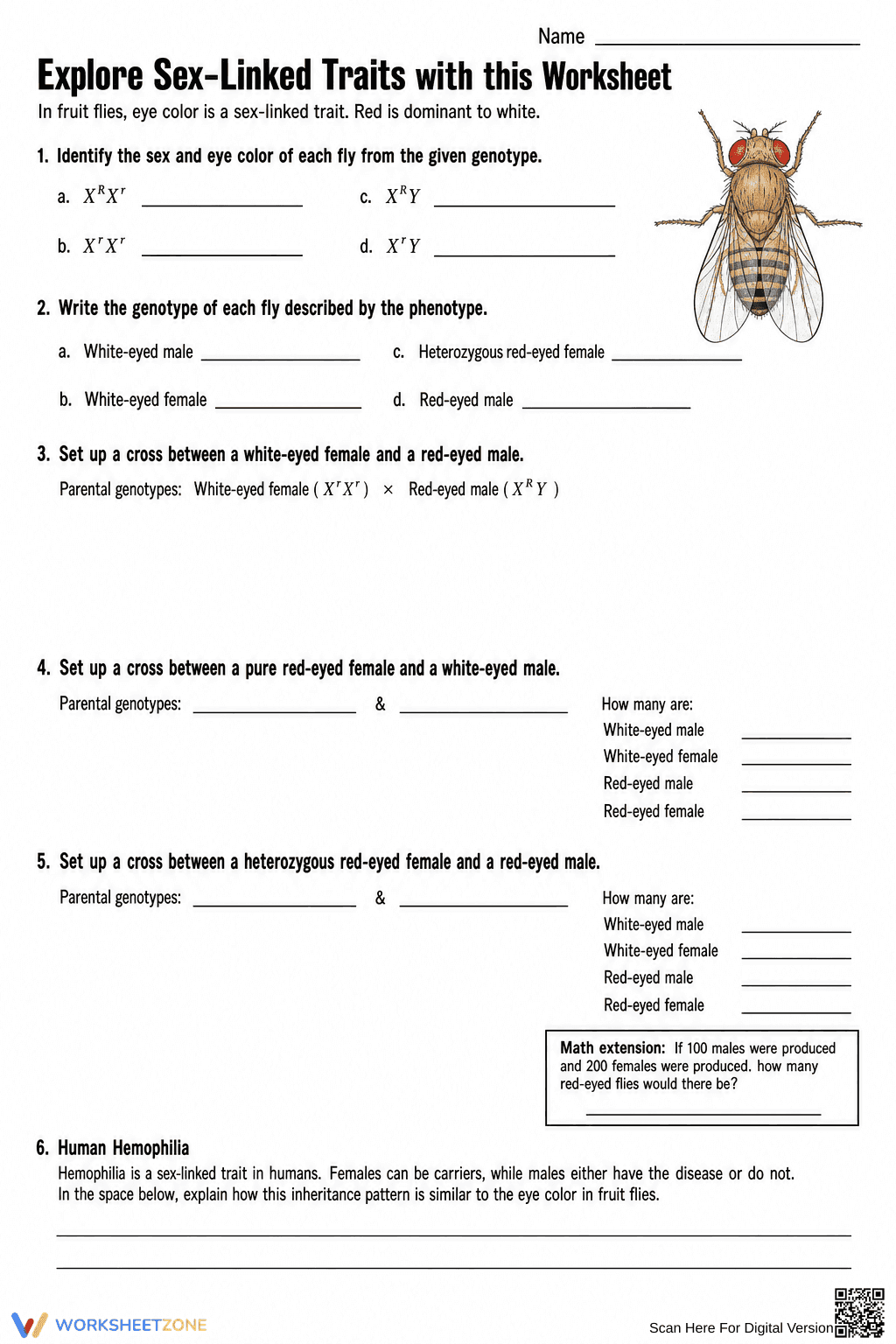
This high school biology worksheet provides targeted practice on sex-linked traits and X-linked inheritance patterns. By completing these genetics problems, students will learn to accurately predict offspring genotypes and phenotypes using Punnett squares, specifically focusing on real-world examples like fruit fly eye color and human hemophilia.
At a Glance
- Grade: 9 · Subject: Biology
- Standard:
HS-LS3-3— Apply probability to explain trait variation and distribution- Skill Focus: Sex-Linked Traits and Punnett Squares
- Format: 3 pages · 10 problems · Answer key included · PDF
- Best For: Independent practice and review
- Time: 30–45 minutes
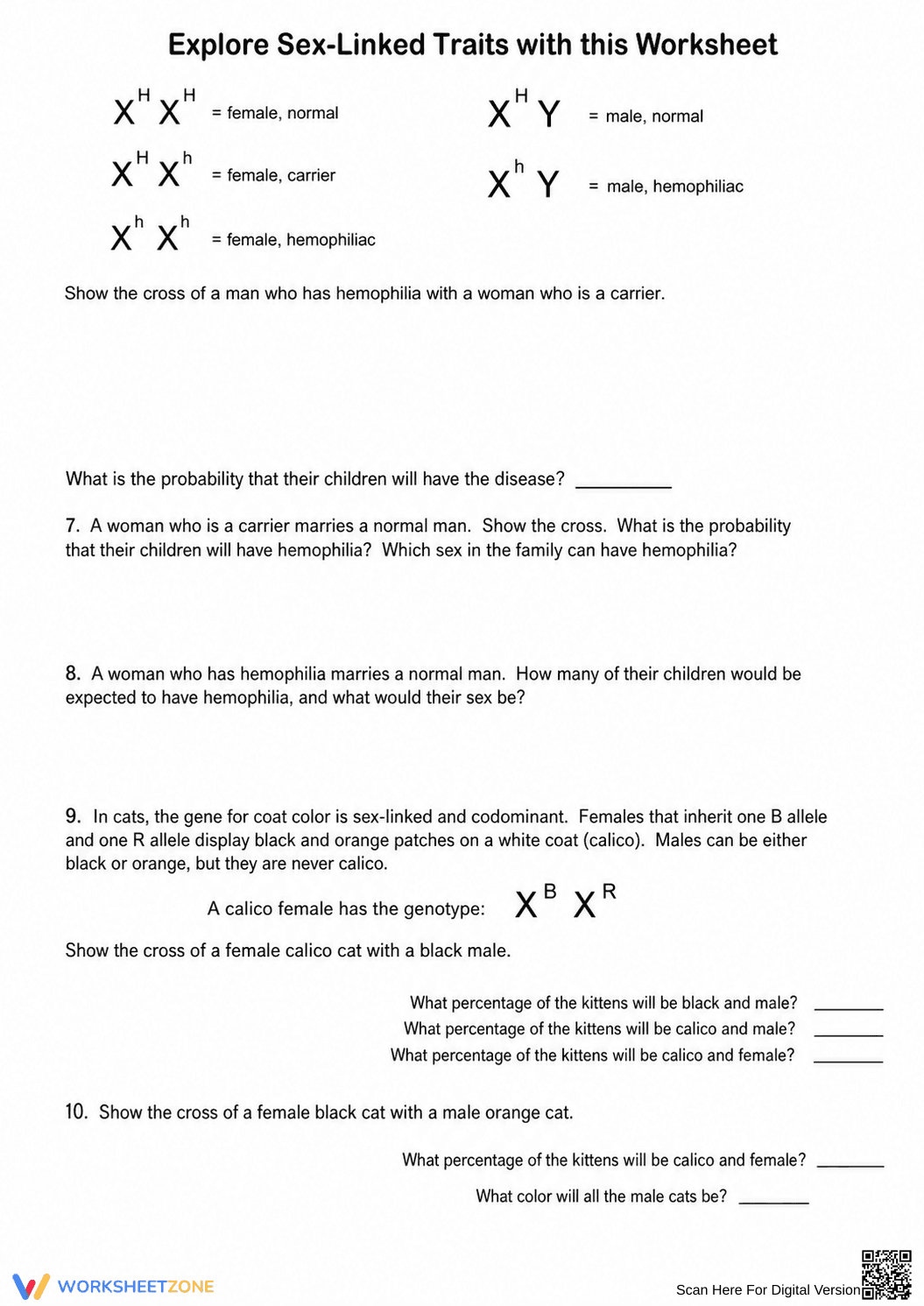
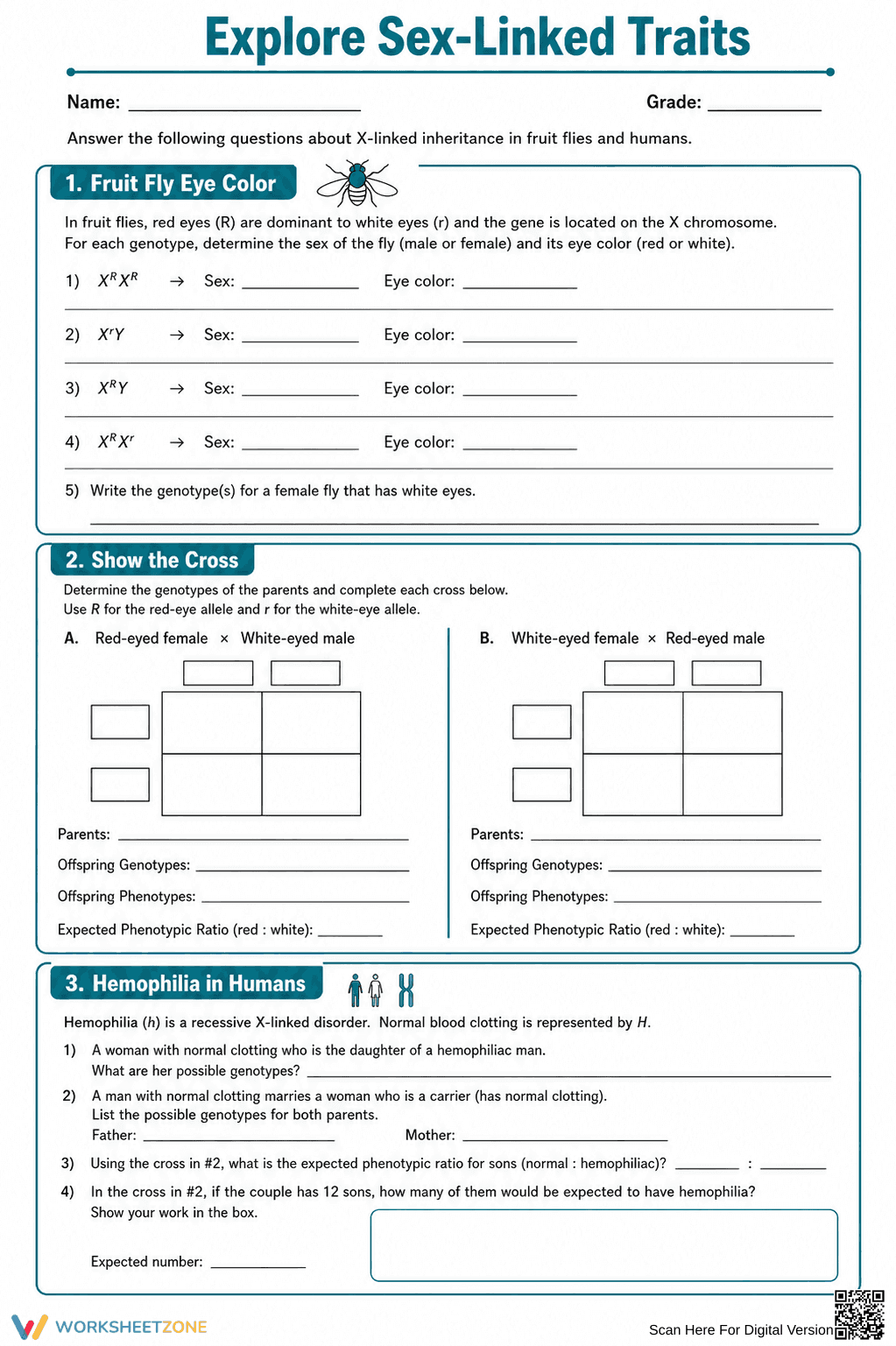
Inside this 3-page PDF, educators will find a comprehensive set of genetics problems structured to build student confidence. The resource includes genotype and phenotype identification tasks, monohybrid cross setups, and probability calculations. Students will analyze X-linked recessive traits through classic examples, including Drosophila (fruit fly) eye color, human hemophilia, and codominant calico cat coat colors. A complete answer key is provided to ensure accurate grading and facilitate quick feedback.
- Guided practice: The first section introduces basic genotype and phenotype identification for X-linked traits, ensuring students understand the notation for male and female chromosomes.
- Supported practice: Students progress to setting up Punnett squares for specific crosses, with provided parental phenotypes to help them determine the correct alleles.
- Independent practice: The final problems require students to read word problems, deduce parental genotypes, complete the crosses, and calculate expected phenotypic ratios and percentages independently.
This gradual-release approach ensures students build foundational knowledge before tackling complex probability questions.
This resource is aligned to HS-LS3-3: Apply concepts of statistics and probability to explain the variation and distribution of expressed traits in a population. It also supports foundational genetics comprehension required for advanced biology coursework. Both standard codes can be copied directly into lesson plans, IEP goals, or district curriculum mapping tools.
Deploy this worksheet during your genetics unit after direct instruction on non-Mendelian inheritance. It serves as an excellent independent practice assignment or a collaborative station activity where students can discuss their Punnett square setups. As a formative assessment tip, walk around the room and observe how students write the male Y chromosome; ensure they are not attaching alleles to it for X-linked traits, which is a common misconception. Students typically complete this assignment in 30 to 45 minutes.
This worksheet is designed for high school biology students in grades 9 through 12 learning about complex inheritance patterns. To support learners who struggle with reading comprehension, teachers can highlight the key phenotypes in the word problems before distributing the assignment. It pairs perfectly with a visual anchor chart detailing the differences between autosomal and sex-linked inheritance.
Mastering HS-LS3-3 requires students to apply probability to explain trait variation and distribution. When students practice calculating expected phenotypic ratios for sex-linked traits, they develop critical analytical skills necessary for advanced scientific literacy. According to a ScienceDirect TpT Analysis, providing students with structured, step-by-step genetics problems significantly improves their ability to transfer mathematical reasoning to biological concepts. This targeted practice helps solidify the connection between abstract chromosomal inheritance and observable physical traits. By repeatedly setting up Punnett squares and analyzing the outcomes of X-linked crosses, learners move beyond rote memorization and begin to understand the statistical nature of genetic inheritance. This foundational knowledge is essential for success in upper-level science courses and fosters a deeper appreciation for the complexity of human and animal genetics.


