




























Views
Downloads


Printable Sex-Linked Traits Worksheet | Grade 9 Biology

Paste this activity's link or code into your existing LMS (Google Classroom, Canvas, Teams, Schoology, Moodle, etc.).
Students can open and work on the activity right away, with no student login required.
You'll still be able to track student progress and results from your teacher account.
This high school biology worksheet provides focused practice on sex-linked traits, helping students calculate the probability of offspring inheriting specific genetic conditions. By working through realistic scenarios involving hemophilia and colorblindness, learners will strengthen their ability to construct Punnett squares and accurately interpret complex genotypic and phenotypic ratios.
At a Glance
- Grade: 9 · Subject: Biology
- Standard:
HS-LS3-3— Apply concepts of probability to explain the variation of expressed traits- Skill Focus: Sex-linked inheritance and Punnett squares
- Format: 2 pages · 18 problems · PDF
- Best For: Independent practice or homework assignments
- Time: 30–40 minutes
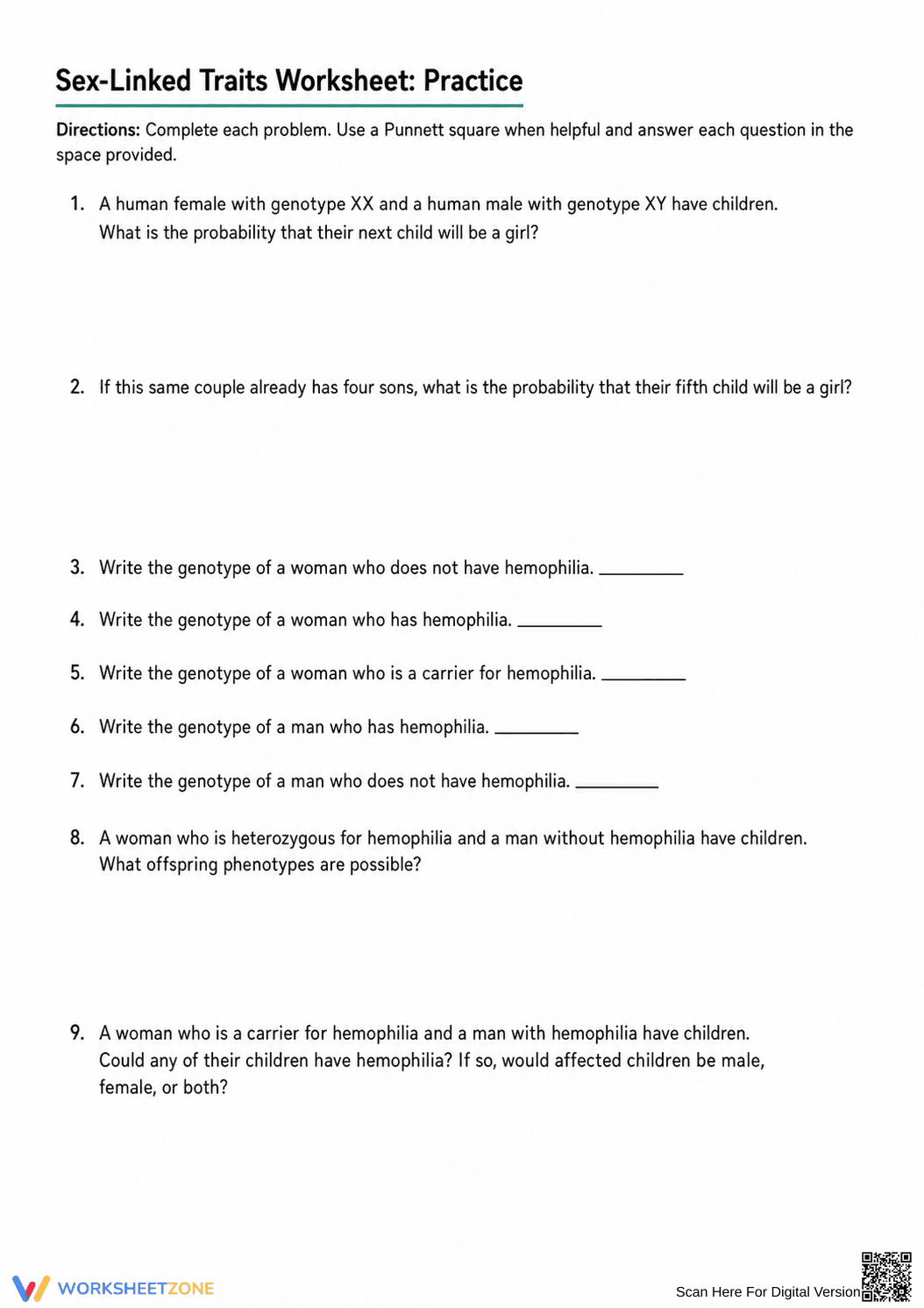
This two-page resource features 18 carefully sequenced problems that guide students through the mechanics of sex-linked inheritance. The first page focuses on hemophilia and basic sex determination, requiring students to write specific genotypes for carriers and affected individuals. The second page introduces colorblindness, challenging learners to set up their own Punnett squares from word problems and determine the exact phenotypic probabilities for both male and female offspring.
- Guided practice: The initial questions establish foundational knowledge by asking students to identify and write out the specific genotypes for males and females, including carriers.
- Supported practice: Mid-level problems provide parental genotypes and ask students to determine the possible phenotypes of their children, reinforcing the connection between alleles and physical traits.
- Independent practice: The final tasks require students to read a scenario, determine the parental genotypes independently, construct a Punnett square, and calculate the exact percentage or probability of specific outcomes.
This gradual-release approach ensures students build confidence before tackling complex, multi-step genetic crosses.
This resource is directly aligned to HS-LS3-3: Apply concepts of statistics and probability to explain the variation and distribution of expressed traits in a population. It specifically targets the application of probability to sex-linked recessive disorders. Both standard codes can be copied directly into lesson plans, IEP goals, or district curriculum mapping tools.
Deploy this worksheet following direct instruction on sex chromosomes. It serves as excellent independent practice, taking students 30 to 40 minutes to complete. Alternatively, use it as a targeted review before a unit exam. As a formative assessment tip, walk the room while students work on colorblindness problems; ensure they correctly place alleles on the X chromosomes and leave the Y chromosome blank, a common point of confusion.
This material is designed for high school biology students mastering Mendelian and non-Mendelian genetics. It is particularly helpful for visual learners who benefit from writing out genotypes before attempting mental calculations. For students needing extra support, pair this worksheet with a visual anchor chart detailing the differences between autosomal and sex-linked inheritance patterns.
Mastering complex genetic probabilities requires repeated, highly structured practice with realistic biological scenarios. This targeted worksheet aligns directly with HS-LS3-3, helping students apply probability to explain trait variation across generations. According to a recent ScienceDirect TpT Analysis, providing students with focused problem sets that isolate specific genetic variables—such as sex-linked recessive traits—significantly improves their ability to transfer these analytical skills to broader, more complex biological phenomena. When learners actively construct Punnett squares and calculate exact genotypic and phenotypic ratios, they move beyond simple rote memorization and develop a much deeper conceptual understanding of inheritance mechanisms. By carefully breaking down the sequential steps from identifying parental genotypes to predicting offspring phenotypes, this resource minimizes cognitive overload and maximizes long-term skill retention. Consistent engagement with these types of rigorous analytical tasks ensures students are thoroughly prepared for advanced scientific reasoning and standardized assessments in high school biology.


