




























Views
Downloads

HS-LS3-3 Worksheet: Sex-Linked Traits — Essential Biology

Paste this activity's link or code into your existing LMS (Google Classroom, Canvas, Teams, Schoology, Moodle, etc.).
Students can open and work on the activity right away, with no student login required.
You'll still be able to track student progress and results from your teacher account.
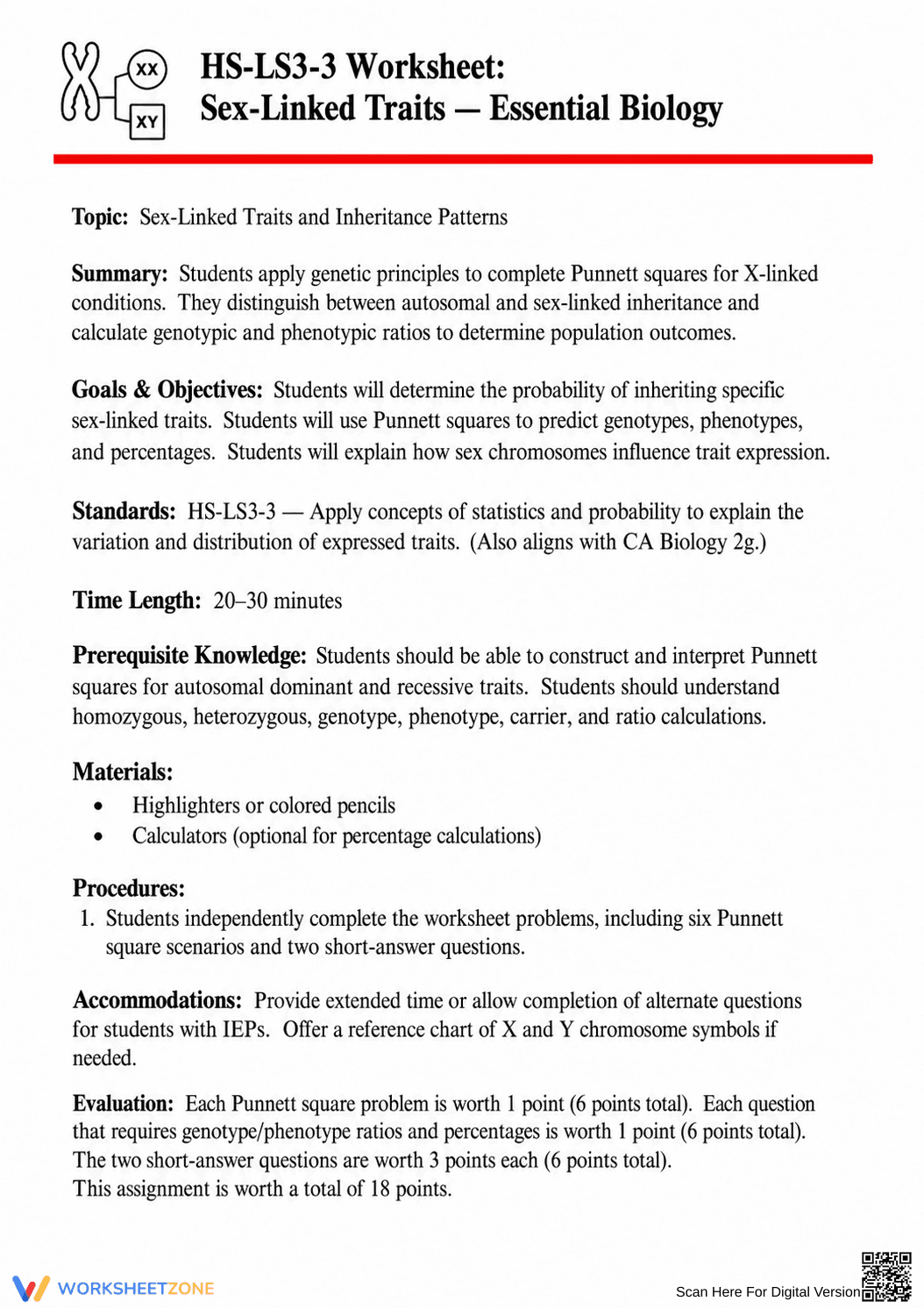
This high school biology worksheet provides a structured approach to understanding inheritance patterns through sex-linked traits. Students apply genetic principles to solve complex Punnett squares, distinguishing between autosomal and X-linked disorders. By calculating genotypic and phenotypic ratios, learners develop a quantitative understanding of how specific traits are passed through generations.
At a Glance
- Grade: 9-12 · Subject: Biology
- Standard:
HS-LS3-3— Apply concepts of statistics and probability to explain the variation and distribution of expressed traits- Skill Focus: Sex-linked Punnett Squares
- Format: 3 pages · 8 problems · Rubric included · PDF
- Best For: High school genetics unit assessment
- Time: 20–30 minutes
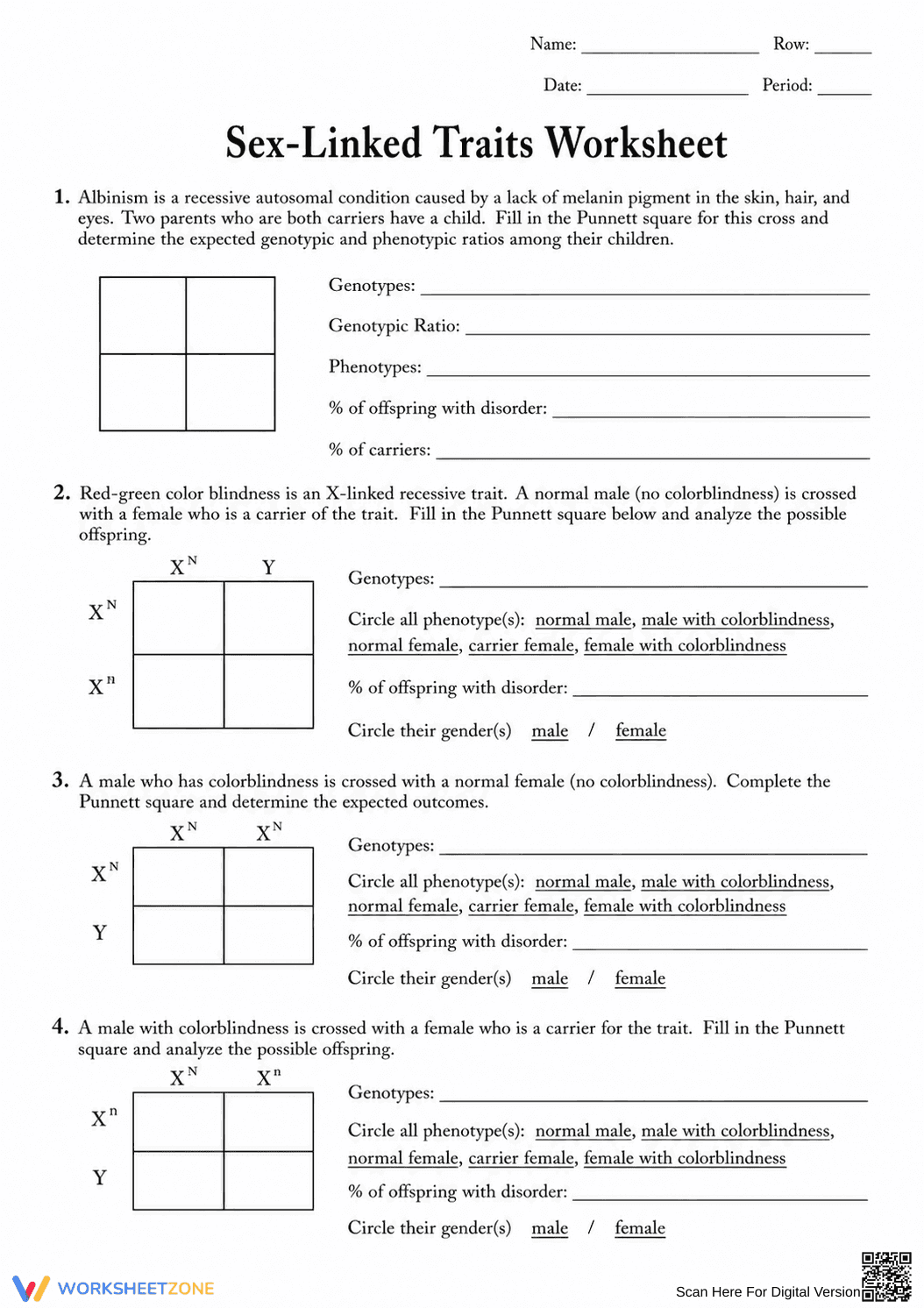
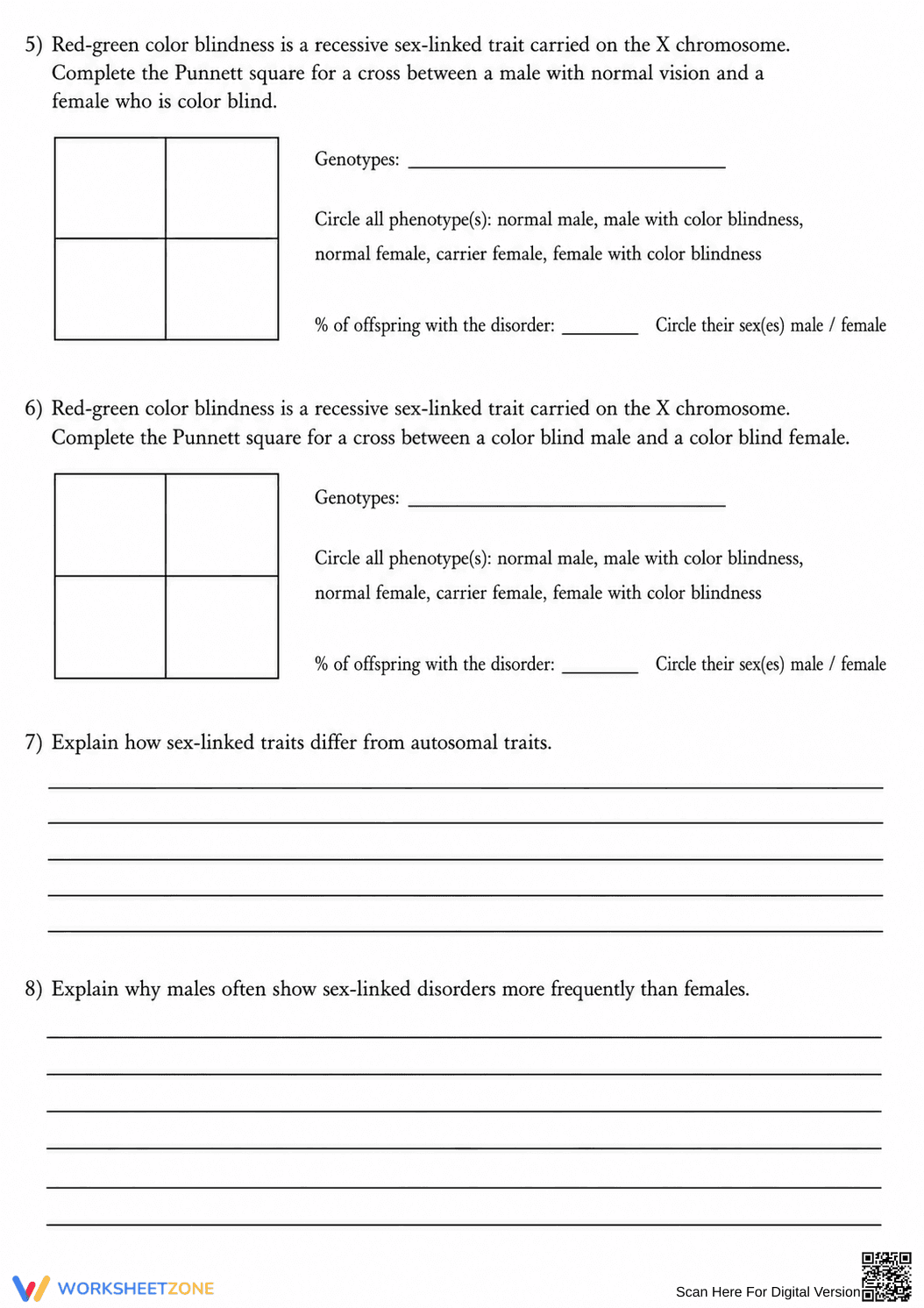
The resource includes a comprehensive teacher guide and a two-page student handout. It features 6 detailed Punnett square scenarios involving albinism and color blindness, followed by 2 critical thinking questions. The layout provides dedicated space for genotypes, phenotypes, and percentage calculations, ensuring students organize their genetic data clearly for accurate analysis.
Mastery Evidence
The included evaluation framework allows for precise tracking of student progress toward mastery. Each Punnett square is weighted at 1 point, while complex phenotypic analysis and short-answer explanations carry higher point values for a total of 18 points. This tiered scoring system helps teachers identify if students are approaching, meeting, or exceeding the standard for predicting allelic combinations. Scores can be entered directly into gradebooks or used for IEP progress monitoring notes.
Standards Alignment
This worksheet is aligned with HS-LS3-3, focusing on the application of probability to explain trait distribution. It also meets the legacy CA Biology 2g standard regarding predicting allele combinations in zygotes from the genetic makeup of parents. Both standard codes can be copied directly into lesson plans, IEP goals, or district curriculum mapping tools.
How to Use It
Use this as a summative assessment after introducing X-linked inheritance. It works effectively as a mid-unit check to ensure students can differentiate between carrier status and expressed traits. Teachers should observe students during problem 2 to ensure they correctly use X and Y notations for sex chromosomes. Expected completion time is 20 to 30 minutes depending on prior knowledge.
Who It's For
Designed for high school biology students, this resource is particularly useful for those requiring clear visual scaffolds for genetic crosses. It pairs naturally with a lecture on chromosomal theory or a digital pedigree simulator to reinforce the connection between genotypes and physical expression in human populations.
Research from EdReports (2024) emphasizes that high-quality science materials must require students to use mathematical thinking to explain biological phenomena. This worksheet fulfills that requirement by mandating the calculation of genotypic ratios and percentages within the context of HS-LS3-3. By focusing on sex-linked traits like color blindness, the resource addresses the specific cognitive challenge of non-Mendelian inheritance patterns. Fisher & Frey (2014) note that gradual release in science instruction is most effective when students move from guided autosomal examples to independent sex-linked analysis. This 3-page packet provides that necessary transition, ensuring students can accurately predict possible combinations of alleles in a zygote. The inclusion of a formal 18-point rubric aligns with best practices for evidence-based grading in secondary science classrooms, providing clear data points for student mastery of complex genetic concepts and statistical probability in biological systems.


