


























Views
Downloads

Sex-Linked Traits Practice | Essential Grade 9-12 Biology
Paste this activity's link or code into your existing LMS (Google Classroom, Canvas, Teams, Schoology, Moodle, etc.).
Students can open and work on the activity right away, with no student login required.
You'll still be able to track student progress and results from your teacher account.
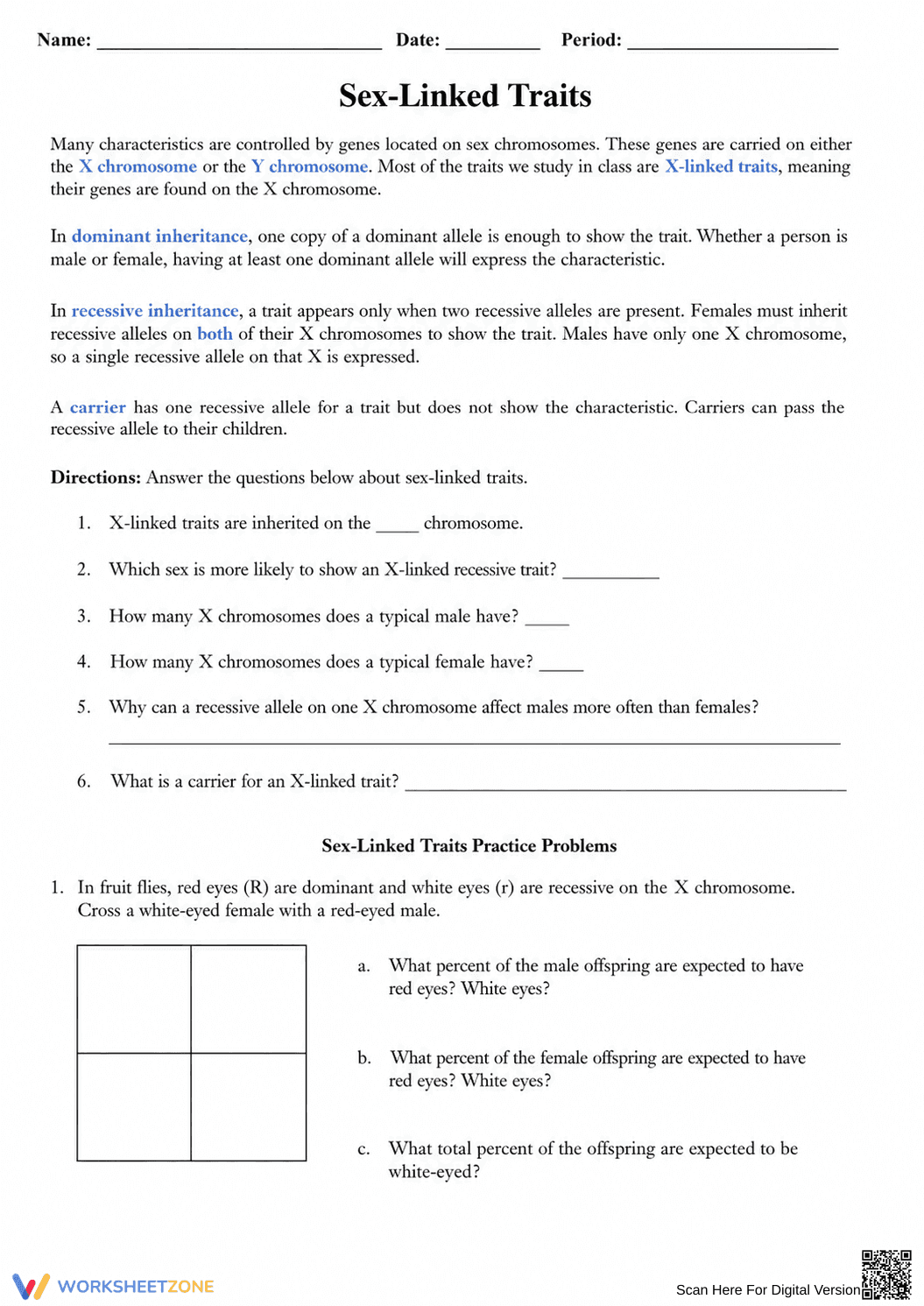
Students will master the complexities of X-linked inheritance by analyzing carrier genotypes and calculating phenotypic ratios using Punnett squares. This worksheet provides a clear conceptual bridge between chromosomal theory and practical genetic probability. By the end of the session, learners will be able to predict offspring eye color in fruit flies and explain why certain traits appear more frequently in specific sexes.
At a Glance
- Grade: 9-12 · Subject: Biology
- Standard:
HS-LS3-3— Apply probability to explain the variation and distribution of expressed traits- Skill Focus: Sex-linked inheritance and Punnett squares
- Format: 1 page · 9 tasks · Answer key included · PDF
- Best For: Independent practice or sub plans
- Time: 20–30 minutes
This 1-page resource begins with concise text defining X-linked traits, dominant versus recessive inheritance, and carriers. Students then complete 6 comprehension questions reinforcing vocabulary. The second half features a multi-part practice problem on Drosophila eye color, requiring students to construct a Punnett square and calculate percentages for male, female, and total offspring. A full answer key is provided.
Zero-Prep Workflow:
1. Print: Download the PDF and print copies.
2. Distribute: Hand out as a warm-up or independent practice.
3. Review: Use the answer key to quickly grade or review Punnett square ratios. Total prep time is under 2 minutes, making this ideal for busy days or sub folders.
Standards Alignment
Aligned to HS-LS3-3, this resource focuses on non-Mendelian inheritance patterns on sex chromosomes. It also supports HS-LS3-1 by asking students to clarify the relationship between DNA and chromosomes. These standard codes can be copied directly into lesson plans or curriculum maps.
How to Use It
Assign this worksheet following a lecture on sex chromosomes as a formative assessment. As students work, circulate to observe if they correctly place X and Y chromosomes in the grid. Taking 20 to 30 minutes, it is a perfect exit ticket or homework assignment to solidify learning.
Who It's For
Designed for high school biology students in grades 9-12, this resource is ideal for those needing a refresher on sex-linked mechanics. It is helpful for students who benefit from text-based scaffolds before mathematical calculations. Pair it with a digital chromosome simulation for a multi-sensory learning experience.
The gradual release of responsibility model is highly effective when students move from conceptual reading to applied problem-solving. This worksheet facilitates that transition by providing a clear text-based introduction to sex-linked traits before requiring complex Punnett square calculations. By focusing on HS-LS3-3, the resource ensures students apply statistical probability to biological outcomes rather than just memorizing definitions. Structured practice in genetics helps bridge the gap between abstract chromosomal theory and observable phenotypic ratios. This 1-page resource provides necessary scaffolding for high school learners to master recessive inheritance on the X chromosome. Using this worksheet as a formative assessment allows educators to identify misconceptions regarding male versus female inheritance patterns early in the unit.


