




























Views
Downloads

Essential Homeostasis Worksheet | Grade 9-12

Paste this activity's link or code into your existing LMS (Google Classroom, Canvas, Teams, Schoology, Moodle, etc.).
Students can open and work on the activity right away, with no student login required.
You'll still be able to track student progress and results from your teacher account.
This biology worksheet helps high school students master internal regulation and biological balance. By engaging with conceptual definitions and data-driven analysis, learners develop a robust understanding of how organisms respond to changes. Students will identify feedback types and explain physiological mechanisms that sustain life.
At a Glance
- Grade: 9-12 · Subject: Biology
- Standard:
HS-LS1-3— Plan and conduct investigations to provide evidence that feedback mechanisms maintain homeostasis- Skill Focus: Feedback Loops & Regulation
- Format: 2 pages · 14 problems · Answer key included · PDF
- Best For: Formative assessment and biology unit review
- Time: 30–45 minutes
What's Inside
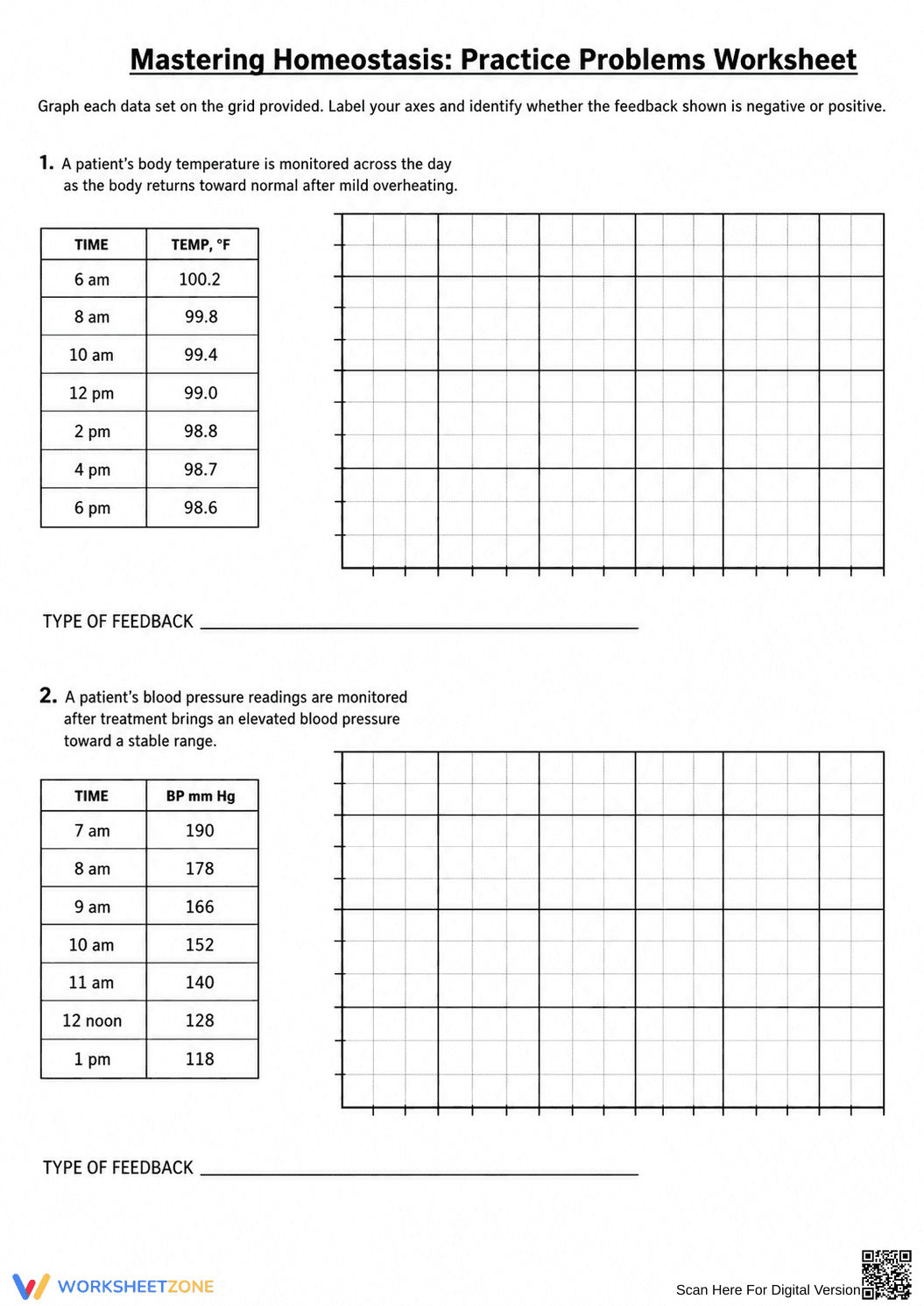
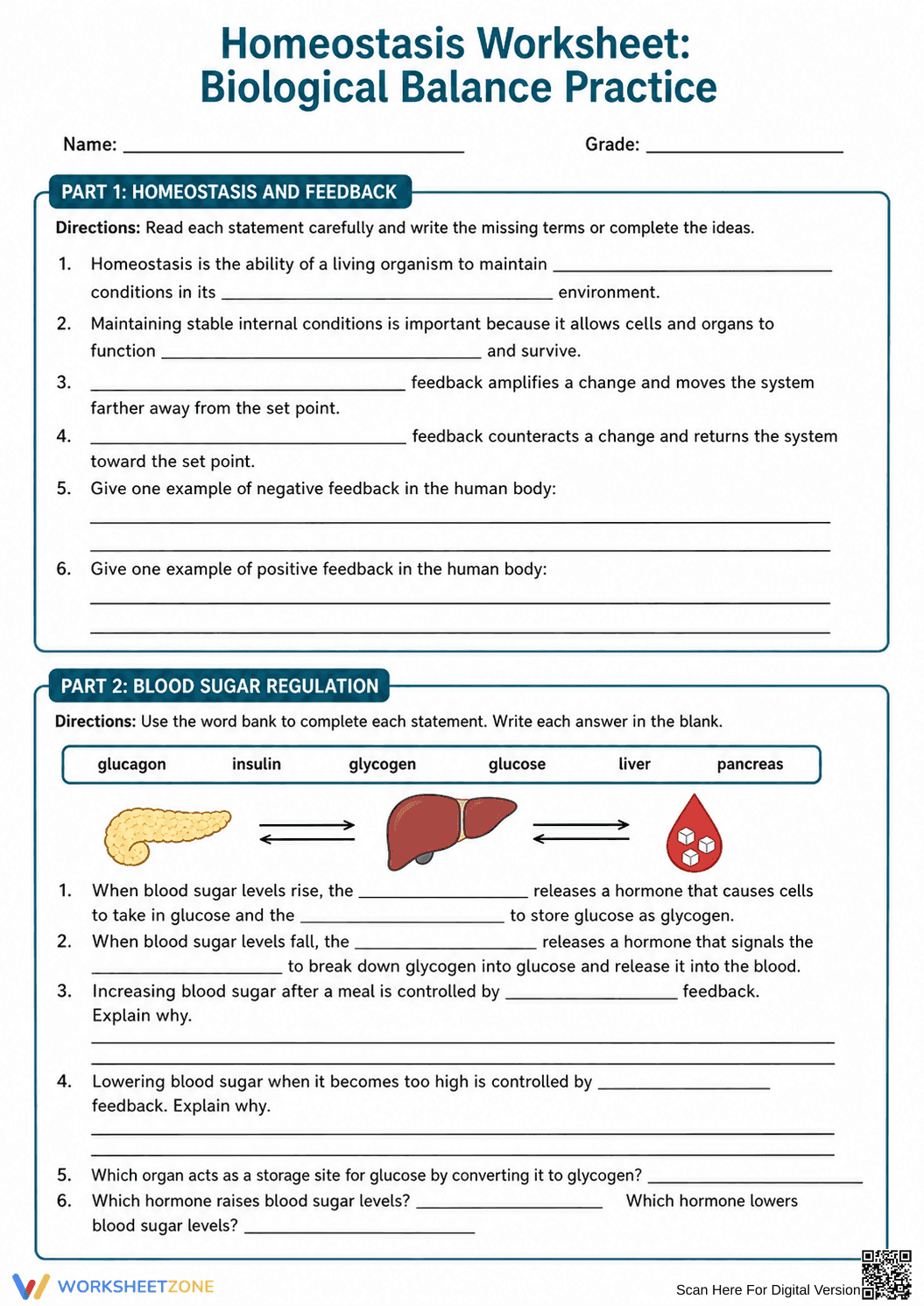
This 2-page resource is divided into three sections to build student confidence. It includes a vocabulary-focused fill-in-the-blank section, a diagram-supported analysis of the endocrine system's role in glucose management, and a graphing component. The worksheet features a word bank for hormonal regulation and two coordinate grids for plotting physiological data sets, ensuring a multi-modal approach.
Skill Progression
- Guided Practice: Students begin with 6 fill-in-the-blank definitions to establish a baseline understanding of internal environments and differences between positive and negative feedback.
- Supported Practice: The second phase utilizes a word bank and anatomical diagrams to explore blood sugar regulation, requiring students to map the roles of the pancreas, liver, insulin, and glucagon in maintaining glucose levels.
- Independent Practice: The final section challenges students with 2 data-driven graphing tasks where they must plot body temperature and blood pressure readings over time to identify and justify the specific feedback type observed.
This instructional design follows the gradual-release model, moving students from foundational terminology to the independent interpretation of biological evidence.
Standards Alignment
This resource aligns directly with HS-LS1-3: "Plan and conduct an investigation to provide evidence that feedback mechanisms maintain homeostasis." It addresses the core idea that feedback mechanisms encourage or discourage what happens inside the body. This standard code can be copied directly into lesson plans or curriculum mapping tools.
How to Use It
This worksheet is ideal for the middle of a human body systems unit or as a summative review before an exam. Teachers can use the graphing section as a formative assessment to check if students can distinguish between stabilizing negative and amplifying positive feedback. Expect students to spend 15 minutes on the first page and 20 minutes on data analysis.
Who It's For
Designed for high school biology students in grades 9-12, including Honors or AP Biology tracks, this resource reinforces core physiological concepts. It is particularly effective when paired with direct instruction on the endocrine system or a laboratory investigation involving exercise and heart rate recovery.
Homeostasis is a core concept in the HS-LS1-3 framework. Research emphasizes the importance of scaffolds like word banks and diagrams in complex biological systems to reduce cognitive load while building conceptual mastery. This worksheet provides 14 targeted tasks moving from vocabulary acquisition to data interpretation, ensuring students identify positive and negative feedback loops in human physiology. By integrating graphing exercises with hormonal regulation questions, the resource aligns with evidence-based practices for science literacy. Structured practice in feedback loops significantly improves student performance on standardized life science assessments. This resource serves as a reliable tool for documenting student progress toward mastery of internal regulation concepts.


