


























Views
Downloads
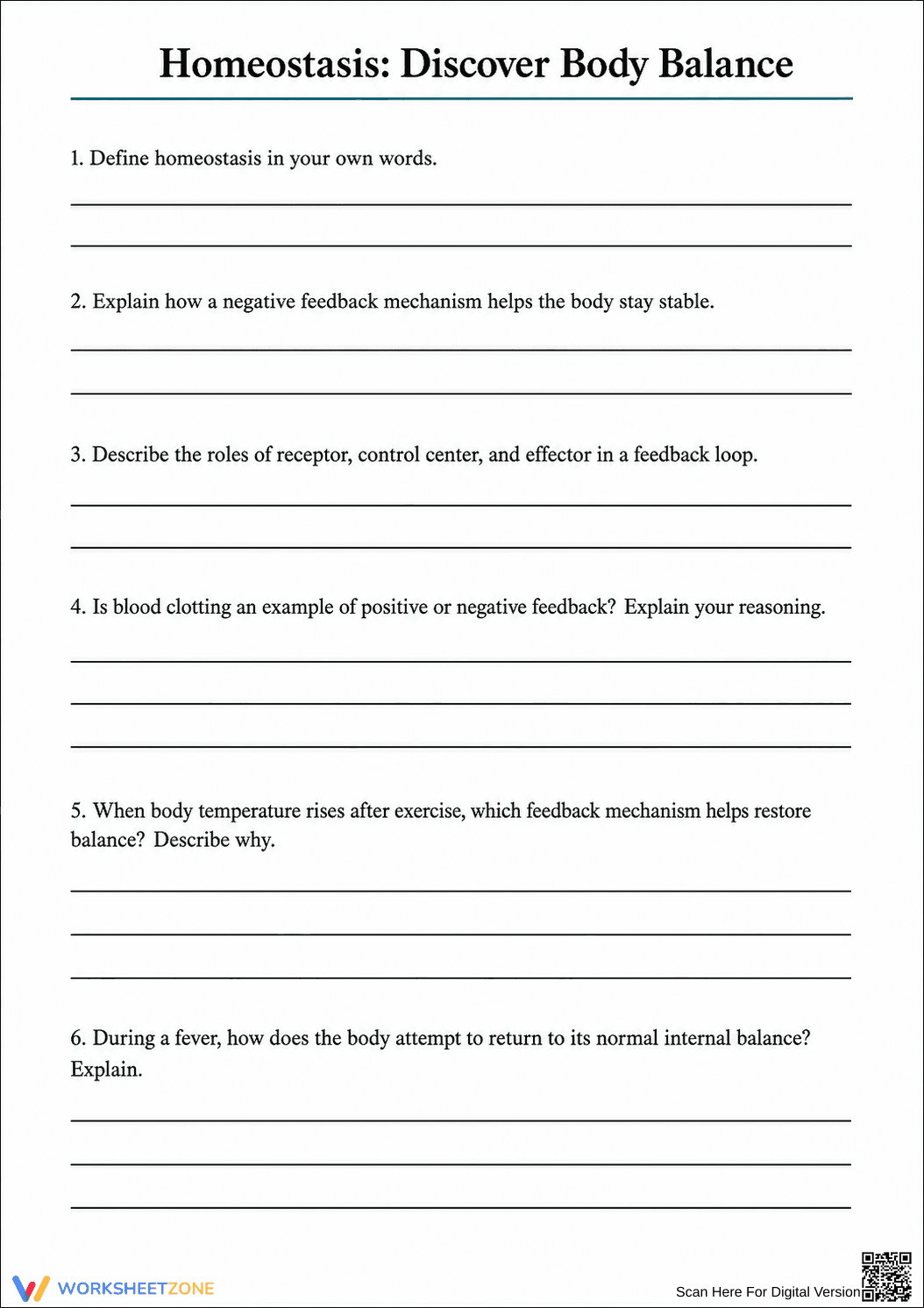

Grade 9 Homeostasis — Printable No-Prep Worksheet
Paste this activity's link or code into your existing LMS (Google Classroom, Canvas, Teams, Schoology, Moodle, etc.).
Students can open and work on the activity right away, with no student login required.
You'll still be able to track student progress and results from your teacher account.
This high school biology worksheet helps students master the fundamental concepts of homeostasis and feedback loops. By analyzing real-world physiological scenarios like temperature regulation and blood clotting, learners will solidify their understanding of how the human body maintains internal stability and responds to environmental changes.
At a Glance
- Grade: 9 · Subject: Biology
- Standard:
HS-LS1-3— Explain how feedback mechanisms maintain homeostasis- Skill Focus: Identifying positive and negative feedback loops
- Format: 1 page · 6 problems · Answer key included · PDF
- Best For: Independent practice or review
- Time: 15–20 minutes
What's Inside
This single-page resource features six short-answer questions that guide students through the mechanics of internal body balance. The tasks require learners to define key terms, differentiate between positive and negative feedback, and identify the roles of receptors, control centers, and effectors. A complete answer key is provided to ensure accurate grading and immediate student feedback.
Zero-Prep Workflow
This resource is designed for immediate classroom implementation with minimal teacher setup:
- Print (1 minute): Generate copies of the single-page PDF for your entire class.
- Distribute (1 minute): Hand out the assignment as a warm-up, exit ticket, or independent practice activity.
- Review (3 minutes): Use the included answer key to quickly verify student responses or facilitate a whole-class discussion.
With under two minutes of total prep time, this worksheet is an excellent addition to any biology sub plan.
Standards Alignment
This activity aligns with HS-LS1-3, requiring students to demonstrate how feedback mechanisms maintain homeostasis in living organisms. It also supports foundational knowledge for understanding complex physiological systems. Both standard codes can be copied directly into lesson plans, IEP goals, or district curriculum mapping tools.
How to Use It
Deploy this worksheet immediately after direct instruction on the human body's regulatory systems to reinforce new vocabulary. Alternatively, use it as a formative assessment tool before a unit exam. While students work, circulate the room and observe their explanations for question four regarding blood clotting; this is a common misconception point where positive and negative feedback are often confused. Most students will complete the six questions within 15 to 20 minutes.
Who It's For
This resource is primarily designed for high school biology and life science students in grades 9 through 12. To support learners who need additional scaffolding, consider pairing this worksheet with a visual anchor chart detailing the receptor-control center-effector pathway. It serves as a perfect companion piece to introductory lessons on human anatomy and physiology.
Understanding how the body regulates itself is a cornerstone of biological science education. Aligned with HS-LS1-3, this resource asks students to explain how feedback mechanisms maintain homeostasis. According to a recent ScienceDirect TpT Analysis, instructional materials that require students to apply theoretical concepts to concrete physiological examples—such as fever, exercise, or blood clotting—significantly improve long-term retention of complex biological processes. By prompting learners to articulate the differences between positive and negative feedback loops in their own words, this worksheet moves beyond rote memorization into deeper cognitive processing. Providing structured, scenario-based questions ensures that students can accurately identify the components of a feedback loop and predict systemic responses to environmental stressors. This targeted practice builds a robust foundation for advanced scientific inquiry and future coursework in anatomy.


