


























Views
Downloads
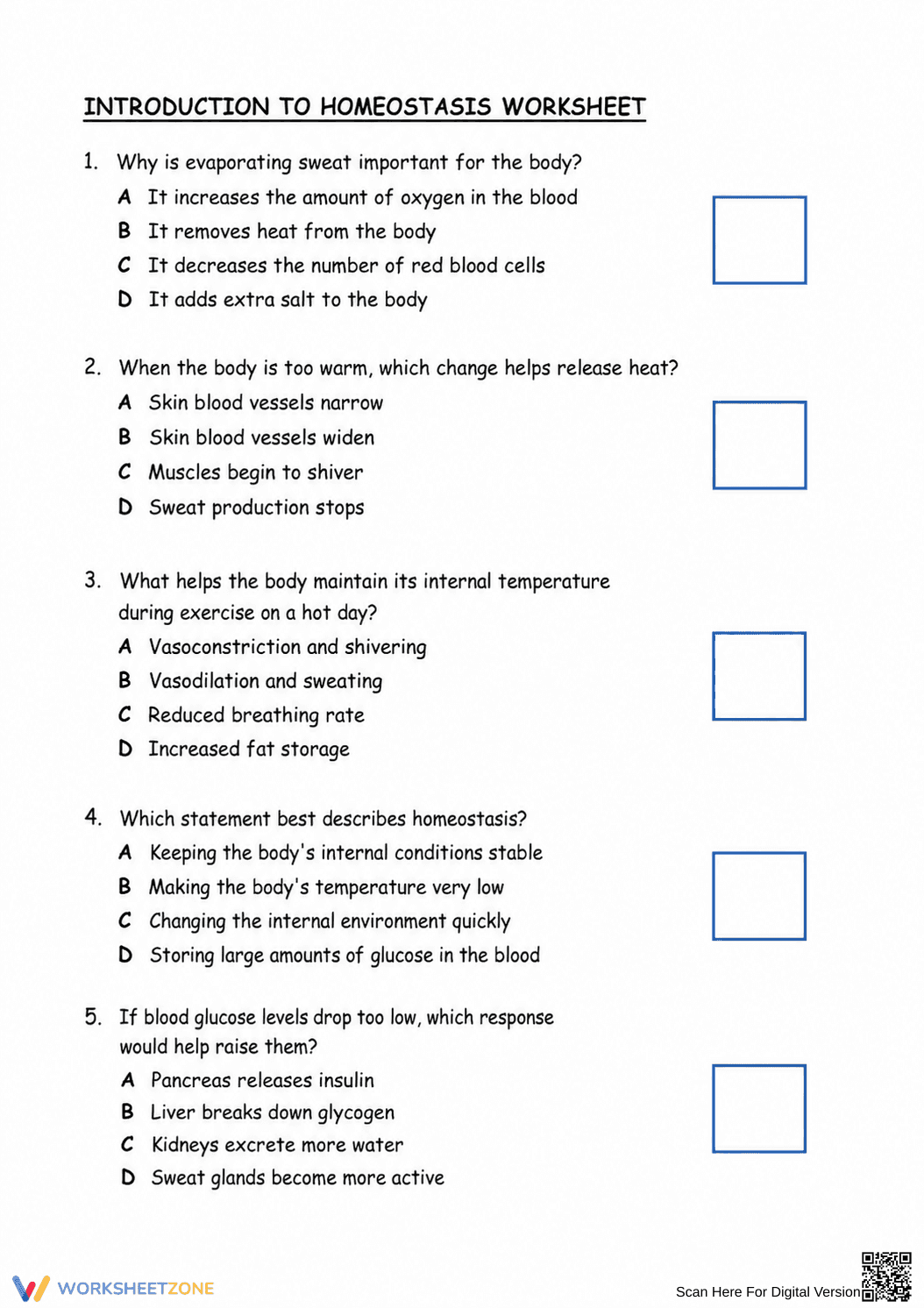

Essential Homeostasis Worksheet | Grade 9-12 Biology
Paste this activity's link or code into your existing LMS (Google Classroom, Canvas, Teams, Schoology, Moodle, etc.).
Students can open and work on the activity right away, with no student login required.
You'll still be able to track student progress and results from your teacher account.
This essential biology worksheet provides a focused introduction to homeostasis, helping students identify how the human body maintains internal stability through feedback loops. By analyzing specific physiological responses like thermoregulation and glucose management, learners develop a concrete understanding of biological balance. It is designed to produce immediate clarity on complex regulatory systems.
At a Glance
- Grade: 9-12 · Subject: Biology
- Standard:
HS-LS1-3— Plan and conduct an investigation to provide evidence that feedback mechanisms maintain homeostasis- Skill Focus: Physiological Feedback Mechanisms
- Format: 1 page · 5 problems · Answer key included · PDF
- Best For: Quick formative assessment or sub plans
- Time: 10–15 minutes
This single-page PDF features five high-quality multiple-choice questions that target the core components of human homeostasis. The layout is clean and distraction-free, providing students with clear checkboxes for their selections. It covers critical vocabulary and concepts including vasodilation, vasoconstriction, thermoregulation via sweat evaporation, and the role of the liver in blood glucose regulation. A comprehensive answer key is provided for rapid grading.
The zero-prep workflow for this resource is designed for maximum efficiency. First, print the single-page document (30 seconds). Second, distribute the worksheet to students as a bell-ringer or exit ticket (1 minute). Third, review the five answers as a whole class to identify common misconceptions (5 minutes). Total teacher preparation time is under two minutes, making it an ideal emergency sub plan or transition activity.
This resource is aligned with HS-LS1-3, which requires students to understand how feedback mechanisms maintain homeostasis. The questions specifically address how the body responds to internal and external changes to keep conditions within a narrow range. This standard code can be copied directly into lesson plans, IEP goals, or district curriculum mapping tools.
Use this worksheet as a formative assessment immediately following a lecture on the endocrine or integumentary systems. Observe whether students can distinguish between the cooling effects of sweating versus the circulatory changes of vasodilation. Alternatively, assign it as a pre-test to gauge prior knowledge before starting a unit on human body systems. Completion typically takes 10 to 15 minutes.
This resource is tailored for high school biology students in grades 9 through 12, including those in honors or introductory life science tracks. It is particularly effective for learners who benefit from concise, targeted practice. Pair this worksheet with a diagram of a negative feedback loop or a short reading passage on the hypothalamus to provide a complete instructional cycle.
According to the RAND AIRS 2024 report on secondary science instruction, the use of targeted formative assessments significantly improves student retention of complex physiological concepts like homeostasis. This worksheet addresses the core requirements of HS-LS1-3 by requiring students to identify the specific biological processes that maintain internal balance. By focusing on five high-leverage questions, the resource allows educators to quickly pinpoint gaps in student understanding regarding thermoregulation and glucose stability. Research from Fisher & Frey (2014) emphasizes that checking for understanding through structured multiple-choice tasks provides the necessary data for effective scaffolding in the science classroom. This resource serves as a reliable tool for evidence-based instruction, ensuring that students can articulate the why and how behind the body's constant drive for equilibrium. It is a high-utility addition to any high school biology curriculum, providing clear evidence of student mastery in a time-efficient format.


