


























Views
Downloads

Printable Homeostasis Worksheet | Grade 9-12 Biology
Paste this activity's link or code into your existing LMS (Google Classroom, Canvas, Teams, Schoology, Moodle, etc.).
Students can open and work on the activity right away, with no student login required.
You'll still be able to track student progress and results from your teacher account.
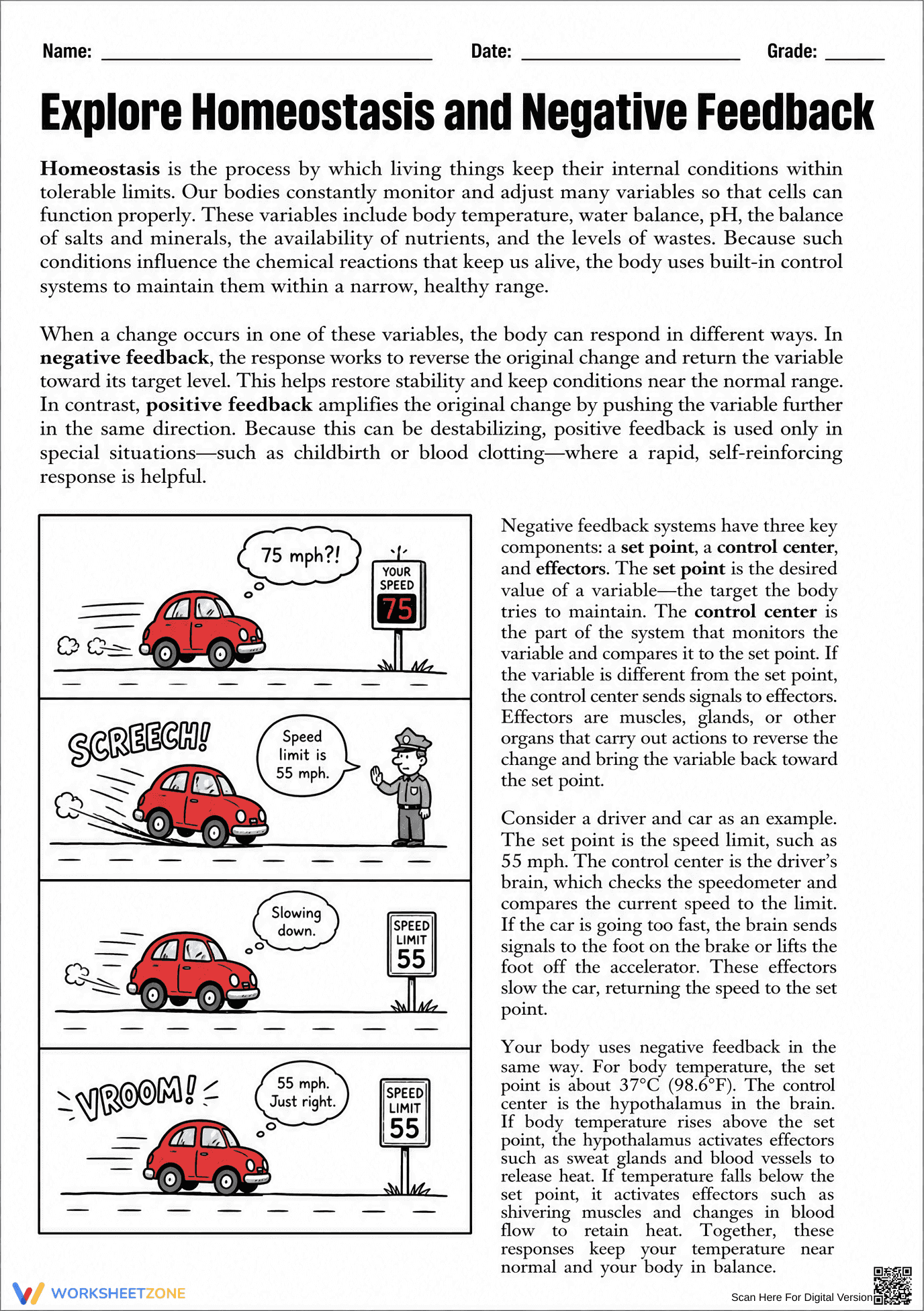
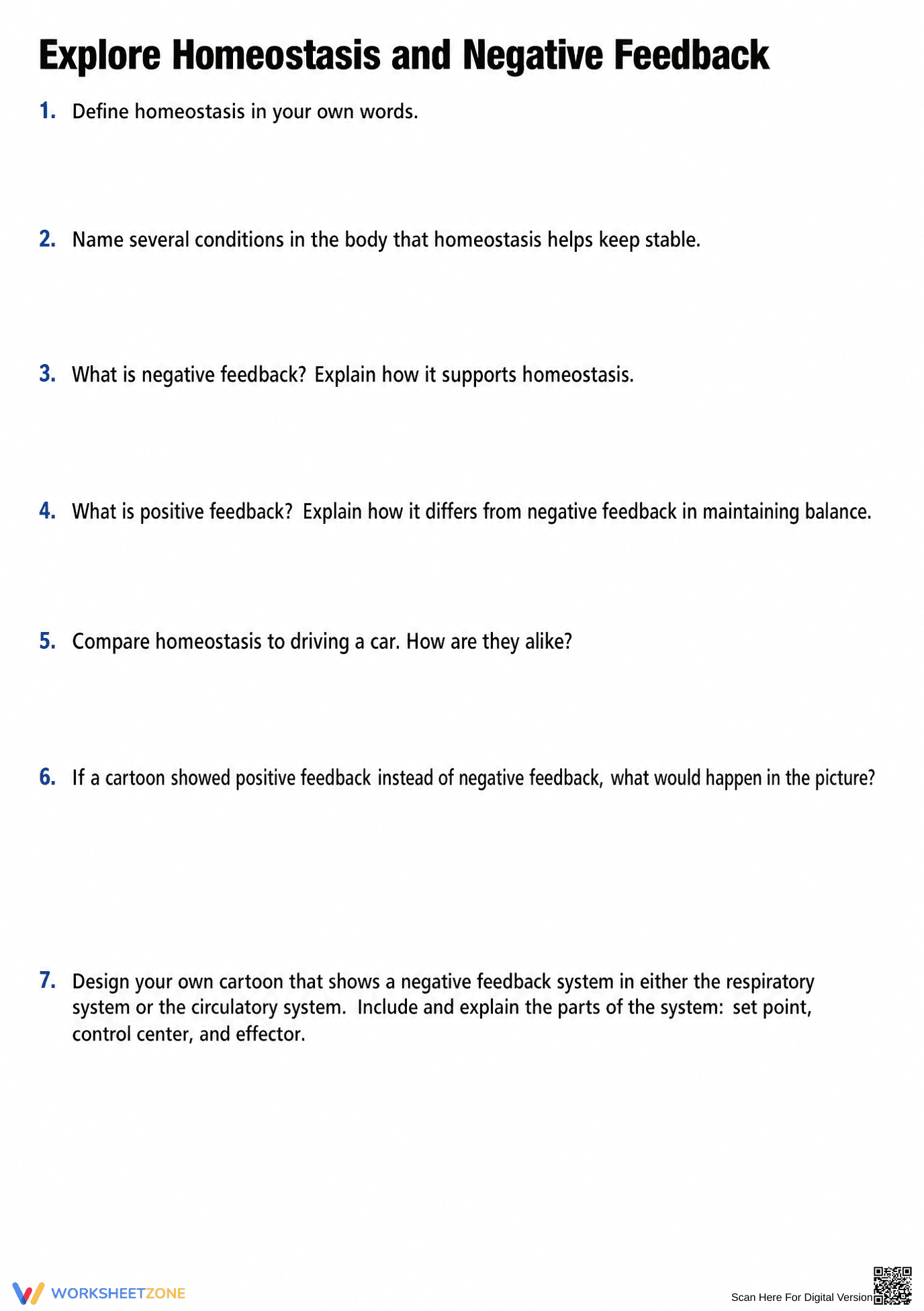
This high school biology worksheet introduces students to the critical concepts of homeostasis and negative feedback loops. By reading an accessible analogy and answering targeted questions, students will understand how the body maintains a stable internal environment.
At a Glance
- Grade: 9-12 · Subject: Biology
- Standard:
HS-LS1-3— Explain how feedback mechanisms maintain homeostasis- Skill Focus: Identifying negative feedback components
- Format: 2 pages · 7 problems · Answer key included · PDF
- Best For: Independent practice and sub plans
- Time: 25–35 minutes
This comprehensive resource features a two-page layout designed for immediate classroom use. The first page provides a clear, illustrated reading passage that compares physiological negative feedback to a driver maintaining a speed limit. The second page contains seven assessment tasks, including six short-answer comprehension questions and one creative application task where students design their own cartoon illustrating a biological feedback system.
Designed for maximum efficiency, this resource requires virtually zero teacher preparation.
- Print (1 minute): Simply print the two-page PDF for each student. No special materials or prior setup are required.
- Distribute (1 minute): Hand out the reading passage and question sheet at the start of class. The self-contained text means students can begin immediately.
- Review (5 minutes): Use the included answer key to quickly grade responses or facilitate a whole-class discussion on the final creative drawing task.
With under two minutes of total prep time, this worksheet is an ideal emergency sub plan or independent reading assignment.
This activity is directly aligned to HS-LS1-3, requiring students to investigate and explain how feedback mechanisms maintain homeostasis in living organisms. It also supports crosscutting concepts related to stability and change in biological systems. Both standard codes can be copied directly into lesson plans, IEP goals, or district curriculum mapping tools.
This worksheet serves as an excellent introductory activity before a broader lecture on human body systems. Have students read the passage independently and complete the questions to build foundational vocabulary like "set point" and "effector." Alternatively, use it as a formative assessment after direct instruction. While students work, teachers can circulate and observe their responses to question five, ensuring they correctly map the car analogy to physiological processes. Expect students to complete the reading and questions within 25 to 35 minutes.
This resource is primarily designed for high school biology and introductory life science students. The relatable car analogy provides excellent scaffolding for learners who struggle with abstract physiological concepts, making it highly suitable for inclusive classrooms. Pair this worksheet with a hands-on lab measuring heart rate after exercise to further solidify the concept of negative feedback loops in action.
Understanding how biological systems regulate themselves is a cornerstone of life science education. According to a recent ScienceDirect TpT Analysis, instructional materials that utilize relatable analogies significantly improve student comprehension of abstract physiological processes. This resource supports HS-LS1-3 by helping students explain how feedback mechanisms maintain homeostasis. By comparing complex biological control centers and effectors to the familiar experience of driving a car, learners can more easily visualize internal stability. The inclusion of both analytical questions and a creative design task ensures that students process the information through multiple cognitive pathways. This dual approach not only reinforces the immediate vocabulary but also builds the foundational systems-thinking skills required for advanced scientific inquiry and long-term academic success in biology.


