


























Views
Downloads

Essential Social Skills Worksheet: Understanding Judgment
Paste this activity's link or code into your existing LMS (Google Classroom, Canvas, Teams, Schoology, Moodle, etc.).
Students can open and work on the activity right away, with no student login required.
You'll still be able to track student progress and results from your teacher account.
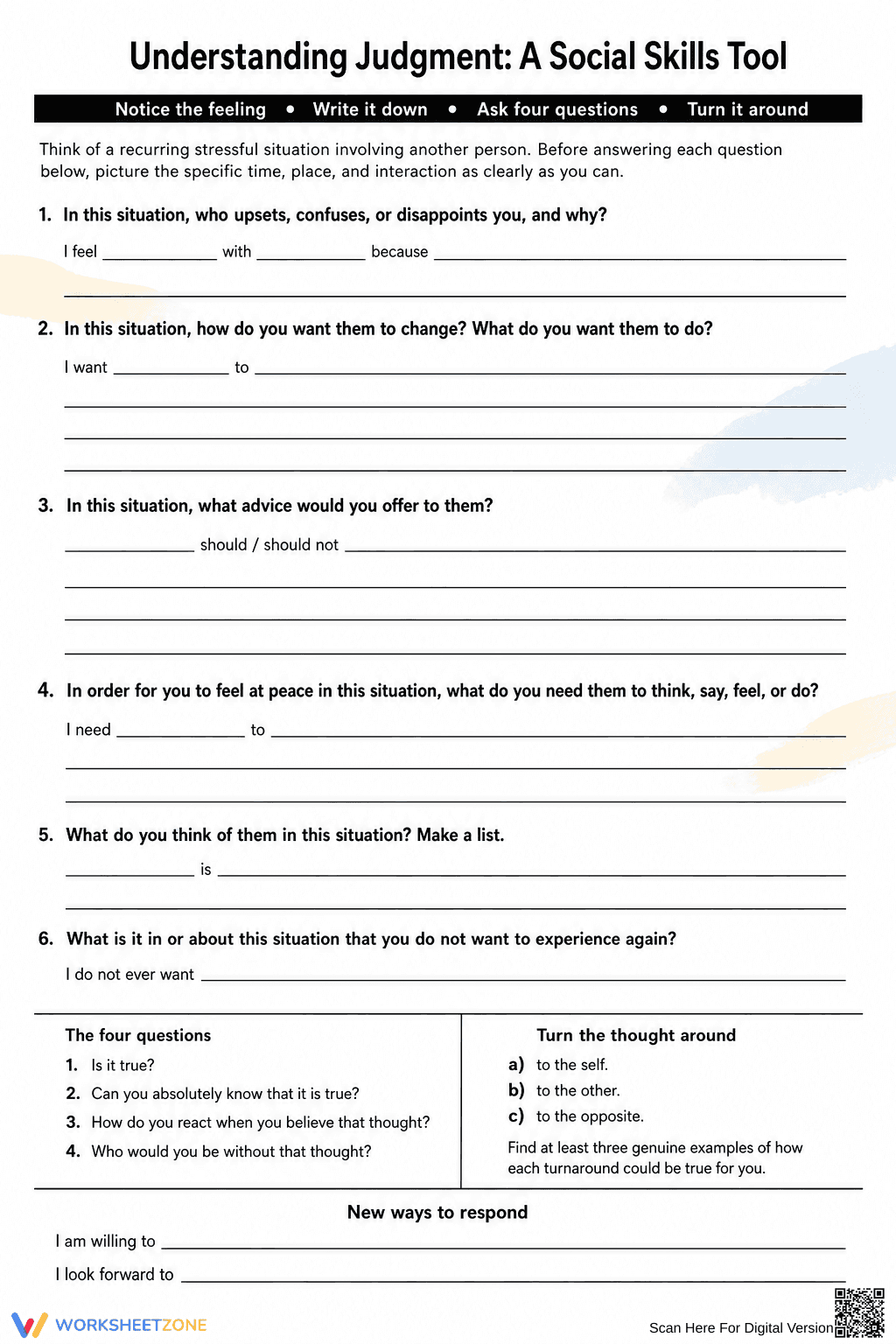
This social skills worksheet facilitates deep emotional processing and conflict resolution by guiding students through a structured inquiry of their judgments. By identifying specific stressors and questioning the validity of negative thoughts, learners develop the self-awareness necessary to de-escalate interpersonal tension and foster empathy in complex social situations.
At a Glance
- Grade: 9–12 · Subject: Social Skills
- Standard:
CCSS.ELA-LITERACY.SL.9-10.1.D— Respond thoughtfully to diverse perspectives and summarize points of agreement and disagreement- Skill Focus: Emotional Regulation & Perspective Taking
- Format: 1 page · 9 prompts · No answer key needed · PDF
- Best For: Conflict resolution and self-reflection exercises
- Time: 20–30 minutes
The worksheet features a logical progression of 9 reflective tasks. It begins with situational identification, asking students to name the person and the specific cause of their distress. It then moves into desire-mapping, where students articulate what they want the other person to change. The final section introduces a rigorous inquiry method involving "The Four Questions" to test the truth of a thought, followed by a "Turnaround" exercise to find alternative perspectives.
Zero-Prep Workflow
- Print: Generate copies for the class or individual counseling sessions in less than 1 minute.
- Distribute: Hand out the single-page PDF and provide a brief overview of the "Notice, Write, Ask, Turn" framework (1 minute).
- Review: Allow students to work independently or in pairs to process a specific interaction, requiring zero teacher setup or external materials (20-30 minutes).
Standards Alignment
This resource aligns with CCSS.ELA-LITERACY.SL.9-10.1.D, which requires students to respond thoughtfully to diverse perspectives and resolve individual differences. By forcing a "turnaround" of a judgmental thought, students must actively construct a perspective that contradicts their initial bias. This standard code can be copied directly into lesson plans, IEP goals, or district curriculum mapping tools.
How to Use It
Use this worksheet as a formative tool during a unit on communication or as a reactive intervention following a classroom conflict. Teachers should observe if students can move from the "I want them to change" phase to the "Turnaround" phase, as this indicates a successful shift in cognitive flexibility. Expected completion time is 20 to 30 minutes depending on the complexity of the chosen situation.
Who It's For
This tool is designed for high school students, mature teenagers, and adults who need structured support in managing interpersonal stress. It is particularly effective for students with IEP goals related to social-emotional learning (SEL) or those participating in restorative justice circles. It pairs naturally with an anchor chart on cognitive reframing or a direct instruction lesson on perspective-taking.
Social-emotional learning (SEL) interventions that utilize cognitive reframing, such as the "Turnaround" method featured here, are essential for developing adolescent self-regulation. According to the RAND AIRS 2024 report on school-based behavioral health, structured reflection tools significantly reduce the frequency of recurring interpersonal conflicts by teaching students to interrogate their own biases before reacting. This worksheet applies these principles by requiring 9 distinct points of inquiry, moving the student from a reactive emotional state to a reflective analytical state. By aligning with CCSS.ELA-LITERACY.SL.9-10.1.D, the tool ensures that social skills instruction remains grounded in rigorous communication standards. The process of finding three genuine examples for a "turnaround" thought forces the brain to bypass confirmation bias, a key component of emotional intelligence. This evidence-based approach provides a reliable framework for educators to support students in navigating the complexities of human relationships and personal accountability.


