




























Views
Downloads

Printable Social Skills Worksheet | Grade 9-12 Reflection

Paste this activity's link or code into your existing LMS (Google Classroom, Canvas, Teams, Schoology, Moodle, etc.).
Students can open and work on the activity right away, with no student login required.
You'll still be able to track student progress and results from your teacher account.
This Grade 9-12 social skills worksheet guides students through a structured self-reflection process to process interpersonal conflicts and reframe stressful thoughts. By completing targeted prompts, learners develop emotional intelligence, practice cognitive reframing, and build empathy toward themselves and others in challenging situations.
At a Glance
- Grade: 9-12 · Subject: Social Skills
- Standard:
CCSS.ELA-LITERACY.W.9-10.10— Write routinely for reflection and varied purposes- Skill Focus: Self-reflection and cognitive reframing
- Format: 3 pages · 6 core tasks · No answer key required · PDF
- Best For: Independent reflection and SEL blocks
- Time: 30–45 minutes
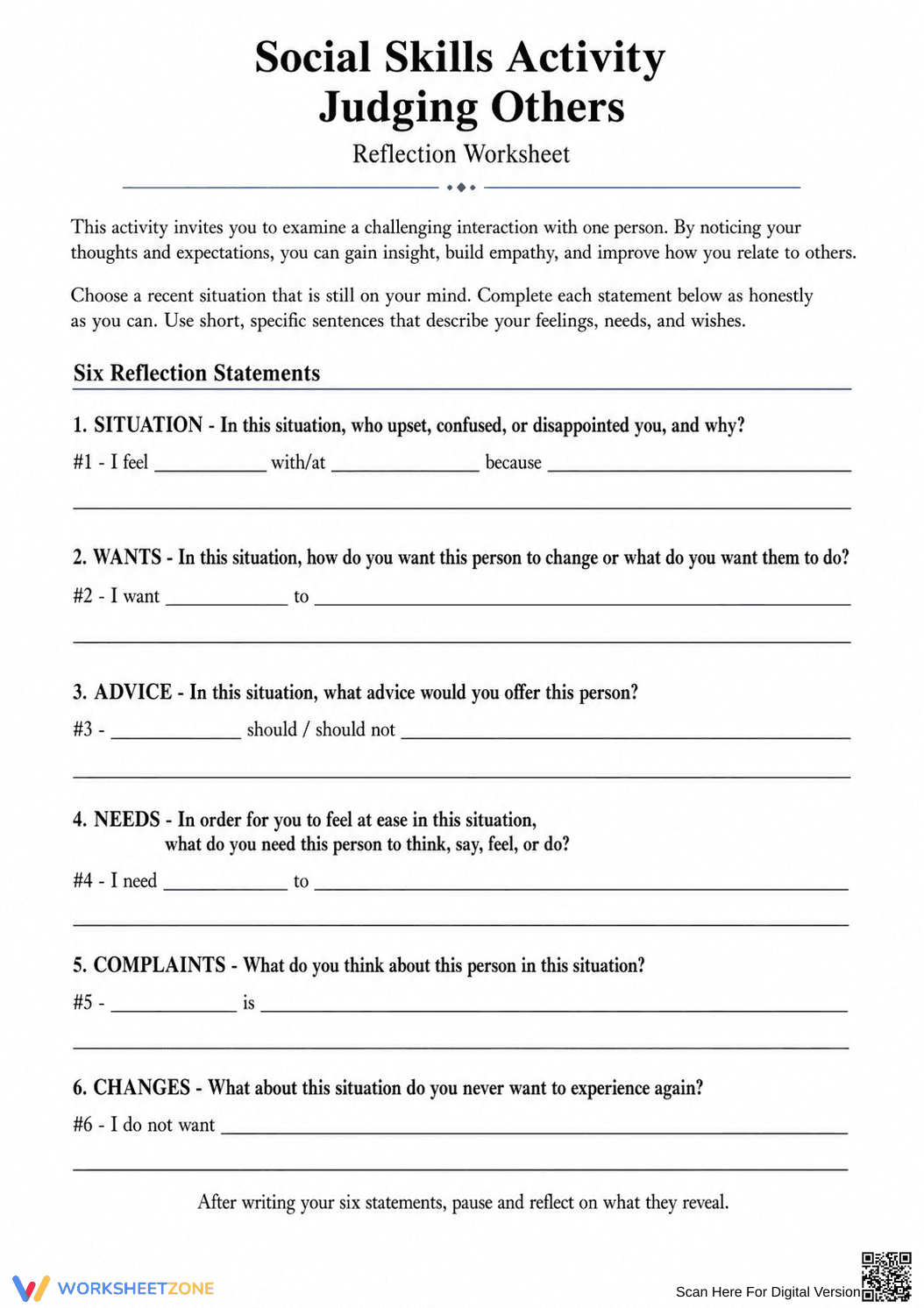
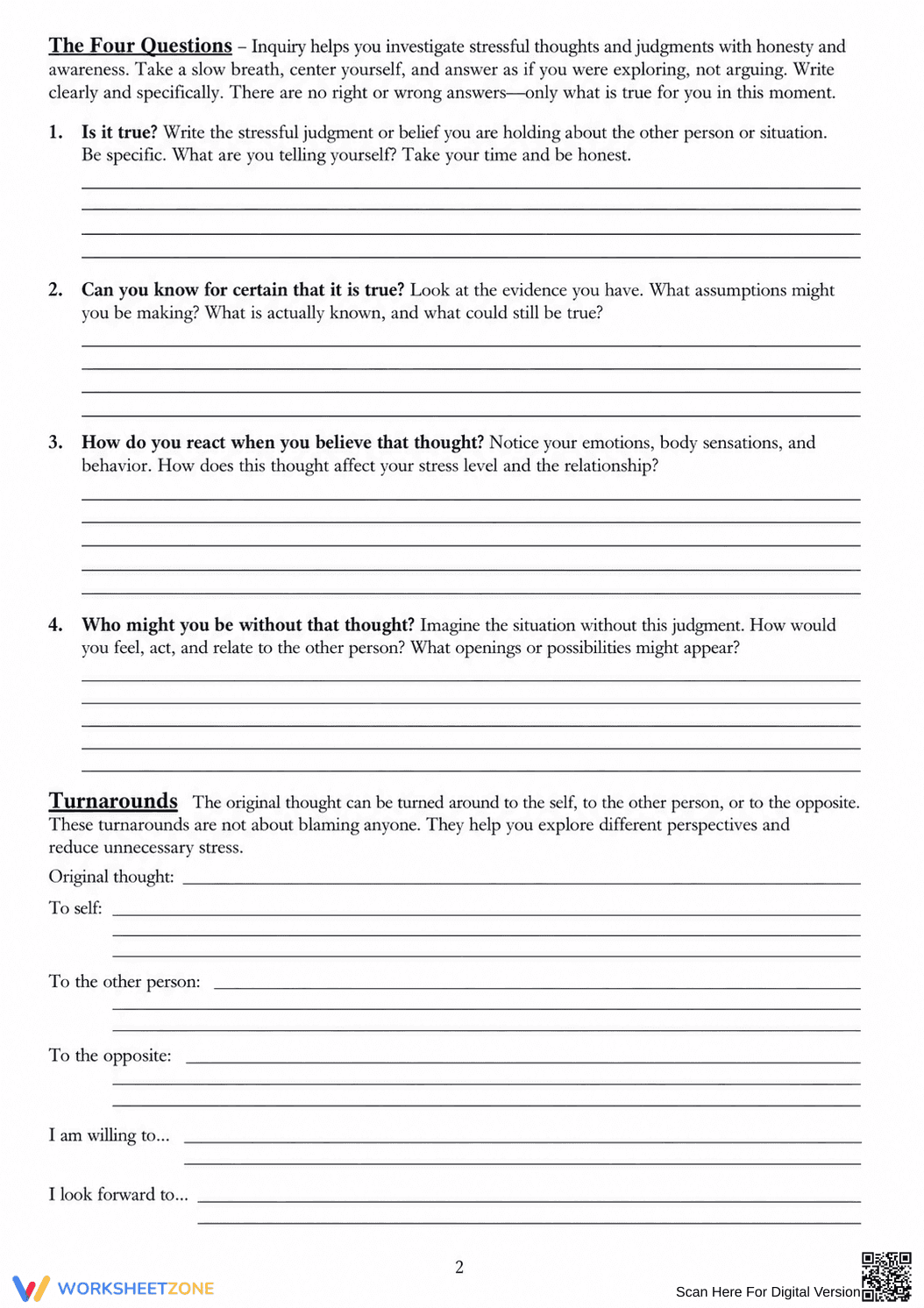
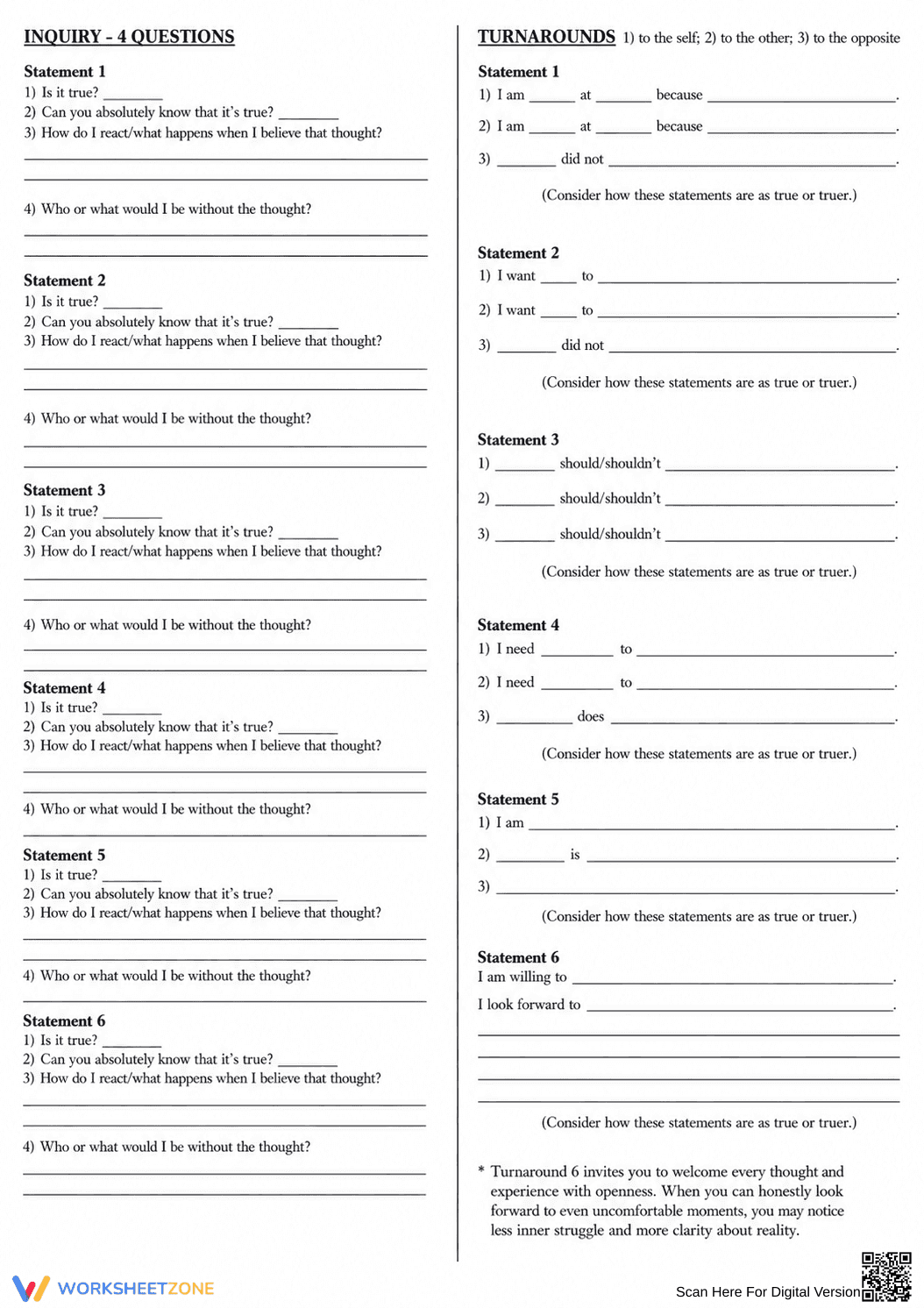
This comprehensive three-page packet features a step-by-step inquiry process based on cognitive behavioral principles. Page one introduces six core reflection statements (Situation, Wants, Advice, Needs, Complaints, Changes) with fill-in-the-blank sentence starters. Page two outlines four deep-dive inquiry questions and turnaround exercises to challenge initial assumptions. Page three provides a structured grid for applying these four questions and turnarounds to all six initial statements, ensuring a thorough analysis of the interpersonal conflict.
- Print (1 minute): Generate the three-page PDF packet for each student. No special materials or prior setup are required.
- Distribute (1 minute): Hand out the packets during a dedicated social-emotional learning (SEL) block, advisory period, or counseling session.
- Review (0 minutes): Because this is a personal reflection exercise, there is no answer key to grade. The structured prompts guide students independently from start to finish.
Total teacher prep time is under two minutes, making this an excellent zero-prep resource for advisory periods, cool-down stations, or emergency sub plans.
Aligned to CCSS.ELA-LITERACY.W.9-10.10: Write routinely over extended time frames and shorter time frames for a range of tasks, purposes, and audiences. This activity also supports CASEL core competencies in Self-Awareness and Relationship Skills by asking students to analyze their emotional responses. Both standard codes can be copied directly into lesson plans, IEP goals, or district curriculum mapping tools.
Use this resource during advisory periods or SEL blocks to help students process peer conflicts independently before engaging in restorative conversations. Alternatively, assign it as a private journaling exercise in a high school English or Health class when discussing themes of perspective and bias. Teachers can formatively assess student engagement by observing their focus during the 30 to 45-minute completion window, without needing to read their private responses.
This resource is designed for high school students (Grades 9-12) and young adults who benefit from structured emotional processing. The fill-in-the-blank sentence frames provide built-in scaffolding, making complex cognitive reframing accessible to students who might struggle with open-ended journaling. It pairs perfectly with direct instruction on empathy, conflict resolution, or cognitive behavioral strategies.
Integrating structured writing tasks into social-emotional learning significantly improves adolescents' ability to regulate emotions and resolve peer conflicts effectively. By aligning with CCSS.ELA-LITERACY.W.9-10.10, this resource requires students to write routinely for reflection and varied purposes, fostering critical self-awareness and emotional intelligence. According to the RAND AIRS 2024 report, students who engage in routine, guided self-reflection exercises demonstrate higher levels of emotional resilience and a greater capacity for perspective-taking in both academic and social settings. This structured inquiry method provides the necessary scaffolding to help learners independently challenge cognitive distortions, reduce interpersonal friction, and build healthier relationships within their school communities. Utilizing these evidence-based frameworks ensures that social skills instruction remains rigorous, measurable, and deeply impactful for young adults navigating complex social dynamics.


