


























Views
Downloads

Essential Judge Your Neighbor Worksheet | College Ready
Paste this activity's link or code into your existing LMS (Google Classroom, Canvas, Teams, Schoology, Moodle, etc.).
Students can open and work on the activity right away, with no student login required.
You'll still be able to track student progress and results from your teacher account.
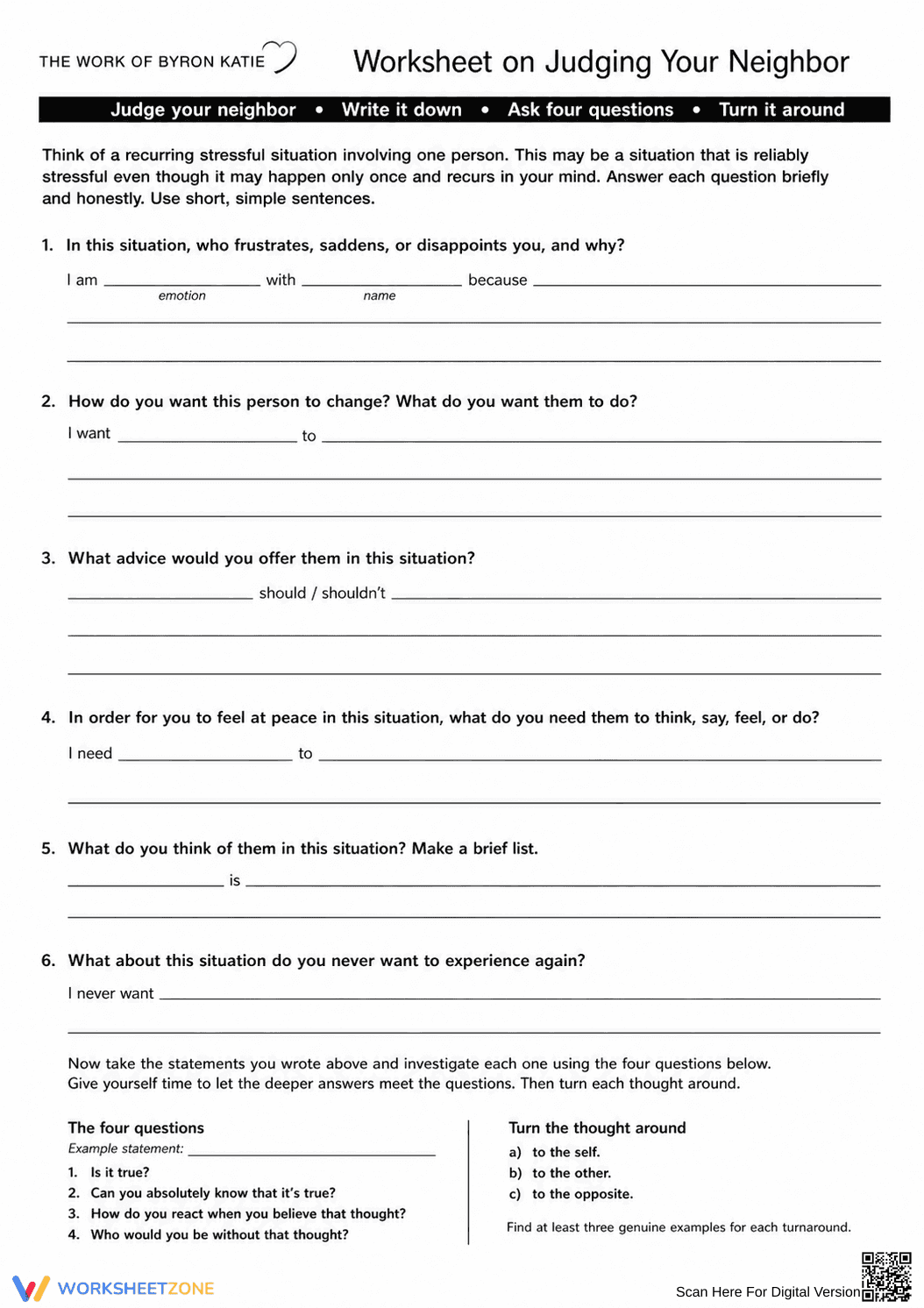
This worksheet facilitates deep self-reflection and cognitive reframing based on "The Work" by Byron Katie. Students identify stressful thoughts about others and systematically dismantle them to find peace. It provides a structured path from judgment to understanding, helping learners process interpersonal conflict through rigorous inquiry and perspective-shifting exercises.
At a Glance
- Grade: College · Subject: Social Skills
- Standard:
CCSS.ELA-LITERACY.SL.11-12.1.D— Respond thoughtfully to diverse perspectives and resolve contradictions in interpersonal contexts- Skill Focus: Cognitive Reframing
- Format: 1 page · 6 prompts · Self-guided inquiry · PDF
- Best For: Conflict resolution and emotional self-regulation
- Time: 25–40 minutes
What's Inside
The document contains a single-page layout featuring six primary writing prompts. These prompts guide the user to identify specific emotions, desired changes in others, and personal needs. It includes a dedicated section for the "Four Questions" of inquiry and a "Turnaround" framework to help users flip their perspective toward themselves or the opposite of their original thought.
Zero-Prep Workflow
The zero-prep workflow is designed for immediate implementation. Print the PDF (30 seconds), distribute to students or clients (1 minute), and allow for silent, independent reflection (20-30 minutes). Because the instructions are self-contained, no prior lecture on Byron Katie’s methodology is required for basic completion, making it an ideal resource for sudden counseling sessions or SEL workshops.
Standards Alignment
Primary standard CCSS.ELA-LITERACY.SL.11-12.1.D: "Respond thoughtfully to diverse perspectives; synthesize comments, claims, and evidence made on all sides of an issue; resolve contradictions when possible; and determine what additional information or research is required to deepen the investigation or complete the task." Both standard codes can be copied directly into lesson plans, IEP goals, or district curriculum mapping tools.
How to Use It
Use this during a conflict resolution unit or as a formative assessment for emotional intelligence. Teachers can observe how students transition from external blame to internal accountability. Expected completion time is 25–40 minutes depending on the depth of the chosen conflict. It works best when students focus on one specific, recurring stressful situation.
Who It's For
This resource is designed for college students, adult learners, and high school seniors. It pairs naturally with units on psychology, communication studies, or restorative justice. It is particularly effective for students struggling with interpersonal friction or those requiring advanced social-emotional scaffolding to navigate complex social dynamics.
According to research by Fisher & Frey (2014), structured metacognitive prompts are essential for helping learners navigate complex emotional landscapes and interpersonal contradictions. This worksheet utilizes the CCSS.ELA-LITERACY.SL.11-12.1.D standard to facilitate cognitive reframing, a process that allows individuals to move from reactive judgment to analytical understanding. By applying the "Four Questions" and "Turnarounds," users engage in a rigorous inquiry process that mirrors the evidence-based practices found in modern behavioral psychology. The 6-task structure ensures that students provide specific evidence for their feelings before subjecting those feelings to logical scrutiny. This methodology aligns with NAEP findings suggesting that high-level perspective-taking is a critical component of post-secondary readiness. The worksheet serves as a practical tool for developing the self-regulation skills necessary for collaborative environments and professional relationship management in adult contexts.


