




























Views
Downloads
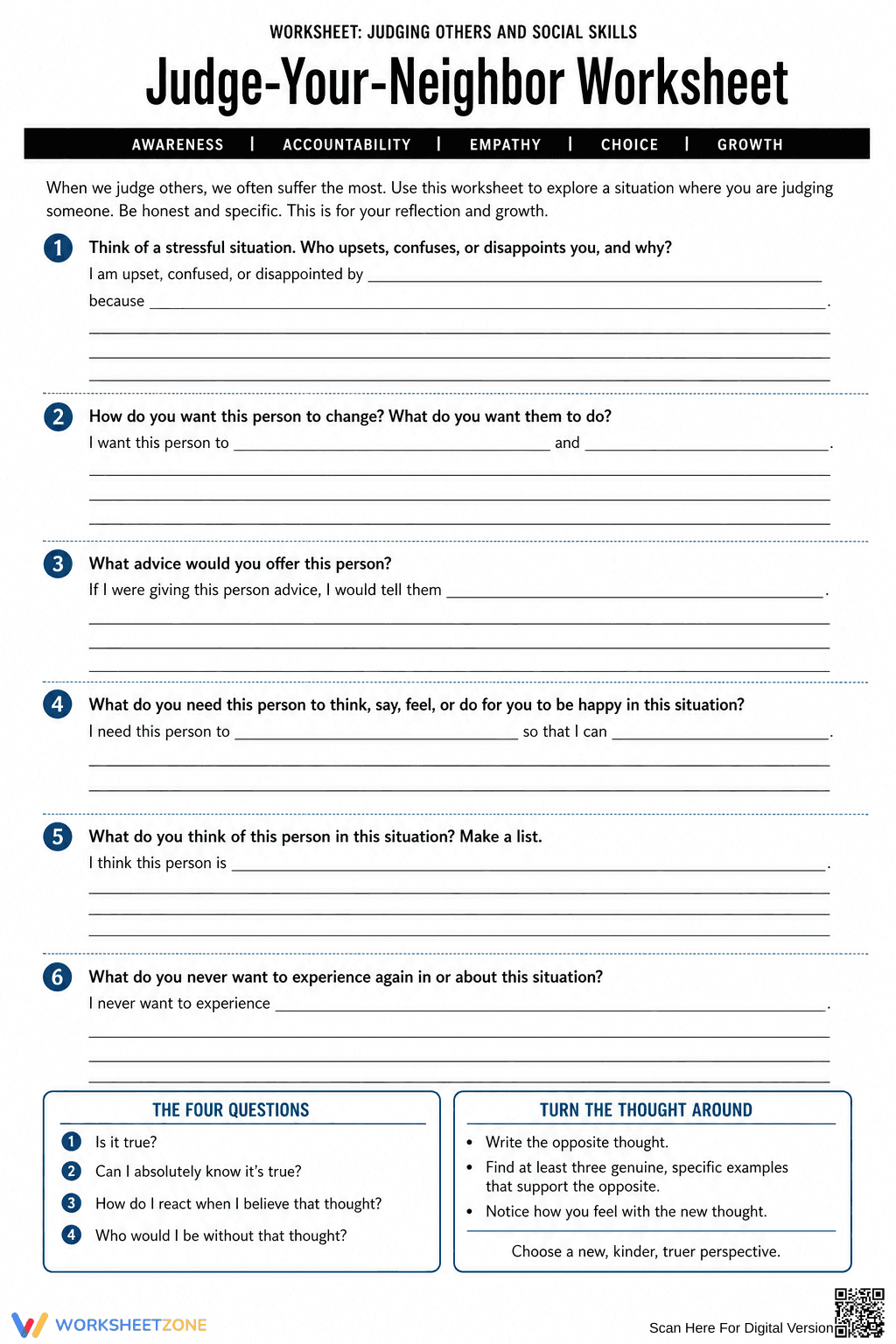

Printable SEL Worksheet: Conflict Resolution Grades 9-12

Paste this activity's link or code into your existing LMS (Google Classroom, Canvas, Teams, Schoology, Moodle, etc.).
Students can open and work on the activity right away, with no student login required.
You'll still be able to track student progress and results from your teacher account.
This high school social-emotional learning worksheet guides students through the process of examining stressful interpersonal situations. By prompting learners to articulate their frustrations and reframe their perspectives, this resource helps students develop critical empathy and conflict resolution skills necessary for healthy communication and emotional regulation.
At a Glance
- Grade: 9-12 · Subject: Social Skills
- Standard:
CCSS.ELA-LITERACY.SL.9-10.1— Participate effectively in collaborative discussions and resolve conflicts- Skill Focus: Cognitive reframing and empathy
- Format: 1 page · 6 problems · No answer key · PDF
- Best For: Independent reflection and SEL advisory
- Time: 15–20 minutes
This single-page resource features six fill-in-the-blank reflection prompts asking students to identify a stressful situation, express desires for another's behavior, and determine their own needs. It includes two cognitive behavioral tools: "The Four Questions" for challenging assumptions and a "Turn the Thought Around" exercise for perspective-taking. No answer key is required.
Zero-Prep Workflow
- Print (1 min): Download the PDF and print a class set. The layout requires no teacher preparation.
- Distribute (1 min): Hand out during advisory or SEL blocks. It functions perfectly as a standalone activity.
- Review (2 mins): Explain cognitive reframing. Allow students to complete the prompts independently and privately.
With under two minutes of prep time, this is an excellent addition to any sub plan.
Standards Alignment
This aligns with CCSS.ELA-LITERACY.SL.9-10.1, requiring students to participate effectively in collaborative discussions, building on others' ideas and expressing their own clearly. Analyzing communication roadblocks builds the self-awareness needed to meet this standard. Both standard codes can be copied directly into lesson plans, IEP goals, or district curriculum mapping tools.
How to Use It
Use this worksheet before a mediated peer conflict resolution session. Completing the prompts independently helps students understand their own triggers. Alternatively, use it as an independent reflection activity after a behavioral incident. As an observation tip, monitor if students successfully complete the "Turn the Thought Around" section, indicating cognitive flexibility. Expect completion in 15 to 20 minutes.
Who It's For
This resource is designed primarily for high school students in grades 9 through 12, though it is also appropriate for adult learners and transition programs. To differentiate for students who struggle with abstract emotional concepts, educators can provide a hypothetical scenario rather than asking them to draw from personal experience. This worksheet pairs naturally with direct instruction lessons on "I" statements and active listening techniques.
Developing robust social-emotional competencies is critical for academic and personal success in secondary education. This resource directly supports CCSS.ELA-LITERACY.SL.9-10.1 by helping students participate effectively in collaborative discussions and resolve conflicts through structured self-reflection. According to a comprehensive RAND AIRS 2024 report on adolescent behavioral interventions, students who regularly engage in cognitive reframing exercises demonstrate a significant decrease in interpersonal conflicts and a marked improvement in classroom climate. By systematically challenging their own assumptions using the provided prompts, learners build the emotional resilience required to navigate complex social dynamics. This evidence-based approach ensures that educators are utilizing strategies proven to foster empathy and reduce reactive behaviors. Integrating these targeted reflection practices into weekly advisory sessions provides a reliable framework for continuous social-emotional growth and improved peer relationships.


