


























Views
Downloads

Essential Social Skills Worksheet | College & Adult Ready
Paste this activity's link or code into your existing LMS (Google Classroom, Canvas, Teams, Schoology, Moodle, etc.).
Students can open and work on the activity right away, with no student login required.
You'll still be able to track student progress and results from your teacher account.
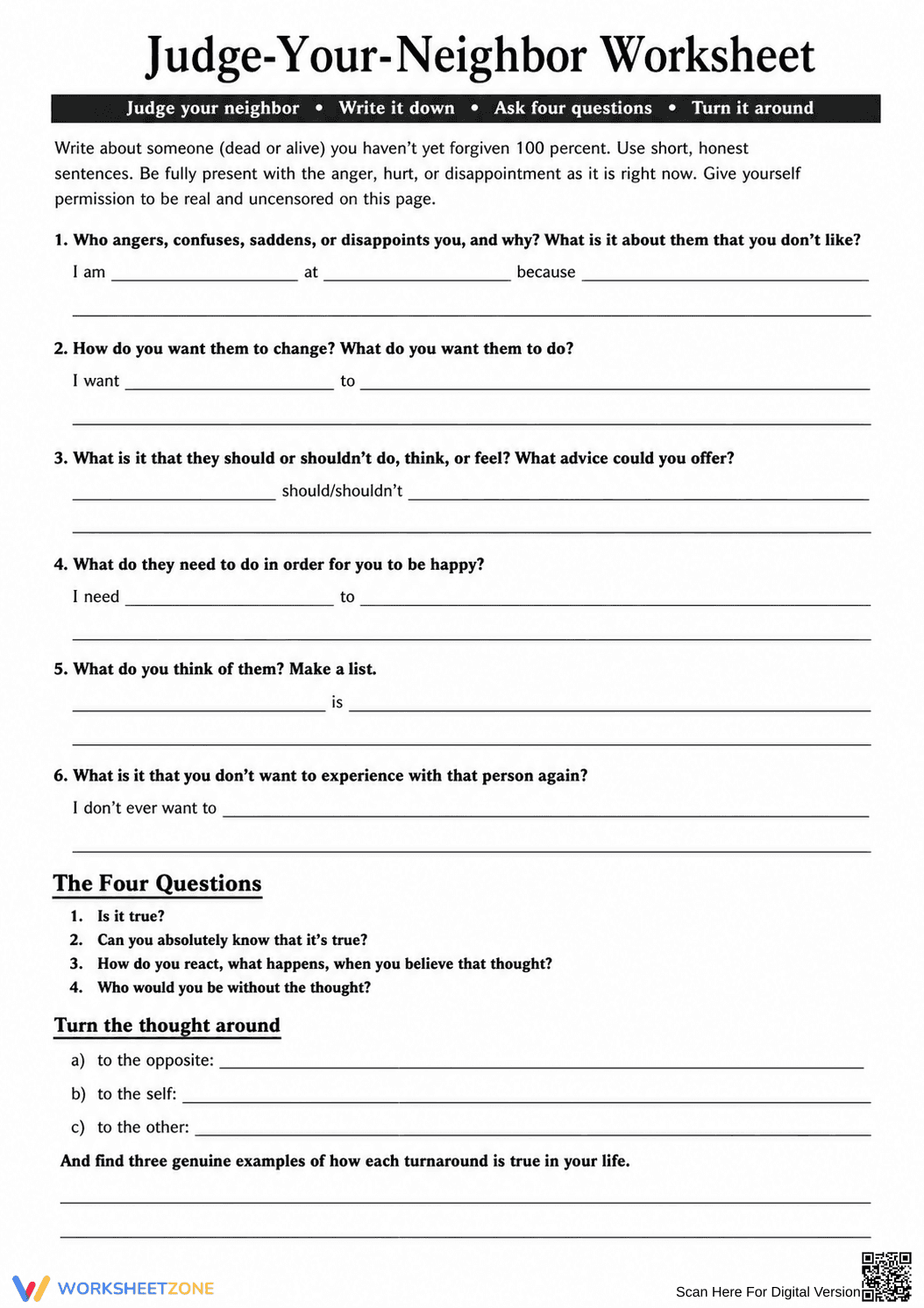
This Essential social skills worksheet provides a structured framework for students to process complex emotions like anger and resentment. By guiding learners through the "Judge-Your-Neighbor" process, it facilitates deep self-reflection and cognitive reframing. Students move from identifying raw feelings to challenging their own assumptions, ultimately fostering improved interpersonal relationships and emotional intelligence.
At a Glance
- Grade: College · Subject: Social Skills
- Standard:
CCSS.ELA-LITERACY.W.11-12.10— Write routinely for reflection and emotional processing tasks- Skill Focus: Perspective-taking & Conflict Resolution
- Format: 1 page · 10 tasks · Self-guided reflection · PDF
- Best For: Individual counseling or SEL workshops
- Time: 20–30 minutes
This single-page PDF features 6 primary writing prompts designed to externalize internal judgments. It includes "The Four Questions" for cognitive inquiry and a "Turn the thought around" section for perspective-shifting. The layout uses clear sentence starters and ample whitespace for uncensored, honest responses, ensuring the focus remains on the internal psychological work rather than complex formatting.
The workflow is designed for immediate implementation in high school or college settings. First, print the single-page document in under 30 seconds. Second, distribute to students during a quiet reflection period or individual session. Third, allow students to work through the prompts independently, requiring zero teacher intervention during the process. This makes it an ideal resource for unexpected sub plans or crisis intervention moments.
This resource aligns with `CCSS.ELA-LITERACY.W.11-12.10`, which requires students to write routinely over shorter time frames for a range of tasks, purposes, and audiences. By engaging in this reflective writing, students practice the discipline of articulating complex internal states. This standard code can be copied directly into lesson plans, IEP goals, or district curriculum mapping tools.
Use this worksheet as a formative tool during units on conflict resolution or interpersonal communication. It is best assigned after a direct instruction session on empathy or cognitive biases. Teachers should observe the depth of student engagement with the "Turnaround" section to assess their ability to synthesize alternative viewpoints. Completion typically takes between 20 and 30 minutes.
This resource is specifically tailored for mature adolescents and college-aged students who possess the emotional maturity for abstract self-reflection. It serves as a powerful tool for students struggling with interpersonal conflicts or those in behavioral health programs. It pairs naturally with an anchor chart on the "Ladder of Inference" or a lecture on emotional regulation.
According to research by Fisher & Frey (2014) on the gradual release of responsibility, structured writing prompts serve as a vital scaffold for internalizing complex cognitive processes. This worksheet applies these principles to social-emotional learning by providing a clear pathway from emotional reactivity to logical inquiry. By utilizing the CCSS.ELA-LITERACY.W.11-12.10 standard, educators can integrate essential perspective-taking skills into the standard curriculum. The "Judge-Your-Neighbor" methodology encourages students to move beyond surface-level reactions to explore the underlying beliefs that drive social friction. This evidence-based approach to self-reflection helps bridge the gap between academic writing and real-world emotional intelligence. Implementing such tools in the classroom supports the development of the whole student, preparing them for the interpersonal demands of college and career environments.


