




























Views
Downloads

Essential Universal Beliefs Worksheet | Grade 9-12

Paste this activity's link or code into your existing LMS (Google Classroom, Canvas, Teams, Schoology, Moodle, etc.).
Students can open and work on the activity right away, with no student login required.
You'll still be able to track student progress and results from your teacher account.
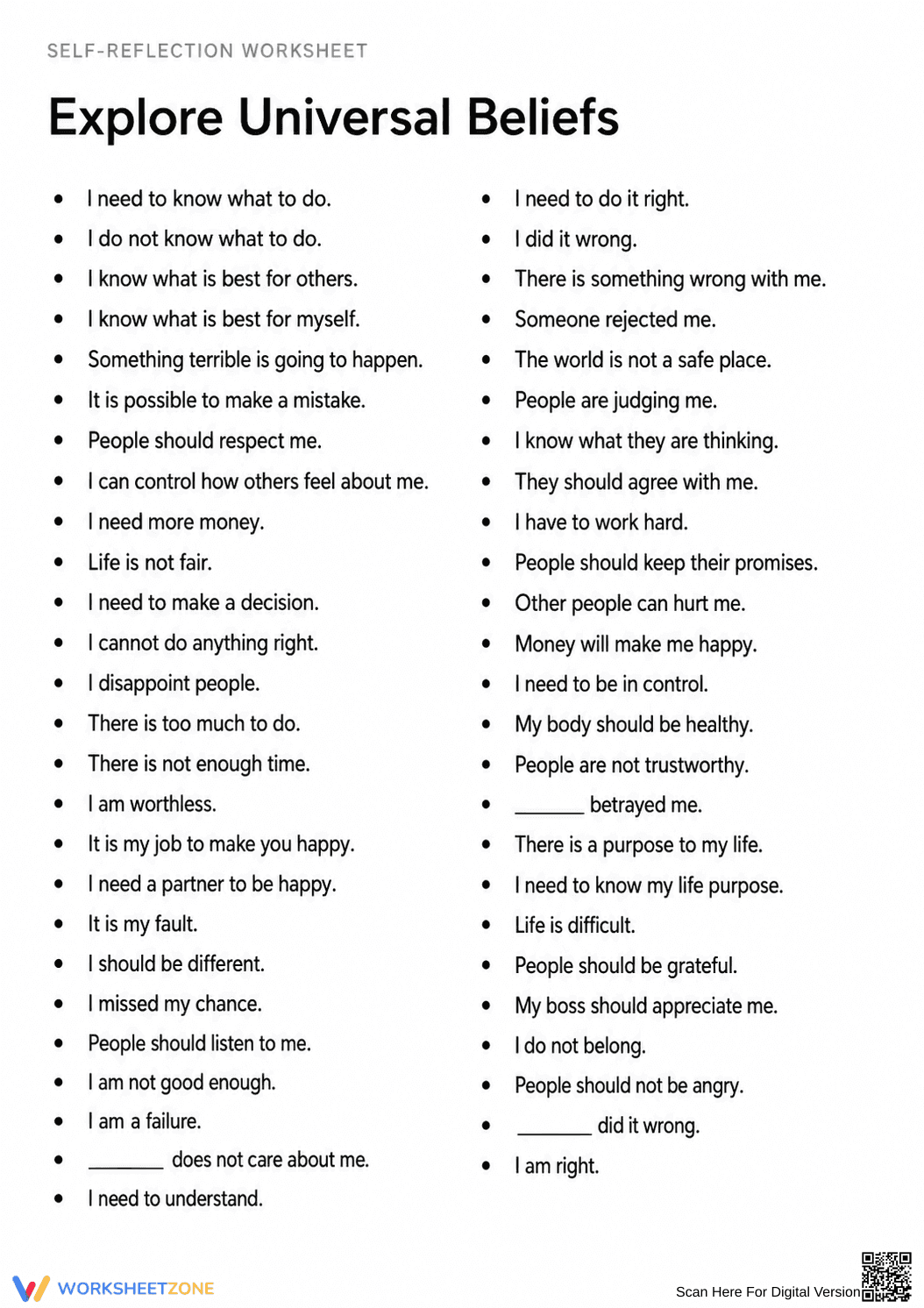
This Grade 9-12 self-reflection worksheet helps students identify and analyze common limiting beliefs to improve emotional intelligence and self-awareness. By reviewing 48 specific thought patterns, learners can pinpoint internal narratives that hinder personal growth. This resource provides a structured starting point for cognitive restructuring and healthy self-dialogue.
At a Glance
- Grade: 9-12 · Subject: Social Skills
- Standard:
CCSS.ELA-LITERACY.W.9-10.10— Write routinely over extended time frames for reflection and revision.- Skill Focus: Self-reflection & Cognitive Awareness
- Format: 1 page · 48 prompts · No answer key · PDF
- Best For: Individual counseling or SEL journaling
- Time: 15–20 minutes
The worksheet features a comprehensive list of 48 "Universal Beliefs" organized into two clear columns. These prompts cover themes of self-worth, interpersonal relationships, financial anxiety, and control. While most items are complete statements like "I am a failure" or "Life is difficult," several include blanks for students to personalize the prompt with specific names or situations. The clean, minimalist design ensures that the focus remains entirely on the internal reflective process without visual distractions.
Zero-Prep Workflow
This resource is designed for a zero-prep classroom environment. To implement, simply print the single-page PDF (30 seconds), distribute it to students as a quiet-start activity (1 minute), and allow for a silent reflection period. Because the worksheet is self-explanatory, it requires no teacher-led introduction, making it an ideal emergency sub plan or a transition tool between high-intensity lessons.
Standards Alignment
The primary alignment is CCSS.ELA-LITERACY.W.9-10.10, which requires students to write routinely for a range of tasks, purposes, and audiences, specifically focusing on reflection. By engaging with these prompts, students practice the metacognitive skills necessary for high-level writing and self-analysis. This standard code can be copied directly into lesson plans, IEP goals, or district curriculum mapping tools to document social-emotional learning integration.
How to Use It
Use this worksheet during the independent practice phase of a social-emotional learning lesson on cognitive distortions. Ask students to circle three beliefs that resonate most with their current mindset. As a formative assessment, observe which categories (self vs. others) students gravitate toward during the session.
Who It's For
This resource is specifically tailored for high school students and young adults who are developing the cognitive maturity to handle abstract concepts of self-perception. It is particularly effective for students in counseling groups, alternative education settings, or those working on IEP goals related to self-regulation.
According to research by Fisher & Frey (2014) on the gradual release of responsibility, providing students with structured scaffolds for self-reflection is essential for developing metacognitive independence. This worksheet utilizes 48 targeted prompts aligned with CCSS.ELA-LITERACY.W.9-10.10 to help learners bridge the gap between subconscious thought and conscious analysis. By identifying "Universal Beliefs," students engage in the foundational steps of cognitive behavioral therapy (CBT) within an educational framework. This process of naming and externalizing internal narratives is a proven strategy for reducing academic anxiety and improving focus. The inclusion of personalized blanks allows for the supported practice necessary for students to apply abstract concepts to their lived experiences. This resource serves as a vital tool for educators seeking to integrate evidence-based social-emotional practices into the secondary curriculum, ensuring that students are equipped with the self-awareness required for post-secondary success.


