




























Views
Downloads
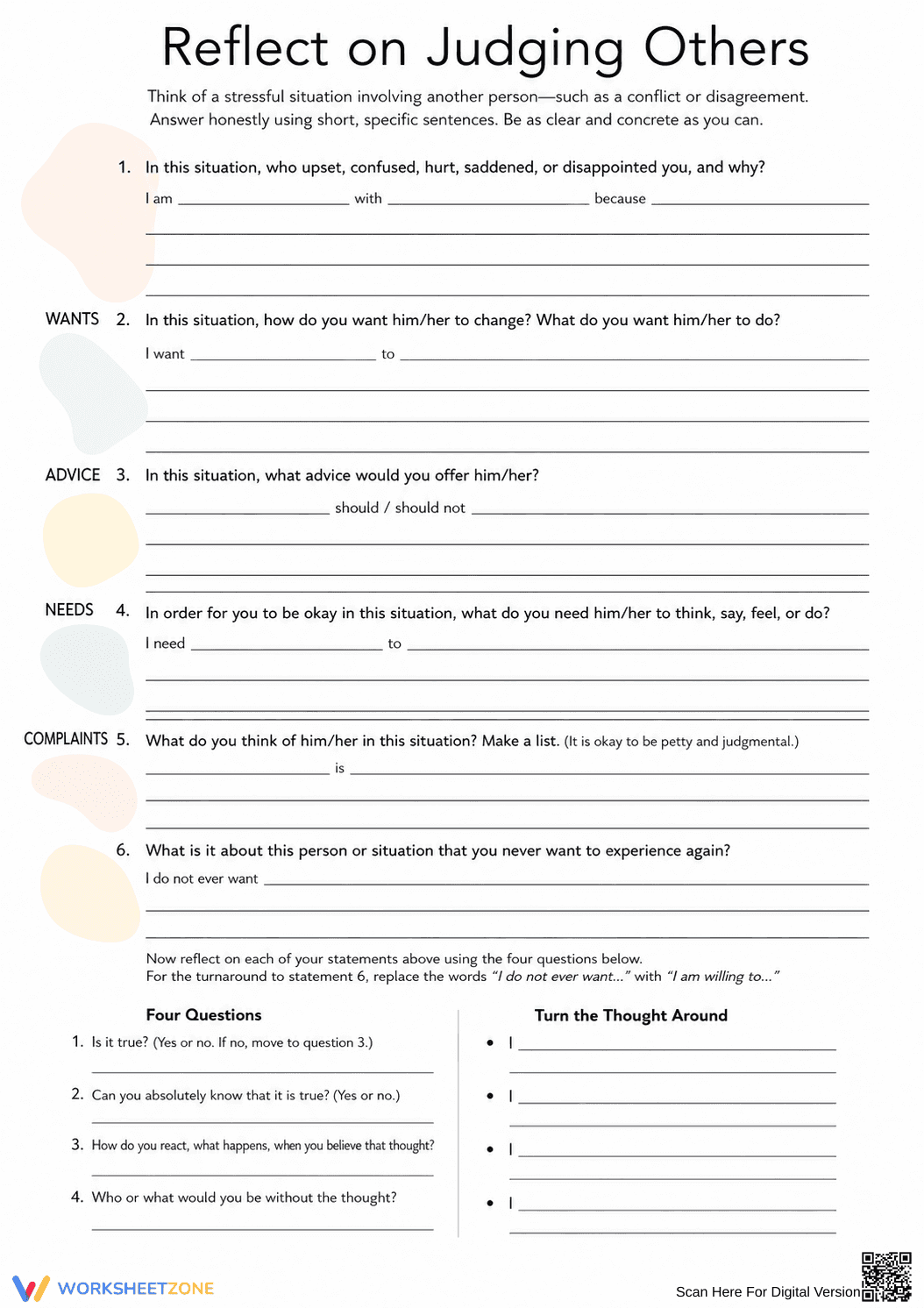

Grade 9-12 Conflict Reflection — Printable No-Prep Worksheet

Paste this activity's link or code into your existing LMS (Google Classroom, Canvas, Teams, Schoology, Moodle, etc.).
Students can open and work on the activity right away, with no student login required.
You'll still be able to track student progress and results from your teacher account.
This Grades 9-12 social-emotional learning worksheet guides students through the process of examining their thoughts and feelings during interpersonal conflicts. By completing structured reflection prompts, students practice emotional regulation and cognitive reframing, allowing them to process distress and develop healthier perspectives on challenging relationships.
At a Glance
- Grade: 9-12 · Subject: Social-Emotional Learning
- Standard:
CCSS.ELA-LITERACY.W.9-10.4— Produce clear writing appropriate to the reflection task- Skill Focus: Emotional regulation and cognitive reframing
- Format: 1 page · 6 reflection prompts · No answer key needed · PDF
- Best For: Independent reflection and counseling
- Time: 15–25 minutes
This single-page resource features six primary reflection sections that ask students to identify their emotions, articulate their needs, and list complaints regarding a specific stressful situation. Following the initial prompts, the worksheet includes a structured "Four Questions" cognitive reframing exercise and a "Turn the Thought Around" section. Sentence frames are built directly into the document to support students in articulating complex feelings clearly and honestly.
Zero-Prep Workflow
- Print (1 minute): Generate copies of the PDF for individual students or keep a stack in a counseling office.
- Distribute (1 minute): Hand out the worksheet during advisory periods, after a peer conflict, or as part of a dedicated SEL lesson.
- Review (3 minutes): Briefly explain the purpose of the "Four Questions" framework, ensuring students understand that this is a personal reflection exercise rather than a graded assignment.
Standards Alignment
This activity aligns with CCSS.ELA-LITERACY.W.9-10.4: "Produce clear and coherent writing in which the development, organization, and style are appropriate to task, purpose, and audience." By requiring students to articulate internal emotional states and logically reframe perspectives, the exercise reinforces purpose-driven written expression. These standard codes can be copied directly into lesson plans, IEP goals, or district curriculum mapping tools.
How to Use It
This worksheet is versatile for classroom and clinical settings. It serves as an excellent independent activity after instruction on conflict resolution or emotional intelligence. Teachers can assign it as a private reflection exercise following a disagreement. School counselors can utilize it during one-on-one sessions to help students deconstruct social interactions. Educators can monitor the "Turn the Thought Around" section to assess cognitive flexibility. Expected completion time ranges from 15 to 25 minutes.
Who It's For
This resource is designed for high school students (Grades 9-12) developing advanced social-emotional competencies. It is easily differentiated by allowing students to choose the severity of the conflict they analyze, ensuring the cognitive load remains manageable. This worksheet pairs naturally with anchor charts on empathy or lessons covering "I" statements and active listening techniques.
Integrating structured reflection tools into daily routines enhances adolescent emotional intelligence. This worksheet supports CCSS.ELA-LITERACY.W.9-10.4 by requiring clear writing appropriate to the task. According to a 2024 report on SEL interventions, students who engage in guided cognitive reframing demonstrate a decrease in disciplinary incidents and improved self-advocacy. By breaking down interpersonal grievances into analytical steps, educators provide a safe framework for emotional processing. This approach mitigates classroom disruptions and builds long-term psychological resilience, equipping young adults with the skills to navigate complex social dynamics both inside and outside the academic environment.


