


























Views
Downloads

Printable Conflict Resolution Worksheet | Grade 9 SEL
Paste this activity's link or code into your existing LMS (Google Classroom, Canvas, Teams, Schoology, Moodle, etc.).
Students can open and work on the activity right away, with no student login required.
You'll still be able to track student progress and results from your teacher account.
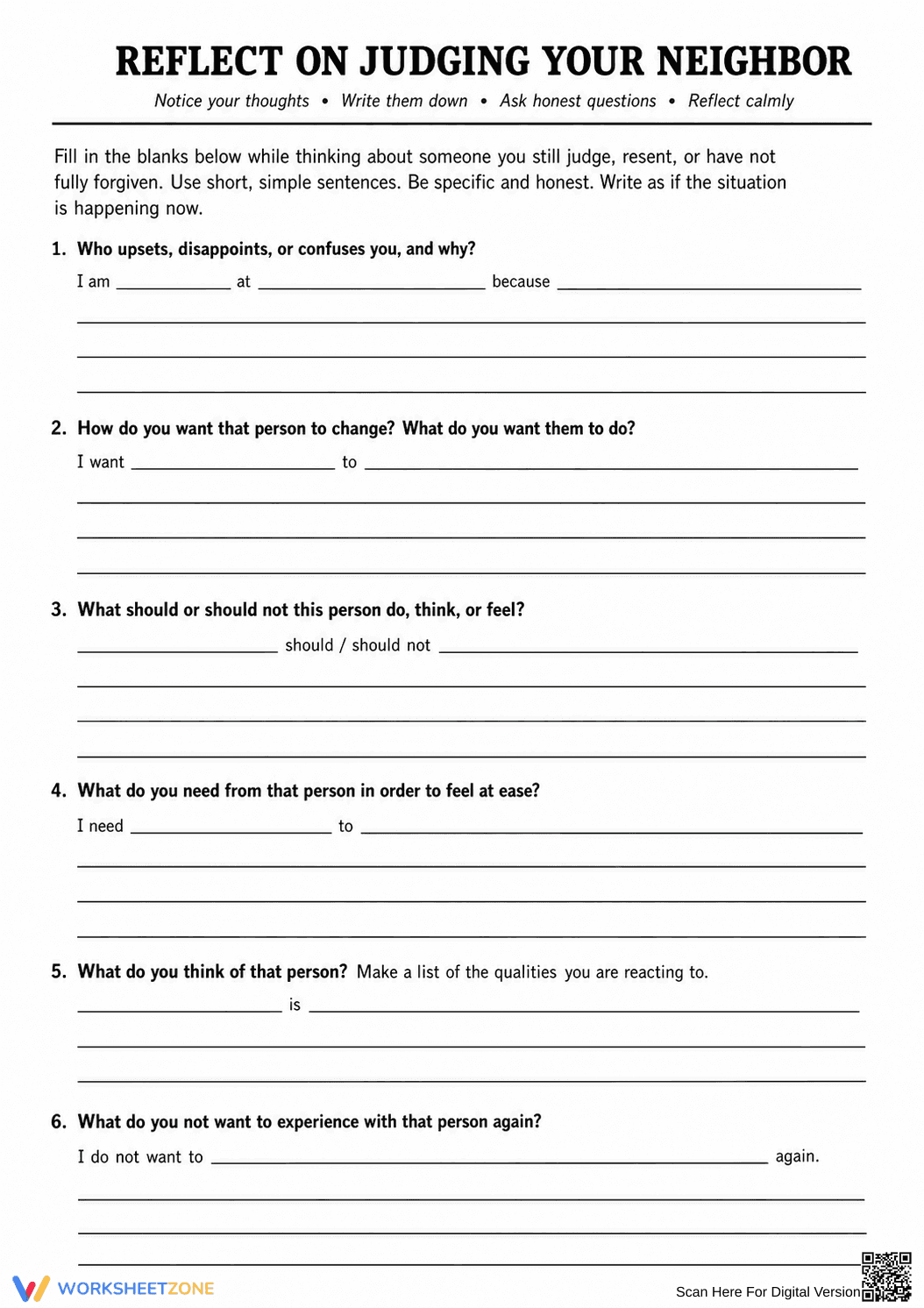
This high school social-emotional learning worksheet helps students process interpersonal conflicts and develop self-awareness. By guiding learners through structured reflection prompts, the activity encourages them to examine their judgments, articulate their feelings, and build empathy toward others in challenging social situations.
At a Glance
- Grade: 9 · Subject: Social Skills
- Standard:
CCSS.ELA-LITERACY.W.9-10.4— Produce clear and coherent writing appropriate to task and purpose- Skill Focus: Conflict Resolution and Emotional Processing
- Format: 1 page · 6 problems · No answer key · PDF
- Best For: Independent reflection and SEL blocks
- Time: 15–20 minutes
This single-page resource features six targeted fill-in-the-blank prompts designed to unpack complex emotions. Students are asked to identify someone who upsets them, articulate how they want that person to change, and list the specific qualities they are reacting to. The structured sentence frames help students organize their thoughts without feeling overwhelmed, making it an excellent tool for guided emotional processing. Because this is a personal reflection exercise, no answer key is included.
This zero-prep resource follows a simple workflow:
- Print (1 minute): Generate enough copies for your advisory group or SEL block. The clean, black-and-white design saves ink.
- Distribute (1 minute): Hand out the worksheets and establish a quiet, safe environment for personal reflection.
- Review (3 minutes): Briefly explain the importance of honesty and using short, simple sentences as outlined in the instructions.
With under two minutes of teacher prep time, this activity suits sub plans or counseling sessions.
This activity aligns with CCSS.ELA-LITERACY.W.9-10.4: Produce clear and coherent writing in which the development, organization, and style are appropriate to task, purpose, and audience. It also supports broader social-emotional learning frameworks by requiring students to practice self-awareness and responsible decision-making. Both standard codes can be copied directly into lesson plans, IEP goals, or district curriculum mapping tools.
Teachers can utilize this worksheet during dedicated advisory periods or as a targeted intervention for students experiencing peer conflict. As a proactive tool, assign it before a group discussion on empathy to help students ground their thoughts. As a responsive tool, use it during mediation sessions to help individuals articulate their grievances constructively. While students work independently for the expected 15 to 20 minutes, observe their engagement levels; hesitation may indicate a need for one-on-one support to process particularly strong emotions.
This resource is primarily designed for high school students in grades 9 through 12, though it is also highly effective for adult learners and transition programs. The straightforward language combined with complex emotional demands makes it ideal for mature students navigating difficult interpersonal dynamics. For a comprehensive lesson, pair this worksheet with a direct instruction lesson on "I" statements or an anchor chart detailing healthy communication strategies.
Integrating structured reflection tools into the classroom significantly enhances students' ability to manage complex interpersonal conflicts. By aligning with CCSS.ELA-LITERACY.W.9-10.4, which requires students to produce clear and coherent writing appropriate to task and purpose, educators ensure that emotional processing is tied to rigorous communication skills. According to a comprehensive RAND AIRS 2024 report on social-emotional learning interventions, students who regularly engage in guided self-reflection exercises demonstrate a marked decrease in reactive behavioral incidents and a measurable increase in peer empathy. Providing a safe, structured format for students to articulate their frustrations allows them to move past immediate anger and toward constructive resolution. This targeted approach not only supports individual emotional regulation but also fosters a more positive, collaborative classroom environment overall, ensuring students are prepared for real-world social challenges.


