




























Views
Downloads


Number 18 Worksheet | Essential Grade K-1 Math

Paste this activity's link or code into your existing LMS (Google Classroom, Canvas, Teams, Schoology, Moodle, etc.).
Students can open and work on the activity right away, with no student login required.
You'll still be able to track student progress and results from your teacher account.
This Number 18 worksheet provides a structured path for Kindergarten and Grade 1 students to master the numeral 18. By combining visual counting with repetitive motor practice, the resource ensures students can both recognize the quantity and produce the written form accurately. It bridges the gap between concrete counting and abstract numerical representation.
At a Glance
- Grade: Kindergarten · Subject: Math
- Standard:
K.CC.A.3— Write numbers from 0 to 20 and represent objects with a numeral- Skill Focus: Number 18 recognition and formation
- Format: 2 pages · 18 tasks · Answer key included · PDF
- Best For: Early numeracy centers and homework practice
- Time: 15–20 minutes
What's Inside
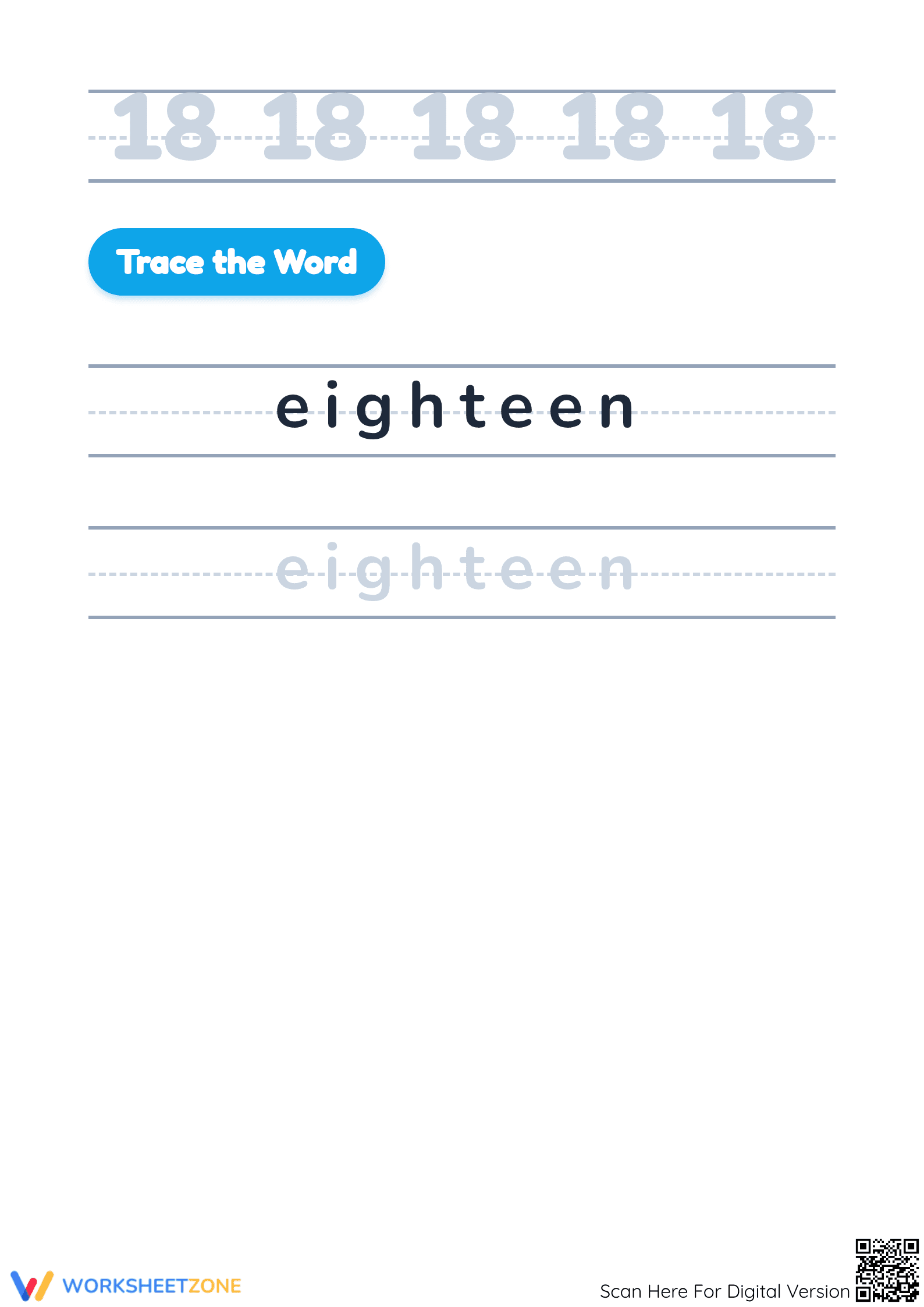
The two-page PDF includes a dedicated "Let's Learn" section featuring a visual array of 18 objects for 1-to-1 correspondence practice. Students transition to mechanical formation through 15 digit-tracing opportunities organized in a large, clear font. The second page extends the learning to literacy by providing "eighteen" word-tracing lines to support the connection between symbols and their linguistic names.
Skill Progression
The worksheet follows a proven gradual-release model. Guided practice begins with the "Learn" section where a large reference numeral is paired with a berry count. Supported practice occurs through the tracing rows, where students follow grey-scale guides to build muscle memory for the digits 1 and 8. Independent practice is achieved as students move from digit formation to tracing the full word "eighteen," cementing the concept across multiple formats.
Standards Alignment
The primary focus is CCSS.MATH.CONTENT.K.CC.A.3: "Write numbers from 0 to 20. Represent a number of objects with a written numeral 0-20." It also supports K.CC.B.5 through the object-counting visual. Both standard codes can be copied directly into lesson plans, IEP goals, or district curriculum mapping tools to ensure your instructional documentation remains audit-ready and compliant with state reporting requirements.
How to Use It
Deploy this worksheet during the "You Do" phase of a math block after a whole-group introduction to the number 18. For formative assessment, observe students as they count the berry array to ensure they are pointing to each individual item. The worksheet is also an excellent choice for a quiet morning work station or as a targeted intervention for students struggling with number reversals.
Who It's For
This resource is designed for Kindergarten and Grade 1 students developing foundational counting and cardinality skills. It is particularly beneficial for learners who require high-contrast visual cues and spacious tracing lines. Pair this with a physical set of 18 manipulatives like counters or blocks to create a multi-sensory math experience that reinforces the worksheet's visual representations.
Effective number sense in the early grades depends on the integration of visual, motor, and symbolic learning paths. Research by Fisher & Frey (2014) emphasizes that the gradual-release model, as implemented in this K.CC.A.3 resource, significantly improves student retention of numerical symbols and their corresponding values. By providing 18 specific tasks that move from visual counting to digit formation and word recognition, this worksheet aligns with best practices for developing automaticity in number writing. Early mastery of the number 18—a complex "teen" number requiring two-digit placement—is a critical milestone before transitioning to higher-order operations. Educators using this tool can be confident that they are providing a research-backed framework that supports long-term mathematical fluency and prepares students for more advanced base-ten concepts. This evidence-based approach ensures that students move beyond simple memorization to a deeper, functional understanding of how numbers are constructed and communicated in writing.


