Second grade teachers often reach for even and odd numbers worksheets right after students have built some comfort with counting and simple addition. This skill is not just a stand-alone topic to check off a pacing guide. It is the entry point into a bigger idea: numbers can be grouped, split, and reasoned about in ways that lay the groundwork for multiplication and division later on. When a student can confidently sort a pile of counters into pairs and explain why six objects always split evenly while seven always leaves one behind, they are building the exact reasoning they will need for equal groups work in grade 3.
Worksheets that isolate this skill give teachers a low-prep way to move students from hands-on pairing to number-based sorting without losing the conceptual thread in between. That progression matters more than it might seem at first glance, since a rushed jump straight to digit rules tends to produce students who can recite that numbers ending in 0, 2, 4, 6, or 8 are even, but who cannot explain why that rule works.
What the Standard Requires
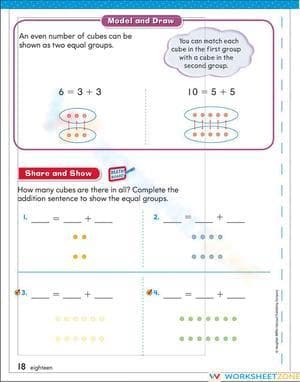
CCSS.MATH.CONTENT.2.OA.C.3 asks grade 2 students to determine whether a group of up to 20 objects has an odd or even number of members. Students should be able to do this by pairing objects or by counting them by 2s. The standard also requires students to write an equation showing an even number as the sum of two equal addends, such as 6 = 3 + 3 or 14 = 7 + 7. This standard lives inside the Operations & Algebraic Thinking domain for grade 2, which signals something important for lesson planning: even and odd numbers are not treated as a stand-alone number sense unit in isolation. They are explicitly tied to operations and equation writing from the start.
That equation-writing requirement is easy to overlook when selecting worksheets, since many generic sorting sheets stop at labeling numbers as odd or even. If a worksheet does not also ask students to record the equal-addend equation for even numbers, it is only covering half of what 2.OA.C.3 actually demands, and teachers may need to supplement with an equation-writing component to fully address the standard.
Connecting Even Numbers to Doubles Facts
One of the more useful angles for planning instruction is the direct link between even numbers and doubles addition facts. Every even number can be expressed as a doubles fact: 8 = 4 + 4, 10 = 5 + 5, 12 = 6 + 6, and so on. Worksheets that explicitly pair even/odd sorting with doubles fact practice help students see that these are not two separate skills to memorize but one underlying number relationship viewed from two angles.
This connection also gives teachers a natural way to differentiate. Students who already have strong doubles fact fluency can move quickly through the equation-writing portion of even/odd worksheets, while students still building fluency benefit from worksheets that keep the doubles connection visible, using matching manipulatives or ten-frames alongside the numeral work.
Using Worksheets in Math Centers and Intervention Groups
Even and odd numbers worksheets fit naturally into rotating math centers because the task is self-explanatory once modeled, and it does not require constant teacher supervision. A sorting mat with number cards, paired with a recording worksheet, keeps students engaged during independent center time while producing a paper trail teachers can review later.
For small-group intervention, these worksheets work well as both a diagnostic and a practice tool. A teacher can hand a student a worksheet with 10 to 20 problems, watch how they approach the first few (do they draw pairs, use fingers, or apply a digit rule they may not fully understand), and adjust instruction on the spot. Students who default straight to a digit-ending rule without being able to explain it are a signal that more concrete pairing practice is needed before moving forward, even if they are getting correct answers.
Common Misconceptions to Watch For
A frequent misconception among grade 2 students is treating the digit-ending rule as an isolated fact to memorize rather than a shortcut that emerges from skip counting by 2s. Students who learn the rule in isolation sometimes struggle to explain their reasoning when asked why a number is even, which can show up as inconsistent performance when problems are phrased differently than they expect.
Another common error appears when students pair objects but miscount the leftover, especially with numbers closer to 20. Worksheets that include a mix of smaller and larger object groups, rather than only single-digit examples, help surface this error earlier so it can be corrected before it becomes a habit.
Frequently Asked Questions
1. What grade level typically learns even and odd numbers under Common Core?
Even and odd number identification for groups of up to 20 objects is a grade 2 standard under CCSS.MATH.CONTENT.2.OA.C.3, sitting within the Operations & Algebraic Thinking domain.
2. How can teachers use pairing strategies before introducing digit-based rules?
Start with worksheets showing physical objects that students pair off visually, building the conceptual understanding of even and odd before moving to skip counting by 2s and eventually to sorting numerals without visual support.
3. How do even/odd worksheets support later multiplication and division skills?
Sorting numbers into equal groups through pairing builds the same equal-groups reasoning that underlies multiplication and division, making even/odd work in the Operations & Algebraic Thinking domain a direct bridge to grade 3 content.
4. What are effective ways to use these worksheets in small-group intervention?
Use a worksheet as a quick diagnostic by watching whether a student pairs objects, skip counts, or applies a digit rule, then adjust instruction based on whether their strategy shows genuine understanding or memorized shortcuts.
5. How can teachers assess mastery of 2.OA.C.3 using worksheet data?
Choose a worksheet that combines object pairing, number sorting, and equal-addend equation writing in one document, since mastery of the full standard requires all three components rather than sorting alone.