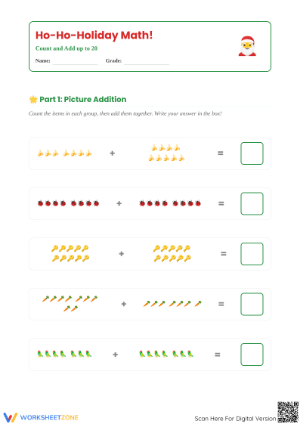
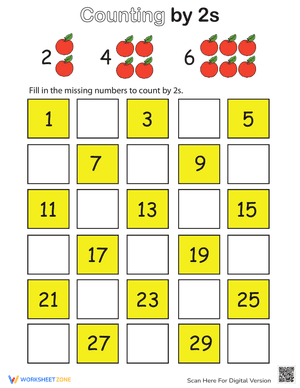
These numbers 11–20 worksheets give kindergarten teachers a targeted set of practice tools for the stretch of early math that trips up more students than almost any other — not because the numbers are large, but because the English words for them are linguistic outliers. Eleven and twelve encode nothing about their quantity; thirteen sounds like it might come before twelve to students still anchoring on sound patterns. The worksheets address that gap directly, building numeral recognition, correct formation, quantity matching, sequencing, and the foundational place value understanding that teen numbers introduce.
The Specific Skills Targeted
Each worksheet in the set isolates one or two skills so students aren't asked to split attention across too many demands at once. The skills covered across the full set include numeral recognition on sight (without counting up from one), correct two-digit numeral formation, counting drawn object sets and writing the matching numeral, ordering and sequencing within the 11–20 range, and decomposing teen numbers into a group of ten and some additional ones. That last skill — understanding that 14 is one ten and four ones — is where the set bridges counting practice into early place value work, which is exactly the conceptual move K.NBT.A.1 is designed to prompt.
The format varies across worksheets: tracing pages with dotted numerals for students still developing pencil control, double ten-frame pages where students mark or count dots to represent quantities, cut-and-paste matching tasks that pair numerals with object sets or number words, and fill-in-the-blank sequencing strips with missing numbers scattered across the 11–20 range. Running the same student through all of these across a unit gives a much clearer picture of where the breakdown actually is — a child who aces tracing but writes 41 for fourteen on a free-write task has a different problem than one who forms numerals correctly but loses count at 17 every time.
Standard Alignment
The core standards these worksheets address are K.CC.A.3 (writing numerals 0–20 and representing a number of objects with a written numeral), K.CC.B.5 (counting to answer "how many" for sets of up to 20 objects), and K.NBT.A.1 (composing and decomposing numbers 11–19 into ten ones and some further ones). In classroom terms, K.CC.A.3 and K.CC.B.5 tend to be the entry points early in a kindergarten unit on teen numbers, while K.NBT.A.1 comes into focus once students can reliably recognize and count in the range — the decomposition worksheets are better saved for mid-to-late unit rather than introduced alongside tracing practice.
Mistakes Students Make That These Worksheets Help You Catch
The reversal errors in this range go beyond the classic flipped 3 or backward 5. Students who have learned to write single-digit numbers without issue will frequently write teen numbers in the wrong order — producing 41 for fourteen or 71 for seventeen — because they hear the ones value first in the spoken word ("four-teen") and write it that way. This is distinct from a formation problem; the digits themselves look fine. Sequencing strips surface this quickly because the student's answer breaks the visible number line, making the error hard to miss during a quick table scan.
A second pattern appears on quantity-matching tasks: students will count correctly to 15 or 16 and then either lose their place or recount objects they've already touched, arriving at 17 or 18 for a set of 16. This isn't a numeral-knowledge problem — it's one-to-one correspondence breaking down at the higher end of the range, where keeping track demands more working memory. Pairing these worksheets with a small cup of counters lets students physically move each object aside as they count, which reduces that particular error substantially in the 5–6 age range.
How to Build These Worksheets Into Your Lesson Plans
The tracing and recognition pages work well as arrival activities — something already placed at each seat so the first five minutes of the day have a clear task. That transition window, before morning meeting starts, is often underused in kindergarten, and a single numeral-tracing page fills it without requiring any setup or explanation from the teacher.
During math centers, running two or three different worksheet formats at separate stations covers more skill ground in a single block than any one format can. A group working on ten-frame pages at one table, another doing cut-and-paste matching at a second, and a third completing sequencing strips at a third station means every student is practicing the 11–20 range through a different entry point in the same 30-minute period. Rotate every 10 to 12 minutes and the pacing stays tight enough that students don't lose focus.
For quick formative checks, a sequencing strip with six or seven blanks distributed across the 11–20 range takes less than three minutes to complete and immediately shows which numbers a student is uncertain about. If the same student skips 13 or writes 15 before 14 across two separate checks, that's a precise reteaching target rather than a vague sense that "teen numbers need more work."
Adjusting the Worksheets for a Range of Learners
For pre-K students or kindergarteners who are still building pencil control, the tracing pages and simple numeral-recognition tasks are the right starting point. Asking these students to fill in sequencing strips independently before they can form the numerals fluently adds motor demand on top of number-sense demand — that split load slows both down. Let them trace and recognize first.
Students who have already internalized numeral recognition and can count sets accurately need the decomposition tasks: writing the "1 ten and ___ ones" equation for each teen number, or filling a ten-frame and labeling how many are in the full frame and how many in the overflow. Those students also benefit from completing the worksheets without manipulative support, since the goal is mental representation rather than physical modeling. The cut-and-paste matching tasks sit comfortably in the middle — accessible enough for students who need the concrete connection between numeral and quantity, engaging enough that stronger students don't feel they're backtracking.
Frequently Asked Questions
Why are thirteen through nineteen harder for students than twenty-one through twenty-nine?
The teens are named in reverse order compared to how place value is read. "Thirteen" puts the ones value first — "thir" (three) before "teen" (ten) — while "twenty-three" names the tens value first, matching the left-to-right order of the written numeral. Students learning to write numbers in this range are fighting a mismatch between what they hear and the order in which the digits appear on paper. That's why reversal errors like 31 for thirteen are so common, and why they persist even after students have had significant counting practice.
What's the right time in the year to introduce these worksheets?
Most kindergarten teachers introduce the 11–20 range after students have solid footing with 0–10, which typically means mid-fall for on-level students. Tracing and recognition work can begin as soon as students can handle two-digit numerals conceptually, but the decomposition and place value worksheets are better suited to the second half of the year, once ten-frames have been introduced in whole-group instruction and students have had hands-on experience building teen numbers with linking cubes or base-ten materials.
Can these worksheets work for first grade students who are still shaky on teen numbers?
Yes, and without modification. First graders who haven't consolidated the 11–20 range — particularly around numeral formation and decomposition — need the same foundational practice kindergarteners do. The worksheet content isn't visually "babyish" in a way that would feel discouraging, and the sequencing and place value tasks in particular align with first-grade review goals at the start of the year.
















 Interactive Worksheet Maker
 Quiz Maker
 Word Search Maker
 Crossword Puzzle Maker
 Word Scramble Generator
 Sentence Scramble Generator
 Handwriting Worksheet Generator
 Name Tracing Generator
 Fill In The Blank Generator