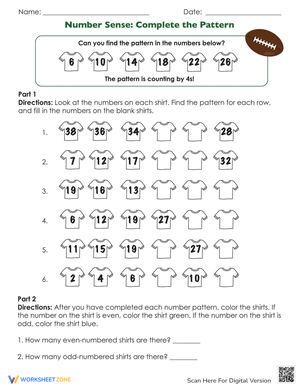
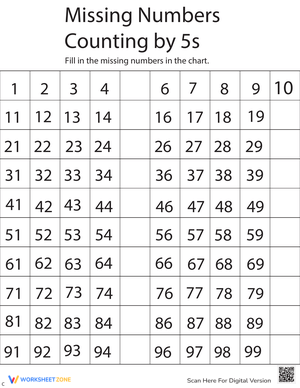
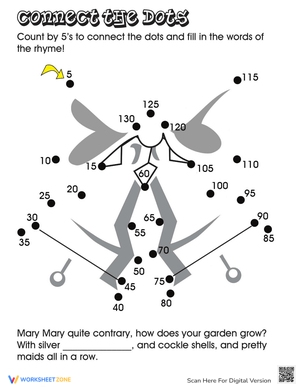
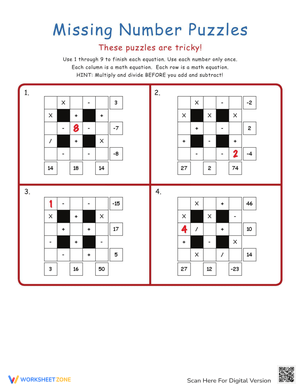
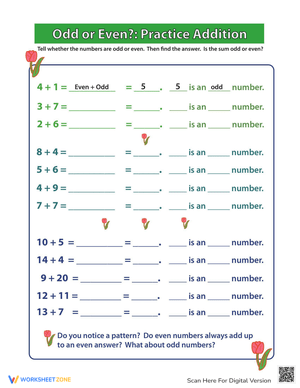
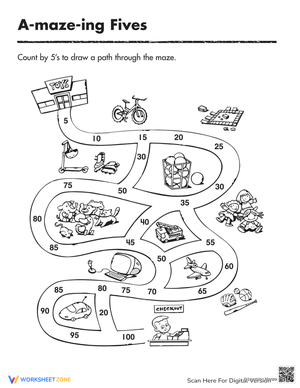
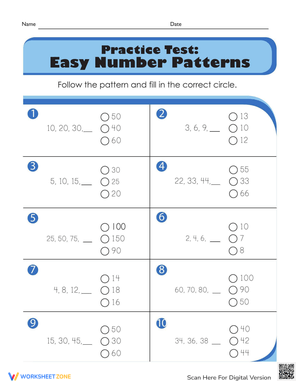
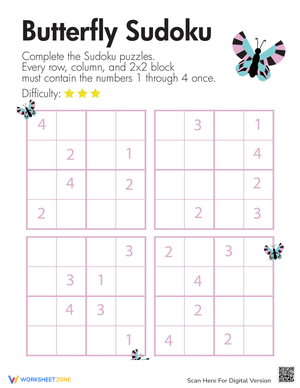
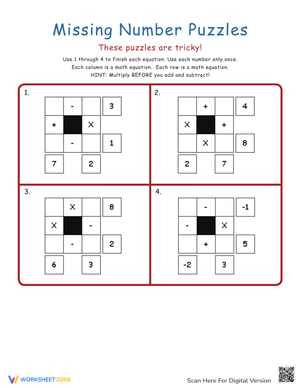
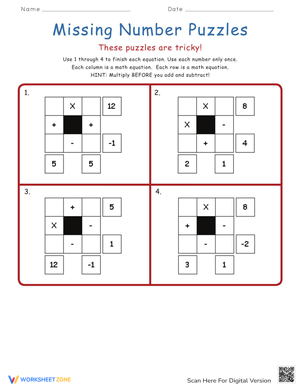
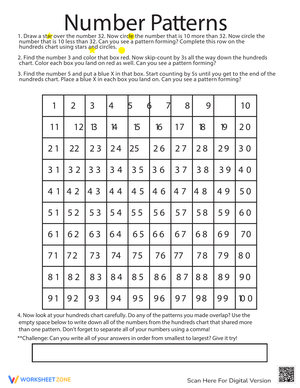
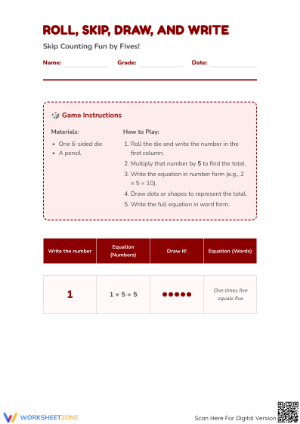
These number patterns worksheets give students in grades K–8 structured practice identifying, extending, and writing the rules behind arithmetic and geometric sequences — the exact work that separates students who see math as a set of memorized procedures from those who recognize it as a system of relationships. The set spans a developmental range wide enough to use across multiple grade levels, with each worksheet targeting a specific sequence type and skill level rather than mixing everything onto one undifferentiated page.
What Each Worksheet Covers
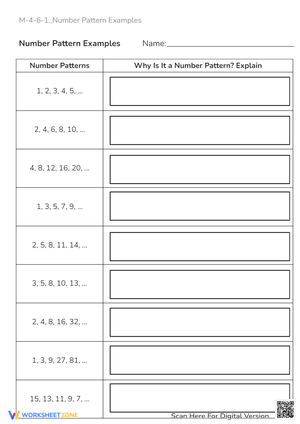
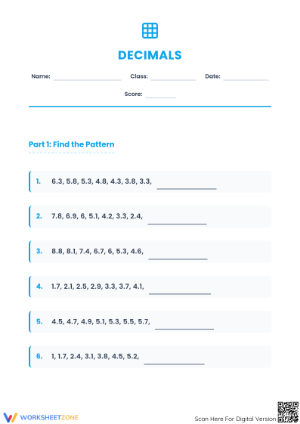
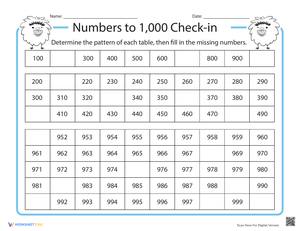
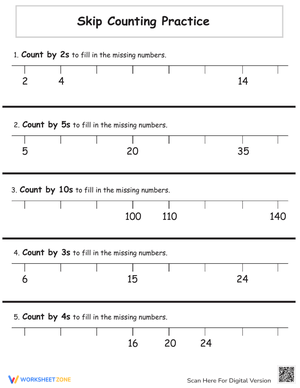
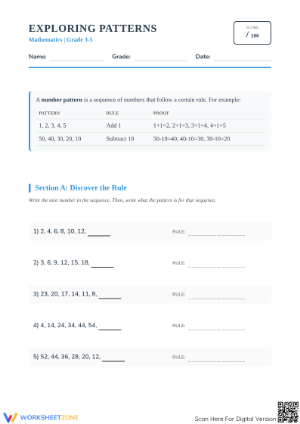
The worksheets address three core sequence types: arithmetic patterns (constant addition or subtraction), geometric patterns (constant multiplication or division), and mixed-rule sequences where students must determine which operation governs a sequence before they can extend it. Within arithmetic patterns, worksheets progress from single-digit skip counting — twos, fives, tens — to decreasing sequences and multi-digit intervals. Geometric sequences appear in later worksheets, where students encounter doubling and halving patterns before moving to ratios like ×3 or ÷4.
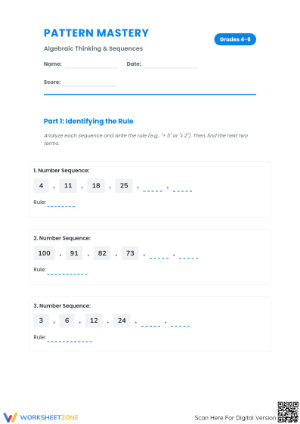
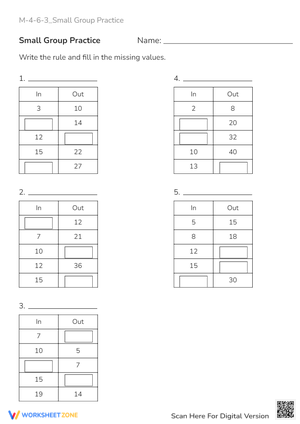
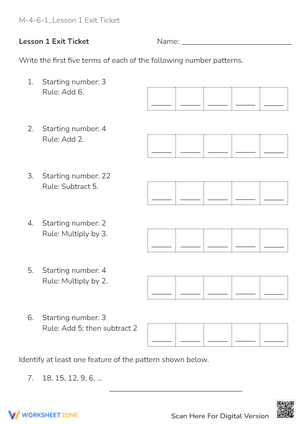
Beyond fill-in-the-blank extension, several worksheets ask students to write the rule in words after completing the sequence. Others present a starting number and a written rule, and students generate the sequence themselves — the skill directly assessed in 4.OA.C.5. A subset of worksheets uses error analysis: sequences are presented with one term deliberately wrong, and students identify, explain, and correct the error. That task type changes the cognitive demand considerably. Students must hold the rule in working memory, apply it to every term, and articulate why a specific number breaks the pattern — not just follow the sequence forward.
The Specific Skills These Worksheets Build
- Extending arithmetic sequences with positive and negative intervals, including sequences that cross zero
- Identifying the common ratio in geometric sequences and distinguishing them from arithmetic ones
- Writing rules in words ("subtract 6 each time") and checking whether a proposed rule holds across all terms
- Generating a complete sequence from a starting value and a given rule, then describing a non-obvious feature of the resulting pattern
- Analyzing pre-completed sequences for embedded errors and correcting them with written justification
- Translating visual skip-count patterns on a number line into numeric sequences
Standard Alignment
The core standard these worksheets address is 4.OA.C.5, which asks fourth graders to generate a number or shape pattern that follows a given rule, then identify features of the pattern that weren't stated explicitly in the rule. For example, students given "Start at 1, add 3" should recognize not only that the sequence is 1, 4, 7, 10, 13 but also that every term is odd — a feature that emerges from the pattern rather than from the rule as written. Worksheets that include a "What do you notice?" prompt after students complete a sequence target exactly this standard.
Related standards include 2.NBT.A.2 (skip counting by 5s, 10s, and 100s) for the foundational worksheets, and 5.OA.B.3 for upper-elementary worksheets that ask students to form and analyze two related sequences simultaneously. The error-analysis worksheets, while not tied to a single standard, support the mathematical practice standard MP.3 — construct viable arguments and critique the reasoning of others — because students must explain in writing why a given term violates the pattern's rule.
Frequent Student Errors Worth Watching For
The most persistent error at the elementary level is students applying the correct rule to only part of a sequence. A student who identifies "add 7" will often compute the first two or three terms accurately, then slip — particularly when one of the additions crosses a tens boundary. In the sequence 28, 35, 42, __, the jump from 42 to 49 is reliable; the jump from 49 to 56 is where students who are weak on place value will write 55 or 57. The worksheet format surfaces this because students have to produce every term, not just the next one.
With geometric patterns, a different confusion appears: students who are comfortable with arithmetic sequences will try to add rather than multiply when they see growth. Presented with 3, 6, 12, 24, a student who looks only at the first two terms may write "+3" as the rule, then arrive at 27 instead of 48 for the fourth term. Once they see that 12 + 3 ≠ 24, they reconsider — but the error reveals that they checked the rule against a single pair rather than confirming it across the sequence. Walking students through that two-step verification before independent practice dramatically reduces this pattern.
A subtler issue arises with decreasing geometric sequences. Students who understand that geometric patterns multiply will hesitate when they see 64, 32, 16, 8 — many initially describe the rule as "subtract half" rather than "divide by 2," which becomes a problem when they encounter 3, 9, 27, 81 and try to subtract. Making the multiplicative structure explicit with a few guided examples before students work independently is worth the three minutes it takes.
Building These Worksheets Into Lesson Plans
The worksheets fit most naturally into three moments in the instructional week. As a warm-up, a single number patterns worksheet used during the first eight minutes of class — before the main lesson topic — gives students a low-stakes retrieval task and surfaces who is still uncertain about the previous day's sequence type. As a guided practice tool, the error-analysis worksheets work well in pairs immediately after a mini-lesson on a new sequence type; the discussion students have while identifying a wrong term often does more instructional work than another round of fill-in-the-blank. As a Friday review block activity, assigning one worksheet from each sequence type covered during the week gives a quick formative snapshot without requiring a formal assessment.
One underused approach is assigning the rule-writing worksheets as an exit task rather than as practice-during-class. When students write "multiply by 3 starting from 2" as their way out the door, you get written evidence of whether they can articulate the rule — not just whether they can compute the next term. That distinction matters more than it appears on paper.
Frequently Asked Questions
Do these worksheets cover both increasing and decreasing sequences?
Yes. Arithmetic worksheets include subtraction-based sequences — 100, 91, 82, 73 — alongside the more commonly practiced addition sequences. Decreasing geometric sequences (halving, dividing by 3) also appear in the set. Decreasing patterns tend to appear less frequently in commercial resources, so including them explicitly prevents the misconception that sequences always grow.
Which worksheets are most appropriate for third grade versus fourth grade?
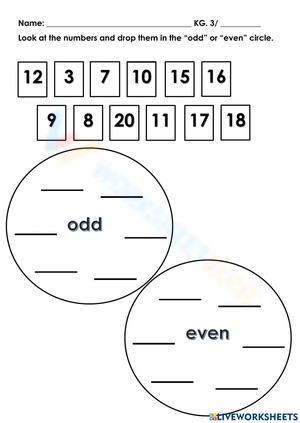
Third-grade students are generally ready for arithmetic sequences using addition and subtraction with single- and double-digit intervals, plus skip-counting patterns on a number line. The rule-identification and rule-writing worksheets are more appropriate for fourth grade, where 4.OA.C.5 makes this skill an explicit standard. The error-analysis worksheets work at both levels, though the complexity of the sequence used should reflect the grade's number range.
Can these be used effectively as homework rather than in-class practice?
The fill-in-the-blank extension worksheets send home cleanly — students can work independently and parents can check the answers straightforwardly. The error-analysis and rule-writing worksheets are harder to assign as homework without prior classroom modeling, because students who haven't seen the error-detection task type before will often just correct the numbers without writing any explanation. Introduce those formats in class first before sending them home.
How do these worksheets connect to later algebraic work?
When students write a rule for a sequence and then test it against every term, they are doing the same reasoning they will use in sixth and seventh grade when checking whether a value satisfies an equation. The specific habit — propose a rule, verify it across multiple cases, revise if it fails — is algebraic thinking before the variables appear. Students who have practiced this process with number patterns worksheets arrive at formal algebra with the verification habit already formed, which is meaningfully different from students who encounter that expectation for the first time in a variables context.