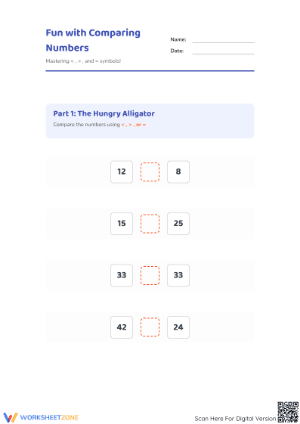
Ordering numbers from least to greatest and greatest to least is one of the first ways young learners show they understand more than just counting by rote. Ascending and descending number worksheets ask students to look at a group of numerals, compare them, and arrange them in a required direction. That single task pulls together counting sequence knowledge, number recognition, and an early sense of magnitude. For a kindergarten or grade 1 teacher building a number sense unit, these worksheets are a quick, low-prep way to check whether a student can move beyond simply reciting numbers in order and can actually reason about where a number belongs relative to others.
Because the skill is so foundational, these worksheets show up constantly in morning work bins, math centers, and homework folders. They are easy to differentiate by adjusting the number range, and they give a teacher a fast visual read on which students are still confusing digit order, skipping numbers, or reversing sequences.
Kindergarten Counting Sequence vs Grade 1-2 Place Value Comparison
The way ascending and descending practice looks changes quickly across the K-2 span. In kindergarten, ordering work usually stays inside the 1-20 range and connects directly to counting sequence fluency: can the student say and write what comes next, and can they place a scattered set of numerals back into the correct counting order. This lines up with standards that focus on comparing numbers of objects and numerals rather than multi-digit place value.
By grade 1, the same ordering skill starts to lean on place value. Students are expected to count to 120 and to compare two-digit numbers using tens and ones reasoning, so ascending and descending worksheets at this level often include numbers like 47, 74, and 71 that look similar but require attention to the tens digit first. Grade 2 extends this further into three-digit comparison, where students must weigh hundreds, tens, and ones together before deciding on order. A teacher moving a student from kindergarten review into grade 1 intervention should expect the worksheet range and the reasoning demand to shift together.
Building Number Sense Before Formal Place Value Instruction
One of the most useful things about ascending and descending worksheets is that they can be used before students have formal place value vocabulary. A kindergarten student does not need to know the word tens to notice that 15 comes after 14 in a sequence, or that 9 is smaller than 12. That informal ordering experience becomes the groundwork teachers can point back to once place value language is introduced.
In practice, students who can only recite a counting sequence forward often stumble the first time they are asked to reorder a scrambled set of numerals, because scrambled ordering removes the rhythm of rote counting and forces true comparison; this is why many kindergarten and grade 1 teachers use a short ascending or descending worksheet as a quick diagnostic before starting a formal comparing-numbers lesson, rather than saving ordering practice for after place value has been taught.
Classroom Routines: Morning Work, Math Centers, and Exit Tickets
Ordering worksheets slot naturally into several daily routines. As morning work, a short ascending or descending task gives students an independent warm-up that does not require new instruction. In a math center rotation, ordering practice pairs well with a hands-on version, such as arranging number cards, followed by the paper worksheet as a written check. As an exit ticket, a five-number ordering task takes under two minutes and gives a teacher a fast snapshot of who needs to be pulled for reteaching the next day.
Because these worksheets do not require lengthy directions, they are also useful for substitute teacher days or for early finishers who need an extra task that still targets a real standard rather than busywork.
Connecting Ordering Practice to CCSS Progression
For teachers who need to justify worksheet choices during planning or observation, the standards trail is straightforward. Kindergarten ordering work supports comparing numbers of objects and numerals. Grade 1 ordering work supports counting to 120 and comparing two-digit numbers using place value reasoning. Grade 2 ordering work extends that same place value comparison to three-digit numbers. Framing an ascending or descending worksheet this way helps show that the activity is not filler, but a direct rehearsal of the comparing and ordering expectations built into the K-2 standards progression.
Frequently Asked Questions
1. What grade level are ascending and descending order worksheets appropriate for?
They work well from kindergarten through grade 2. Kindergarten typically uses ranges of 1-10 or 1-20, grade 1 moves into two-digit numbers within 120, and grade 2 extends to three-digit numbers.
2. What is the difference between ascending and descending order in early math instruction?
Ascending order means arranging numbers from smallest to largest, while descending order means arranging them from largest to smallest. Practicing both directions helps students avoid relying on a single fixed pattern.
3. How can teachers use these worksheets for intervention or reteaching?
A short worksheet can serve as a quick diagnostic in a small-group setting, revealing whether a student is reversing digits, skipping numbers, or unsure of comparison direction, so the teacher can target the exact gap.
4. Which standards align with number ordering practice?
Ordering practice connects to standards on comparing numbers of objects and numerals in kindergarten, counting to 120 and comparing two-digit numbers in grade 1, and comparing three-digit numbers using place value in grade 2.
5. How many numbers should a worksheet include for kindergarten versus grade 1?
Kindergarten worksheets usually stay within 1-20 with five to eight numbers per set, while grade 1 worksheets can include six to ten two-digit numbers as students build toward comparing within 120.